
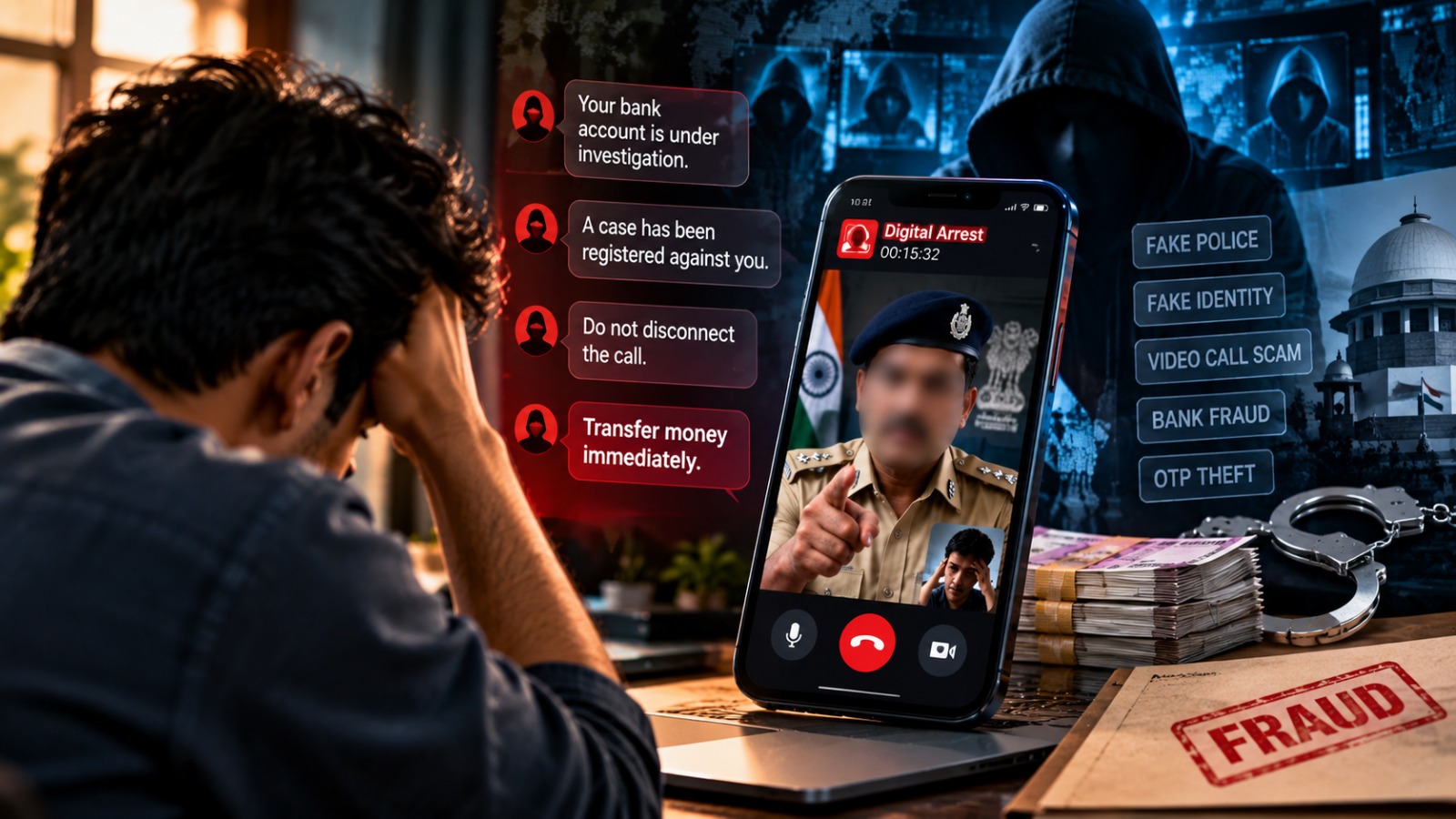
Digital arrest scams in India are becoming a serious form of cyber-enabled financial fraud, using fear, impersonation and technology to pressure people into handing over money or sensitive information. Fraudsters often pose as police officers, investigators or officials from government agencies and falsely tell victims that they are linked to a criminal case.
The scam works because it combines familiar institutions with urgent threats. Victims may be told that their bank account, mobile number or identity documents have been connected to illegal activity and that they must follow instructions immediately to avoid arrest.


The Central Bureau of Investigation has clarified that there is no legal concept of a “digital arrest” in India.
What Are Digital Arrest Scams in India?
Digital arrest scams in India are fraudulent schemes in which criminals impersonate law-enforcement or government officials and create a fake investigation around the victim.
The fraud may begin with a phone call, video call, message or fabricated notice. The caller may claim to be from the police, CBI, RBI, customs authorities or another agency. Fraudsters can also use official-looking documents, logos and fake websites to make their claims appear genuine.
The victim is then told that a criminal case has been registered against them or that their identity has been used for illegal activity.
The criminals may instruct the victim to remain on a video call, avoid contacting family members and follow their directions. In some cases, the victim is pressured to transfer money supposedly for verification, a security deposit, a fine or another fabricated legal requirement.
There is no legal process under which a person can be placed under “digital arrest” through a video call.
How Digital Arrest Scams Work
The first stage is usually impersonation.
A fraudster may introduce themselves as a police officer or another official. The caller can use professional language, fake identification documents and background images designed to resemble an official office.
The second stage is creating fear.
The victim may be told that their Aadhaar details, bank account, SIM card or another document has been connected to a serious crime. The fraudster then creates a sense of urgency by claiming that immediate action is required.
The third stage is isolation.
Victims may be instructed not to disconnect the call or speak to anyone else. Keeping a person continuously engaged makes it harder for them to pause, verify the information or seek advice from family members.
The final stage is often financial pressure.
The victim may be instructed to transfer money or disclose banking credentials. Government guidance has identified threats, fabricated evidence and demands for payment as recurring features of these scams.
5 Ways Criminals Turn Fear Into Financial Fraud
1. Impersonating Police and Government Officials
Criminals exploit the authority associated with government agencies.
A caller may claim to be investigating a criminal case and use an official-sounding identity. The use of uniforms, logos, fabricated documents and video calls can make the deception appear convincing.
The CBI has specifically warned citizens about impersonation calls and fraudulent notices connected to so-called digital arrests.
2. Using Fake Documents and Evidence
A scam becomes more convincing when the victim is shown something that appears official.
Fraudsters can send fabricated notices, warrants, identity documents or screenshots. Some scams may also direct victims to websites designed to resemble legitimate government portals.
These materials do not establish that a criminal investigation is genuine. They are tools used to create credibility and fear.
3. Keeping Victims Under Pressure
Fear is central to digital arrest scams.
Victims may be told that police action is imminent, that their property could be seized or that they will be arrested if they disconnect the call. This pressure reduces the time available for independent verification.
A recent IIT Madras-led study of 33 financial cybercrime victims found that scammers often exploit psychological vulnerability, stress and urgency rather than simply relying on poor digital literacy. The researchers described this manipulation as an “engineered brain freeze.”
This is important because cyber fraud cannot simply be explained as a problem affecting people who are unfamiliar with technology.
4. Demanding Money for a Fake Legal Process
Once the victim believes the investigation is real, the fraudster may demand money.
The payment can be presented as a fine, security deposit, verification amount or another invented requirement. The objective is to make the victim believe that transferring money is the only way to avoid legal consequences.
The victim may also be asked for bank details, passwords, OTPs or other sensitive information.
5. Moving Money Through Multiple Accounts
The money obtained from victims may not remain in the first account receiving the transfer.
Government agencies have highlighted the role of mule accounts and complex financial networks in cyber fraud. The Indian Cyber Crime Coordination Centre has also established systems to identify suspicious accounts and coordinate with banks and other financial institutions.
This makes rapid reporting particularly important because financial institutions and law-enforcement agencies may have a better chance of stopping or tracing fraudulent transfers when complaints are made quickly.
Why Even Digitally Experienced People Can Become Victims
It is easy to assume that cyber fraud happens mainly because someone does not understand technology.
Recent research suggests the reality can be more complicated.
The IIT Madras-led study examined victims including IT specialists, doctors, bankers, management executives and public-sector officers. It found that scammers frequently relied on psychological manipulation, fear and urgency.
This means knowledge of smartphones, online banking or digital payments does not automatically protect a person from a sophisticated impersonation scam.
A person who normally follows good cybersecurity practices can still make a poor decision when confronted with a convincing fake official who claims that police action is imminent.
This is why awareness should focus not only on passwords and OTPs, but also on recognising manipulation and knowing when to stop a conversation.
India’s Response to Digital Arrest Scams
The government has created several mechanisms to respond to cybercrime and financial fraud.
The Indian Cyber Crime Coordination Centre, or I4C, works with states, law-enforcement agencies, banks, telecom companies and other organisations to strengthen India’s response to cybercrime. The National Cyber Crime Reporting Portal allows citizens to report cybercrime, while the 1930 helpline provides assistance for reporting financial cyber fraud.
According to Ministry of Home Affairs data, the Citizen Financial Cyber Fraud Reporting and Management System had helped save more than ₹11,158 crore across more than 32.80 lakh complaints as of June 30, 2026.
The system is designed to enable faster coordination between victims, law-enforcement agencies and financial institutions when fraudulent transactions are reported.
The government has also taken steps involving suspicious bank accounts, SIM cards, international spoofed calls and cybercrime coordination.
What Should You Do If You Receive a Digital Arrest Call?
The most important step is to stop and verify.
Do not assume that a video call, official-looking document or uniform proves that the caller is genuine.
Do not transfer money because someone threatens you with immediate arrest.
Do not share your OTP, password, PIN, bank details or other financial credentials with an unknown caller.
If someone claims to be a government or law-enforcement official, independently find the organisation’s official contact details and verify the claim. Do not use a phone number or website provided by the suspicious caller.
If money has already been transferred, report the incident immediately through the National Cyber Crime Reporting Portal or call 1930.
The speed of reporting matters because the financial cyber-fraud system is designed to coordinate with banks and other institutions to help prevent fraudulent funds from being moved further.
As digital payments become increasingly embedded in everyday life, protecting users from financial fraud has also become an important part of India’s wider digital economy.
The Need for Faster Reporting and Greater Awareness
Digital arrest scams in India highlight a broader challenge: cybercrime is no longer limited to technical attacks.
Criminals increasingly combine technology with social engineering. They may use video calls, spoofed numbers, fake documents, social media information and financial networks as parts of the same fraud.
The response therefore requires more than telling people to be careful.
Banks, telecom companies, technology platforms, law-enforcement agencies and citizens all have roles to play. Faster reporting, better information sharing and stronger systems for detecting suspicious transactions can help reduce losses.
The National Human Rights Commission has also highlighted the wider impact of digital arrest scams, including their effect on the dignity, security and psychological well-being of victims. A recent NHRC discussion noted that digital arrest frauds exploit fear of law-enforcement agencies to pressure people into transferring money.
Conclusion
Digital arrest scams in India show how criminals can turn fear of the law into a financial weapon.
The central warning is simple: there is no legal process called a digital arrest. A person cannot be legally arrested merely through a video call, and legitimate authorities should not demand money as a condition for avoiding such an arrest.
For citizens, the safest response to an unexpected call claiming to involve a criminal investigation is to stop, verify the information independently and avoid sharing financial credentials or transferring money under pressure.
If a person believes they have been targeted or has already lost money, reporting the incident quickly through 1930 or the National Cyber Crime Reporting Portal can help authorities and financial institutions begin the response.
As criminals continue to combine technology with psychological manipulation, recognising the warning signs may be just as important as knowing how to use digital services safely.