
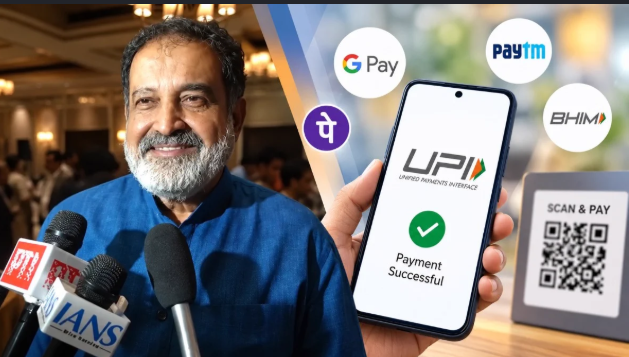
India’s Unified Payments Interface (UPI) ecosystem is set for an important change as the country introduces a new Merchant Discount Rate (MDR) framework for certain high-value merchant transactions. The development has generated questions among consumers and businesses about whether UPI payments will remain free.
Former Infosys CFO Mohandas Pai has highlighted that 96% of Unified Payments Interface (UPI) merchant transactions will not be affected by the new framework. The government has also clarified that UPI will continue to remain free for person-to-person (P2P) transactions, while most merchant payments will remain outside the MDR framework.


The key distinction is between payments made from one individual to another and payments made by individuals to businesses. Understanding this difference is important before assuming that UPI users will start paying charges on every transaction.
What Is Changing in UPI Payments?
The new framework introduces an MDR on specified person-to-merchant (P2M) UPI transactions above ₹2,000.
According to the government’s latest clarification, a nominal MDR of 0.4% will apply to eligible merchant transactions above ₹2,000. For transactions of ₹75,000 or more, the MDR will be capped at ₹300 per transaction.
However, this does not mean that consumers will suddenly have to pay a UPI transaction fee every time they make a payment above ₹2,000.
The government has specifically clarified that MDR is a charge within the merchant payment ecosystem. It is not a tax collected by the government or NPCI, and individuals will not be charged directly for making UPI payments.
This distinction is at the heart of the current UPI debate.
96% UPI Transactions Will Not Be Affected
One of the most important points in the new framework is that approximately 96% of P2M UPI transactions will remain unaffected.
Government data indicates that MDR will apply to only around 4% of merchant transactions. Payments below ₹2,000 and transactions covered under the zero-MDR framework for eligible small merchants will continue without MDR.
This means that the majority of everyday UPI payments will continue to operate under the existing zero-MDR structure.
For example, a customer paying ₹500 at a local store using UPI would not fall under the new MDR threshold. Similarly, eligible small merchants covered by the zero-MDR framework will continue to receive payments without MDR.
The statement that 96% UPI transactions will not be affected therefore refers specifically to merchant transactions and should not be interpreted as saying that only 96% of all UPI transactions remain free.
Will Customers Have to Pay UPI Charges?
For ordinary consumers, the answer is important: the new MDR is not designed as a direct charge on UPI users.
All person-to-person UPI transactions will remain free, regardless of the amount transferred. This means sending ₹5,000, ₹20,000 or even ₹50,000 to another individual through UPI will not attract MDR.
The government has also stated that UPI application providers cannot impose platform fees or hidden charges on individuals under this framework.
Banks have been advised to ensure that merchants do not pass MDR charges on to customers.
Therefore, consumers should distinguish between:
- P2P transactions: Person-to-person payments
- P2M transactions: Person-to-merchant payments
- MDR: A merchant-side payment ecosystem charge
This distinction helps explain why the new policy does not mean that every UPI transaction above ₹2,000 will suddenly become chargeable to consumers.
What Is MDR?
MDR stands for Merchant Discount Rate.
It is a fee associated with processing merchant payments. In the new UPI framework, MDR will be distributed among participants in the payment ecosystem, including banks, payment service providers and UPI application providers.
The government has clarified that MDR is not a tax and is not collected by the government or NPCI.
The broader objective is to create a more sustainable financial model for the UPI ecosystem while continuing to support digital payments.
UPI has experienced enormous growth since its launch, creating significant requirements for payment infrastructure, technology, cybersecurity and fraud-prevention systems. The government has argued that a sustainable revenue framework can support the continued expansion and resilience of the digital payments ecosystem.
Who Will Actually Pay MDR?
The MDR applies to eligible merchant transactions rather than ordinary P2P transfers.
Under the new framework, a standard 0.4% MDR will apply to specified P2M transactions above ₹2,000.
For transactions worth ₹75,000 or more, the MDR is capped at ₹300 per transaction.
There are also special rates for certain sectors.
For example, transactions above ₹2,000 in sectors such as:
- Railways
- Telecommunications
- Insurance
- Fuel
- Agricultural inputs
will attract a flat MDR of ₹5 per transaction under the specified framework.
Capital market-related payments, including certain transactions involving mutual funds, securities, stockbrokers and dealers, will attract an MDR of 0.02%, capped at ₹300.
Small Merchants Get Protection
Another significant part of the framework is the treatment of small merchants.
Eligible small merchants receiving up to ₹1 lakh per month through UPI QR codes under the Person-to-Person-Merchant (P2PM) category will continue to receive zero-MDR treatment on their transactions.
This provision is particularly relevant for street vendors, neighbourhood stores and micro-businesses that rely heavily on QR-based payments.
For these businesses, even a small payment-processing cost can matter because profit margins may already be limited.
The zero-MDR provision is therefore intended to prevent the new framework from placing an additional payment cost on the smallest merchants.
Why Is the Government Introducing MDR?
The introduction of MDR is linked to the long-term sustainability of India’s digital payment infrastructure.
UPI has become one of the world’s largest real-time payment systems. In July 2026 alone, UPI processed approximately 2,366 crore transactions worth ₹29.9 lakh crore, according to the Finance Ministry.
Operating such a large payment ecosystem requires significant investment in technology, infrastructure, security and risk management.
The government has previously stated that any future MDR would be limited to selected merchant transactions and would be significantly lower than traditional card-based MDR in relevant cases.
The new framework therefore attempts to introduce a revenue mechanism without turning UPI into a broadly chargeable service for consumers.
What Mohandas Pai’s Statement Means
The statement attributed to former Infosys CFO Mohandas Pai about 96% of transactions not being affected draws attention to the limited scope of the new MDR framework.
The broader message is that the change should not be interpreted as a blanket UPI charge.
Most merchant transactions are either below the ₹2,000 threshold or fall within zero-MDR provisions for eligible small merchants. As a result, the government estimates that around 96% of P2M transactions will remain unaffected.
For consumers, the impact is even more limited because P2P transactions remain outside the MDR framework altogether.
This means that someone transferring money to a family member, friend or another individual does not have to worry about MDR simply because the transfer exceeds ₹2,000.
What Does This Mean for Everyday UPI Users?
For most people, everyday UPI payments are expected to continue much as before.
Consider a few examples:
Example 1: Paying ₹500 at a shop
A ₹500 merchant payment is below the ₹2,000 threshold and remains outside the MDR framework.
Example 2: Paying ₹1,500 at a restaurant
This is also below ₹2,000, so the transaction remains free of MDR.
Example 3: Sending ₹10,000 to a friend
This is a P2P payment. It remains free regardless of the amount.
Example 4: Paying a merchant ₹5,000
This falls into the category of merchant transactions above ₹2,000 that may attract the specified MDR. However, the MDR is not a direct consumer fee, and the government has instructed banks to ensure that merchants do not pass it on to customers.
These examples show why simply saying “UPI charges will start above ₹2,000” can be misleading.
The type of transaction matters.
Will UPI Still Be Free?
For consumers, the government says yes.
Person-to-person UPI payments will remain free without a monthly quota or a transaction-value limit for free usage.
Merchant payments up to ₹2,000 will also remain free of MDR.
Eligible small merchants covered by the zero-MDR framework will continue receiving payments without MDR.
Therefore, the new framework does not end the free UPI model for ordinary users.
Instead, it introduces a limited MDR structure for specified higher-value merchant transactions.
What Businesses Need to Know
Businesses accepting UPI payments should understand how the new framework could affect their payment costs.
Larger merchants processing substantial numbers of transactions above ₹2,000 may need to account for MDR as part of their payment-processing expenses.
Businesses should also understand their applicable category because the MDR rate differs across transaction types and sectors.
At the same time, small businesses that qualify under the zero-MDR framework may continue accepting UPI payments without this additional cost.
For businesses, the important factors will include transaction size, monthly QR receipts, merchant classification and sector-specific MDR rules.
UPI MDR vs Consumer Charges
It is important not to confuse MDR with a customer transaction fee.
MDR is part of the merchant payment ecosystem. The customer making the payment is not supposed to be charged MDR directly.
The Finance Ministry has explicitly stated that UPI application providers are prohibited from imposing platform fees or hidden charges under the framework.
This means the headline “UPI charges above ₹2,000” does not accurately describe the complete policy.
A more precise explanation is that specified merchant transactions above ₹2,000 will attract MDR, while UPI users will continue to have free P2P transactions and most merchant transactions will remain unaffected.
What Happens Next?
The new MDR framework is scheduled to take effect from October 15, 2026, according to the latest reporting and government clarification.
The implementation will be closely watched by merchants, payment companies, banks and consumers.
One of the major questions will be how businesses respond to the additional payment-processing cost. While the government has instructed banks to prevent merchants from passing MDR on to customers, the practical impact may vary depending on how different businesses manage their payment costs.
The policy could also influence the economics of India’s rapidly expanding digital payment ecosystem.
Conclusion
The statement that 96% of UPI transactions will not be affected provides important context to the latest changes in India’s digital payment system.
The new MDR framework does not introduce a blanket charge on UPI users. Person-to-person UPI transactions will remain free, while merchant payments up to ₹2,000 and eligible small-merchant transactions will continue under zero-MDR provisions. Approximately 96% of P2M transactions are expected to remain unaffected.
The new MDR will apply only to specified merchant transactions above ₹2,000, generally at 0.4%, with a ₹300 cap for transactions of ₹75,000 and above. Certain essential sectors will have separate flat-rate provisions.
For consumers, the key takeaway is simple: UPI is not becoming a universally chargeable payment method. The new framework is focused on a limited portion of merchant transactions while keeping everyday P2P payments and the majority of merchant transactions free.
As India’s digital payment ecosystem continues to grow, the new model is likely to remain an important topic for consumers, merchants and payment companies alike.
For more such stories please visit Business Press