
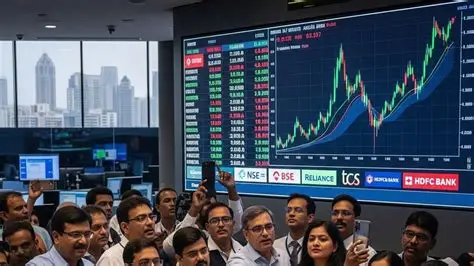
Indian stock market news: Indian shares extend gains ahead of RBI rate decision, Indian equity markets extended their gains on Tuesday, October 6, 2026, as investors assessed positive global cues, improving corporate updates and expectations surrounding the Reserve Bank of India’s (RBI) upcoming monetary policy decision. The benchmark Sensex and Nifty 50 advanced for a second consecutive session, offering some relief after a prolonged period of selling pressure in the domestic stock market.
The latest rally reflects renewed buying interest across several sectors, particularly banking and financial services, as investors look for signs of stability in the Indian economy. However, the market remains cautious because the RBI’s interest rate decision, movements in crude oil prices, foreign investor activity and upcoming corporate earnings could influence the direction of equities in the coming sessions.


According to market data reported on October 6, the Nifty 50 gained 0.98% to close at 22,776.10, while the BSE Sensex rose 0.95% to 73,067.81. Both indices had advanced approximately 0.6% in the previous session, extending their recovery after the market recorded its longest weekly losing streak in 25 years through the previous Friday.
Indian Stock Market Today: Sensex and Nifty Extend Their Rally
The Indian stock market witnessed broad-based buying on Tuesday, with benchmark indices continuing their upward movement ahead of the RBI’s monetary policy announcement scheduled for Wednesday, October 7. The recovery indicates that investors are becoming more willing to enter the market after recent declines, although the sustainability of the rally will depend on economic developments and the central bank’s policy guidance.
Market sentiment improved as investors evaluated domestic banking updates, corporate earnings expectations and developments in international markets. A decline in crude oil prices and easing bond yields also contributed to a more supportive environment for equities. These factors helped offset some of the concerns surrounding inflation, currency weakness and the possibility of higher interest rates.
The rally was not restricted to large-cap stocks. Small-cap and mid-cap shares also advanced, indicating that buying interest extended beyond the largest listed companies. According to market reports, 14 of 16 major sectoral indices finished higher, while small-cap and mid-cap indices gained approximately 1.6% and 1.1%, respectively.
Nevertheless, the latest gains should not automatically be interpreted as the beginning of a sustained bull market. After a period of heavy selling, short-covering and bargain buying can contribute to sharp recoveries. Investors will therefore be watching whether the market can maintain its momentum after the RBI announces its decision.
RBI Monetary Policy Decision: Why Investors Are Watching Closely
The RBI’s monetary policy announcement is the most important near-term event for the Indian stock market. The central bank’s six-member Monetary Policy Committee is reviewing interest rates and broader economic conditions during its October 5–7 meeting, with the outcome expected on October 7.
Before the announcement, market participants were closely assessing whether the RBI would increase the benchmark repo rate in response to inflationary pressures and changing global financial conditions. The repo rate is the interest rate at which the central bank lends money to commercial banks against eligible securities. Changes in this rate can influence borrowing costs, lending rates, consumption, business investment and financial market sentiment.
Economists surveyed by Reuters largely expected a 25-basis-point rate increase, although a larger increase remained a possibility discussed by some market participants. A 25-basis-point increase would raise the repo rate from 5.25% to 5.50%. The decision is particularly significant because the RBI had not raised its policy rate since February 2023, while it cut rates cumulatively by 125 basis points during 2025.
Investors will not focus solely on whether the RBI raises or maintains interest rates. The central bank’s accompanying statement, inflation projections, economic growth outlook and guidance on future policy decisions will also be important. A measured approach that addresses inflation without significantly weakening economic activity could reassure investors, while a more aggressive stance could increase uncertainty around borrowing costs and corporate profitability.
The market reaction will also depend on how the final decision compares with expectations already reflected in share prices. If the RBI delivers an outcome that investors consider less restrictive than anticipated, equities could receive further support. Conversely, a larger-than-expected increase or a particularly hawkish outlook could trigger renewed volatility.
Banking Stocks Lead Buying Ahead of the RBI Announcement
Banking and financial services stocks were among the key contributors to the market’s advance. Investors closely monitor this sector during monetary policy meetings because interest rate changes can influence banks’ funding costs, lending activity, credit demand and profitability.
Private-sector banks recorded notable gains during Tuesday’s session. Axis Bank rose approximately 2.1%, while Kotak Mahindra Bank advanced around 3.8%, according to market reports. The Nifty Private Bank index also gained more than 1% during the session.
Recent quarterly business updates from financial institutions provided additional support to investor sentiment. Credit and deposit growth figures helped reinforce expectations that underlying demand for banking services remained resilient despite the recent volatility in equity markets.
However, the relationship between interest rates and bank stocks is not straightforward. Higher lending rates may improve returns on some loans, but banks could also face higher deposit costs, slower credit demand and an increase in repayment pressure among borrowers. The ultimate effect depends on each bank’s deposit base, loan composition, funding structure and ability to manage asset quality.
Investors will therefore examine the RBI’s policy announcement alongside bank-specific earnings, deposit growth, loan growth and management commentary before drawing conclusions about the outlook for financial stocks.
Reliance Industries and Trent Shares Attract Investor Attention
Apart from banking shares, selected heavyweight and consumer-facing stocks contributed to the market’s positive performance.
Reliance Industries gained approximately 2.7% on Tuesday. Investor interest was supported by optimism surrounding a possible listing of Jio Platforms and commentary about changes in portfolio weightings, according to market reports. Given Reliance Industries’ significant presence in major indices, movements in its share price can have a meaningful effect on overall market sentiment.
Trent was another prominent performer, with its shares surging approximately 12.6% following a positive business outlook. The fashion retailer’s performance highlighted the role that company-specific developments can play in driving stock prices even when broader markets are focused on monetary policy.
Consumer goods companies also advanced. Dabur India gained approximately 2.7%, while Godrej Consumer Products rose around 4.2%, according to reports on the session.
These movements demonstrate that the market recovery was supported by several individual stocks rather than being driven exclusively by expectations surrounding interest rates. Nevertheless, investors will need to assess whether these gains are supported by sustainable revenue growth, earnings visibility and reasonable valuations.
Falling Crude Oil Prices Improve Market Sentiment
Crude oil prices remain an important factor for the Indian economy and domestic equity markets. India imports a substantial share of its crude oil requirements, making the country sensitive to changes in international energy prices.
A decline in oil prices can help reduce imported inflation and ease pressure on the country’s trade balance. Lower energy costs may also benefit industries that depend heavily on fuel, transportation and petroleum-based inputs. These developments can improve business margins and provide some relief to consumers.
During Tuesday’s trading session, Brent crude prices fell by nearly 2%, supporting the broader improvement in investor sentiment. The decline helped offset some concerns about inflation and the possibility of further monetary tightening.
However, the outlook for crude oil remains uncertain because geopolitical tensions and potential disruptions to energy supplies can produce sudden price movements. A renewed increase in oil prices could complicate the RBI’s efforts to control inflation, weaken the rupee and raise operating costs for Indian companies.
For this reason, traders and long-term investors will continue monitoring international oil prices alongside the central bank’s policy statement and domestic inflation data.
Global Market Trends and Bond Yields Support Indian Equities
International financial markets also contributed to the improvement in domestic sentiment. Asian and European equities advanced, while bond yields retreated, providing a more favourable backdrop for risk assets.
Bond yields matter because they influence borrowing costs and the relative attractiveness of different investments. When yields rise, investors may demand higher returns from equities, putting pressure on stock valuations. When yields decline, some investors may become more willing to allocate money to shares, particularly growth-oriented companies whose valuations depend on future earnings.
Global market movements also influence foreign portfolio investors, whose investment decisions can affect liquidity and price trends in emerging markets such as India. Changes in US interest rate expectations, currency movements and geopolitical developments can alter the flow of international capital into Indian equities.
Despite the improvement in global cues, international conditions remain an important source of uncertainty. Investors will continue to assess the interaction between global interest rates, energy prices, exchange rates and domestic economic growth when evaluating the Indian stock market’s outlook.
Indian Rupee and Foreign Investor Activity Remain Key Risks
While equities advanced, the Indian rupee faced pressure ahead of the RBI’s policy decision. The currency closed at approximately 96.42 against the US dollar on Tuesday, reaching its weakest level in more than two months, according to Reuters.
Currency movements are important for the stock market because a weaker rupee can increase the cost of imported goods, particularly crude oil and other commodities. It can also raise the domestic cost of servicing foreign-currency liabilities for some businesses.
At the same time, rupee depreciation can benefit certain export-oriented companies by increasing the domestic-currency value of their overseas earnings, depending on their cost structures and currency exposure.
Foreign portfolio investment is another factor to watch. When overseas investors reduce their exposure to Indian equities, selling pressure can weigh on benchmark indices and the rupee. Interest rate differentials between India and other major economies can influence these decisions, alongside company valuations and expectations for economic growth.
The RBI may therefore face the challenge of balancing domestic growth and inflation objectives with financial stability and currency pressures. Investors will pay close attention to the central bank’s comments on liquidity management and foreign exchange conditions in addition to its headline interest rate decision.
Inflation and Economic Growth Remain Central to the RBI’s Policy Outlook
The RBI’s policy decision comes at a time when inflation remains an important concern for policymakers. India’s headline consumer price inflation reached 4.82% in August 2026, according to reports on the October policy meeting. Although the rate remained within the RBI’s 2%–6% tolerance band, it was above the central bank’s medium-term target of 4%.
Higher inflation can reduce consumers’ purchasing power, increase business expenses and complicate decisions about monetary policy. If price pressures persist, the central bank may consider tighter financial conditions necessary to prevent inflation expectations from becoming entrenched.
At the same time, monetary tightening can increase borrowing costs for businesses and households. Companies may postpone investment, consumers may reduce discretionary spending, and sectors dependent on credit may experience slower demand.
This creates a difficult balance for policymakers. The RBI must assess whether inflationary pressures require higher rates while considering the potential consequences for economic activity and financial stability.
For stock market investors, the central bank’s assessment of future inflation and growth could be just as important as the immediate policy decision. A credible strategy that keeps inflation under control while supporting sustainable economic expansion would help provide greater clarity for businesses and financial markets.
TCS Quarterly Earnings Could Influence the Next Market Move
Beyond the RBI decision, investors are also preparing for the upcoming quarterly earnings announcement from Tata Consultancy Services (TCS), expected on Thursday, October 8.
TCS is one of India’s largest information technology services companies, and its results can influence sentiment across the IT sector. Investors will examine revenue growth, operating margins, deal wins, client spending trends and management commentary about demand in major international markets.
The performance of IT companies is particularly relevant because the sector has exposure to global business conditions and currency movements. Changes in client technology spending, demand for digital transformation services and investment in artificial intelligence can affect revenue expectations and valuations.
A strong earnings outlook could help support the broader market by reinforcing confidence in corporate performance. On the other hand, weaker guidance or signs of slower client spending could limit gains in IT stocks and add to uncertainty.
With both the RBI decision and TCS earnings arriving within a short period, investors may remain selective rather than taking aggressive positions across the market.
What the RBI Rate Decision Could Mean for Different Sectors
The RBI’s decision could have different implications for individual industries, depending on how interest rates affect their business models and financing needs.
Banking and financial services companies may experience changes in deposit costs, lending rates, credit demand and margins. Higher rates can improve returns on certain loans, but they may also increase funding expenses and reduce borrowing demand.
The real estate and automobile sectors are sensitive to borrowing costs because home loans and vehicle financing influence consumer purchases. Higher rates could make loans more expensive, potentially affecting affordability and demand. A stable policy outlook could instead help businesses and consumers plan their spending more confidently.
Consumer goods companies may be affected by changes in household purchasing power and input costs. If inflation remains elevated, consumers could become more cautious about discretionary purchases, while manufacturers may face pressure on margins.
Information technology and other export-oriented businesses are influenced by global demand, exchange rates and international investment conditions. For these companies, the RBI decision may matter less directly than developments in overseas markets and client spending.
Ultimately, sector performance will depend on a combination of interest rates, earnings expectations, valuations and broader economic conditions. Investors should avoid assuming that all stocks within a sector will respond in the same way.
Indian Stock Market Outlook: Will Sensex and Nifty Sustain Their Gains?
The immediate outlook for Indian equities will depend heavily on the RBI’s policy announcement on October 7 and the guidance accompanying it. The latest rally suggests that investors are willing to buy stocks after recent declines, but uncertainty remains around inflation, currency weakness, foreign investment flows and global energy prices.
A policy outcome that is broadly in line with expectations could help reduce uncertainty. If the RBI also provides reassuring guidance on economic growth and inflation, investors may find additional reasons to maintain their equity exposure.
However, the possibility of a stronger-than-expected rate increase or a more restrictive policy outlook could create fresh selling pressure. The rupee’s performance, crude oil prices and the next round of corporate earnings will also play important roles in determining whether the recovery continues.
Market participants will be watching trading volumes, sectoral participation and the behaviour of large-cap stocks to determine whether the rebound is supported by sustained buying. Continued strength across a broad range of stocks would provide a stronger signal than a rally concentrated in only a few heavyweight companies.
For long-term investors, the latest movements highlight the importance of focusing on company fundamentals, earnings quality, financial strength and valuation rather than reacting solely to daily market fluctuations.
Conclusion: Investors Await RBI Policy Clarity as Markets Recover
Indian shares extended their gains on October 6 as the Sensex and Nifty 50 advanced ahead of the Reserve Bank of India’s monetary policy announcement. Banking stocks, selected heavyweight companies, lower crude oil prices and supportive global cues contributed to the recovery.
The market’s attention is now firmly on the RBI’s October 7 decision, with investors evaluating the potential effects of interest rates on inflation, economic growth, corporate borrowing and currency stability. Upcoming earnings from major companies, including TCS, will provide another important indication of business conditions.
Although the latest gains have improved sentiment after a difficult period for equities, investors should remain mindful of the risks associated with monetary policy uncertainty and global financial conditions. The durability of the rally will depend on whether improving sentiment is supported by stronger fundamentals and a favourable outlook for earnings.
For now, the RBI decision represents a key near-term trigger for the Indian stock market, and its impact will be closely watched by domestic investors, foreign institutions and businesses across the economy.
Disclaimer: This article is for informational and educational purposes only and should not be considered investment advice. Stock market investments are subject to market risks. Readers should conduct their own research or consult a qualified financial adviser before making investment decisions.
To read more such news kindly visit: Businesspress