
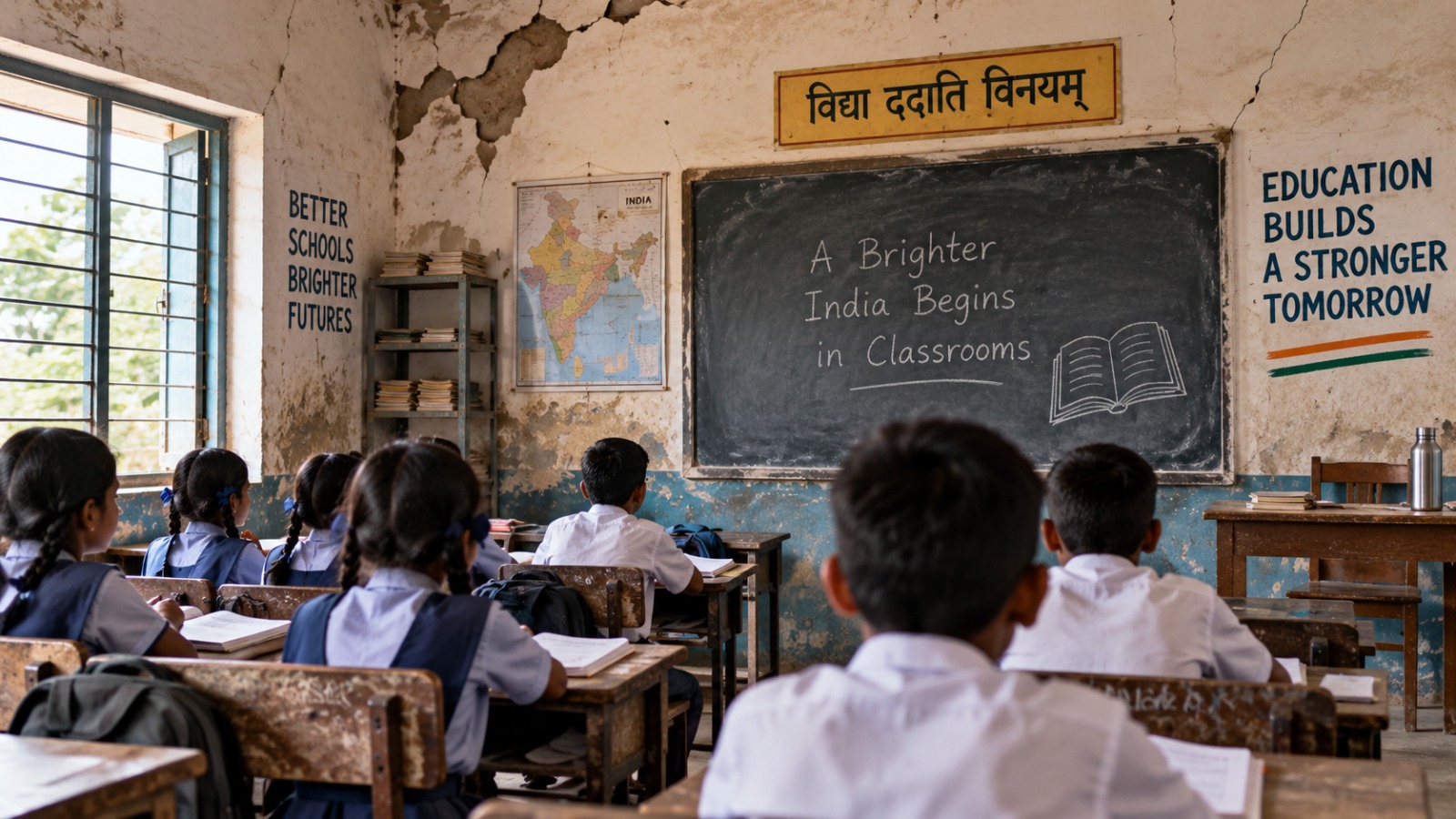
India’s school infrastructure crisis is no longer limited to questions about classrooms and buildings. Across the country, students are raising concerns about basic facilities such as drinking water, electricity, toilets, teachers, computers and internet access. Recent student protests in several states have brought these issues back into public attention.
India has one of the world’s largest school education systems, with around 14.67 lakh schools, 24.72 crore students and 1.03 crore teachers recorded in UDISE+ 2025–26. While official data shows progress in several areas, significant gaps remain between having infrastructure on paper and having facilities that are functional and usable by students.


Why India’s School Infrastructure Is Back in the Spotlight
For many students, the quality of a school is determined by basic questions: Is the classroom safe? Is there drinking water? Are the toilets usable? Is there electricity? Are enough teachers available?
In recent months, students in different parts of India have publicly raised such concerns. Reports from Uttar Pradesh, Bihar, Maharashtra, Rajasthan and other states have highlighted demands for better classrooms, teachers, drinking water, electricity, toilets and other basic facilities.
In one reported case in Uttar Pradesh, students protested against the condition of their school building after concerns about structural safety. Such incidents have put the focus not only on access to education but also on the conditions in which children receive that education.
The issue is particularly important for government schools because they serve a large number of children, including students from rural and economically disadvantaged communities.
What Government Data Says About School Facilities
The latest UDISE+ infrastructure data shows that India has made substantial progress in providing basic facilities, but coverage is not yet universal across all infrastructure categories.
According to UDISE+ 2024–25, India had 14,71,473 schools. Of these, 14,61,032 reported drinking-water facilities and 14,56,968 reported functional drinking-water facilities. However, the figures for digital infrastructure and accessibility remain considerably lower.
The same data recorded computer facilities in 9,51,868 schools, while 8,52,684 had functional computer facilities for pedagogical purposes. Internet facilities were reported in 9,33,987 schools.
This means that the digital divide in schools cannot be measured simply by asking whether computers exist. A computer facility needs to be functional, maintained and supported by reliable connectivity if students are expected to use technology as part of everyday learning.
There has nevertheless been measurable improvement over the past decade. Ministry of Education data comparing 2014 and 2024 shows school internet availability increasing from 8.1% to 63.5%, while computer availability increased from 26.4% to 64.7%. Drinking-water availability increased from 96.1% to 99.3% over the same period.
The numbers show both progress and the remaining challenge: infrastructure coverage has improved considerably, but millions of students still study in schools where some facilities may be unavailable or not fully functional.
The Teacher Shortage Is Another Part of the Problem
A school building alone cannot provide quality education. Teachers are equally important to the functioning of a school.
The shortage of teachers is also closely connected to India’s wider employment challenge, particularly as the country prepares young people for the future workforce.
The Ministry of Education said in July 2026 that teacher recruitment, service conditions and deployment are primarily handled by state governments and Union Territory administrations. Teacher vacancies can arise because of retirement, resignation, creation of new posts, changes in enrolment and the rationalisation of teacher deployment.
UDISE+ 2025–26 recorded 1,00,843 single-teacher schools across India. In these schools, one teacher may have responsibility for students across multiple grades, creating additional challenges for classroom management and teaching.
The situation also varies considerably between states. For example, the UDISE+ data listed 9,269 single-teacher schools in Maharashtra, 7,874 in Uttar Pradesh, 7,200 in Rajasthan and 9,827 in Jharkhand.
At the national level, however, the government reports that the pupil-teacher ratio is within the norms envisaged under the National Education Policy. The reported ratio for 2025–26 was 19 at the primary level, 17 at upper primary, 15 at secondary and 23 at higher secondary level.
This highlights an important distinction: a national average can appear healthy while individual schools or regions may still face shortages.
The Digital Gap Is Becoming More Important
Technology is increasingly becoming part of education, but access remains uneven.
The UDISE+ 2024–25 figures show that more than 9.5 lakh schools had computer facilities, while around 9.34 lakh reported internet facilities. With more than 14.7 lakh schools in the system, this leaves a substantial number of schools without these facilities.
Digital infrastructure also requires more than installing computers. Schools need electricity, internet connectivity, maintenance, appropriate digital content and teachers who can use technology effectively.
The issue became more significant after education systems increasingly adopted digital learning resources. For students in schools without reliable connectivity or functional devices, the benefits of digital education can remain out of reach.
Safety, Toilets and Accessibility Cannot Be Secondary
The school infrastructure crisis also involves physical safety and inclusion.
A functioning school requires more than classrooms. Students need safe buildings, usable toilets, drinking water, electricity and facilities that allow children with disabilities to participate fully in school life.
UDISE+ 2024–25 recorded ramps in 11,64,274 schools and ramps with handrails in 8,08,460 schools. Schools with facilities for children with special needs, including CWSN toilets, numbered 5,23,143.
These figures show that accessibility infrastructure has expanded, but they also demonstrate that access is not yet universal.
For a child with a disability, a staircase without an accessible alternative can become as significant a barrier to education as a missing classroom.
What Is Being Done to Improve School Infrastructure?
The government has several programmes aimed at strengthening school infrastructure.
Under Samagra Shiksha, financial assistance is provided to states and Union Territories for activities including construction of school buildings and additional classrooms, toilets, drinking-water facilities, electricity, boundary walls, libraries and digital classrooms. Funding is linked to gaps identified through UDISE+ data and proposals submitted by states and Union Territories.
The PM SHRI scheme is another major initiative. According to the Ministry of Education, 13,092 schools had been selected as PM SHRI Schools by July 2026, representing around 90% of the target of more than 14,500 schools. The programme aims to develop selected schools as exemplar institutions with improved infrastructure, learning resources, inclusion and 21st-century skills.
The challenge is ensuring that improvements reach schools consistently across different regions and that facilities remain functional after they are created.
The Bigger Question: What Should an Indian School Look Like?
India has made measurable progress in school infrastructure over the past decade. Drinking-water availability, computer access, internet connectivity, toilets and other facilities have expanded significantly according to government data.
At the same time, recent student protests and UDISE+ figures show that important gaps remain.
A future-ready school cannot be defined only by the number of classrooms it has. It also needs safe buildings, adequate teachers, functioning toilets, clean drinking water, electricity, digital connectivity and accessible facilities.
The school infrastructure crisis in India is therefore not simply a question of constructing more buildings. It is about ensuring that the infrastructure already provided is safe, functional, inclusive and capable of supporting students throughout the school year.
For millions of children, these facilities are not additional benefits. They are part of the basic environment required to learn.