
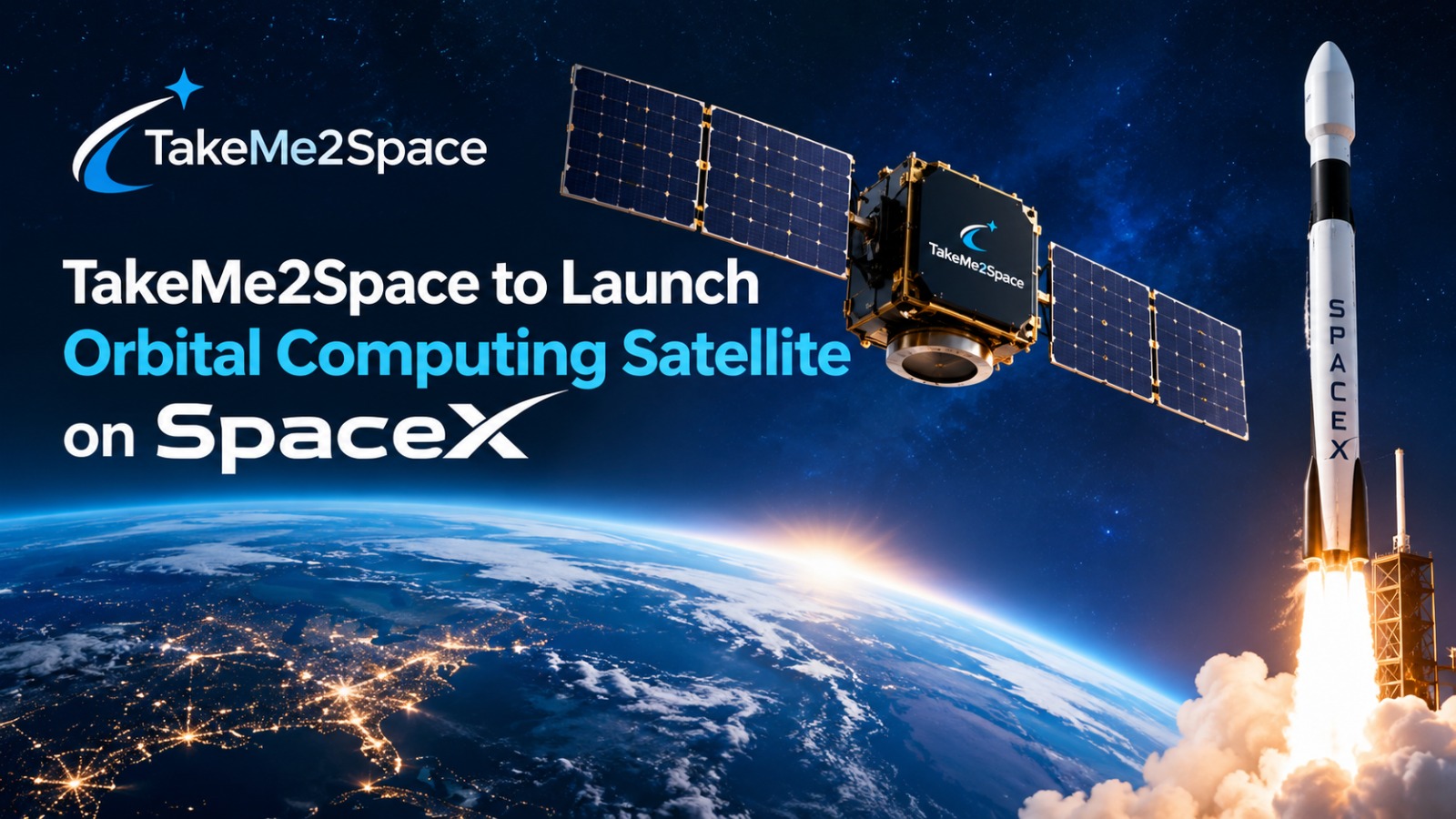
Indian spacetech startup TakeMe2Space is preparing to launch its MOI-1A satellite aboard a SpaceX rocket on October 1, 2026, in a mission focused on processing data directly in orbit rather than transmitting raw information back to Earth.
According to Reuters, the Bengaluru/Hyderabad-based startup describes MOI-1A as India’s first orbital computing satellite. The spacecraft is scheduled to fly as part of SpaceX’s Transporter-18 rideshare mission.


TakeMe2Space Brings Computing Closer to Space
Traditional Earth-observation satellites collect large amounts of data and generally transmit that information to ground stations for processing. TakeMe2Space is developing an alternative approach in which computing takes place directly on the satellite.
The company says its orbital-computing platform is designed to process Earth-observation data in space and transmit useful insights rather than large volumes of raw data. This approach could help reduce data-transfer requirements and speed up the delivery of information.
MOI-1A Satellite to Carry Nvidia Computing Hardware
The MOI-1A spacecraft is a sub-50-kg satellite equipped with Nvidia Orin NX processors, according to Reuters. TakeMe2Space has said the mission will be used to provide orbital computing capabilities to customers while demonstrating its technology in space.
The company’s own technical information lists MOI-1A with 117 TOPS of computing capacity, 16GB of RAM, 2TB of onboard storage and a nine-band multispectral imager.
This combination of computing and imaging capabilities is intended to allow the satellite to analyze information closer to where it is generated.
Startup Has Already Signed 23 Customers
TakeMe2Space said it has signed 23 customers for the mission, including geographic information system companies and educational institutions.
The startup’s potential commercial applications extend across areas such as agriculture, mining, supply-chain management and insurance, according to comments reported by Reuters.
These applications demonstrate how orbital computing could potentially be used beyond traditional satellite operations, particularly in sectors that depend on Earth-observation data.
From Demonstration to Commercial Orbital Computing
TakeMe2Space has already conducted an orbital demonstration mission. Its website states that its MOI-TD mission completed a 14-day orbital demonstration in January 2025 and validated onboard computing and related technologies.
The company subsequently attempted to launch MOI-1 in January 2026, but the spacecraft was lost following an anomaly during the PSLV-C62 mission. TakeMe2Space’s mission records state that its systems remained nominal until the loss of the launch vehicle.
The upcoming MOI-1A mission represents another step in the startup’s effort to develop orbital computing infrastructure.
TakeMe2Space Plans Larger Satellites
The company’s ambitions extend beyond the MOI-1A mission.
TakeMe2Space is planning larger satellites and a broader orbital-computing network. The company says its planned constellation could eventually consist of six satellites, providing wider access to computing and Earth-observation capabilities from low Earth orbit.
Separately, the company has announced plans for a networked orbital data-centre mission in 2028. Business Standard reported that the planned system would involve two 100-kg satellites equipped with Nvidia Thor GPUs and substantial onboard storage, with optical links allowing the satellites to share computing workloads.
Why Orbital Computing Matters
The amount of data generated by satellites continues to increase as Earth-observation systems become more capable. Processing some of that information directly in orbit could reduce the amount of raw data that needs to be transmitted to Earth.
TakeMe2Space’s OrbitLab platform is built around this concept. The company says customers can upload AI models, run experiments and process Earth-observation data using computing resources in orbit.
For applications requiring rapid analysis, processing data closer to the source could potentially reduce delays between data collection and useful insights.
India’s Growing Spacetech Startup Ecosystem
The TakeMe2Space mission also reflects the expanding role of Indian startups in space technology.
Government data published through the Indian Space Research Organisation/IN-SPACe ecosystem lists TakeMe2Space among Indian space startups receiving support under various programmes.
The company is therefore part of a broader ecosystem of Indian startups working on satellite technology, launch systems, Earth observation, space computing and other commercial space applications.
What Comes Next
The immediate milestone for TakeMe2Space is the planned October 1, 2026 launch of MOI-1A aboard SpaceX’s Transporter-18 rideshare mission. The mission will provide an opportunity for the company to demonstrate its orbital-computing technology and serve customers using the platform.
If its technology and business model continue to develop as planned, the startup’s future missions could expand the role of computing infrastructure beyond Earth and into low Earth orbit.
Conclusion
TakeMe2Space’s upcoming MOI-1A mission represents an emerging approach to satellite technology: processing data in orbit instead of sending all raw information back to Earth.
With an Nvidia-powered computing system, multispectral imaging capabilities, a growing customer base and plans for larger orbital data-centre missions, the Indian spacetech startup is working to establish computing infrastructure directly in space. The October 2026 launch will be an important milestone in that development.
To Read More Such News Visit Business Press .