
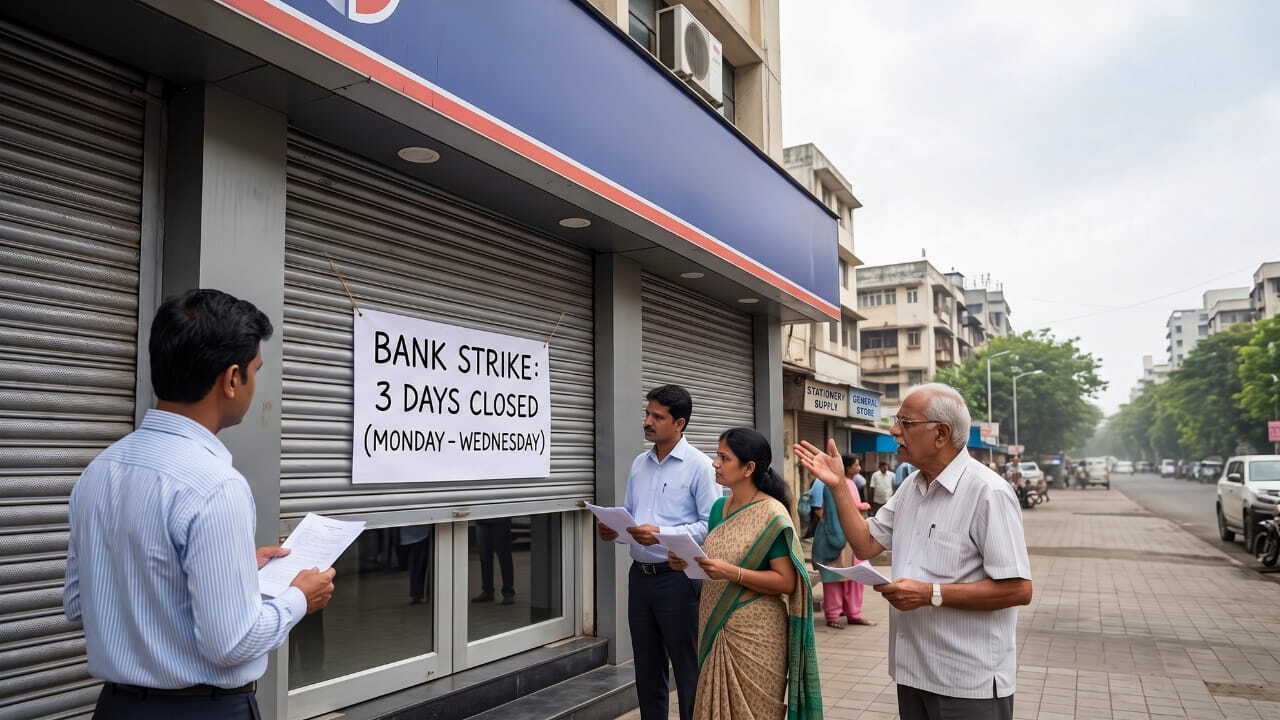
Bank strike deferred : The proposed three-day nationwide bank strike from September 28 to September 30, 2026, has been deferred following discussions between the Indian Banks’ Association (IBA) and the United Forum of Bank Unions (UFBU). The decision came after a late-night meeting between the two sides on September 27, just hours before the proposed strike was due to begin.
The development means customers do not face the nationwide branch shutdown that had been expected between September 28 and 30. The decision is particularly significant because the proposed strike coincided with the end of the half-yearly period for banks, when branch-based and administrative banking activities can be important for customers and businesses.


The immediate dispute has now shifted from industrial action to further negotiations, with both sides agreeing to establish a high-level committee to examine some of the key demands raised by bank employee unions.
Why Was the Bank Strike Planned?
The proposed bank strike was primarily linked to the demand for a five-day banking week. Bank unions have been seeking holidays on all Saturdays, which would effectively move the banking sector towards a five-day working arrangement.
At present, banks are generally closed on the second and fourth Saturdays of each month, while other Saturdays are normally working days, subject to applicable local holidays and individual bank schedules. The unions have been seeking a change that would make all Saturdays holidays.
The demand has been one of the major issues in discussions between bank unions and the banking industry. The UFBU had announced the three-day strike after negotiations did not produce the progress sought by the unions.
Bank Strike Deferred After IBA-UFBU Meeting
The decision to defer the strike followed a meeting between the IBA and UFBU on the night of September 27. According to reports, the two sides agreed to form a high-level committee consisting of representatives from the IBA and UFBU.
The committee will examine the demand for declaring the remaining Saturdays as holidays. It is also expected to explore possible alternatives and consult relevant stakeholders before working towards a solution.
Importantly, the agreement does not mean that the five-day banking week has been approved. The proposal remains under discussion, and the committee’s future deliberations will determine the next steps.
What Will the High-Level Committee Discuss?
The committee is expected to focus on the demand for holidays on all Saturdays. The discussions could involve examining how a five-day banking schedule would affect employees, customers, banking operations and other stakeholders.
The issue is particularly important because changing the banking calendar would have an impact beyond bank employees. Branch operations, customer service schedules, clearing activities and other banking-related processes would need to be considered before any final decision.
The committee will therefore have to consider different options before a final arrangement can be reached.
For customers, this means that all-Saturday bank holidays should not yet be treated as a new rule. Existing bank holiday arrangements continue until any formal change is announced.
Another Key Issue: Performance-Linked Incentive
The five-day banking week is not the only issue being discussed.
The IBA and UFBU have also agreed to discuss changes to the Performance Linked Incentive (PLI) scheme for Scale IV and above officers. The issue concerns the structure and implementation of performance-linked benefits for senior bank officers.
The discussions are expected to continue as part of the broader negotiations between the banking association and employee unions. The IBA is also expected to take up the matter with the government where necessary.
This means that the latest agreement covers several pending issues rather than focusing exclusively on Saturday holidays.
What Does the Bank Strike Deferral Mean for Customers?
The immediate impact is straightforward: the planned three-day nationwide strike has been deferred.
Customers who were concerned about branch closures from September 28 to September 30 can therefore expect banking operations to continue rather than face the nationwide shutdown that had been planned.
The development is particularly relevant for people who needed to visit branches for activities that cannot always be completed through digital banking channels.
These can include certain cash-related transactions, documentation, account-related requests, cheque services and other branch-dependent activities.
Customers should nevertheless check their individual bank’s communication for branch timings and any local holiday arrangements.
Why Was the Timing of the Strike Important?
The proposed strike was scheduled for the final days of September, making the timing particularly significant for the banking sector.
September 30 marks the end of the half-yearly period for banks. A three-day strike immediately before this date could have created additional pressure on branch operations and customers seeking to complete important transactions.
Before the strike was deferred, the government and bank managements had already taken steps to reduce potential disruption.
The Ministry of Finance had announced that Public Sector Banks and Regional Rural Banks would remain open on Sunday, September 27, while the Reserve Bank of India approved the operation of bank branches, offices, ATM-linked branches and currency chests on that day.
The special Sunday opening was arranged because September 26 was the fourth Saturday and September 27 was a Sunday, immediately preceding the proposed three-day strike.
Digital Banking Services and Customers
The proposed strike had raised concerns mainly about branch-based banking services. Customers increasingly depend on digital channels such as mobile banking, internet banking, UPI and ATMs for routine transactions.
Even when branch operations are disrupted, many digital banking services can continue depending on the individual bank’s systems and availability.
However, customers requiring physical branch services may still need to visit a branch during regular working days. The deferral of the strike therefore reduces the possibility of delays for such transactions.
For businesses, the development is also important because the end of the financial half-year can involve payments, reconciliations, documentation and other banking-related activities.
Five-Day Banking Week Still Not Implemented
One of the most important points for customers is that the deferral of the strike does not introduce a five-day banking week.
The demand remains under discussion between the IBA and UFBU. Banks have not yet shifted to a system in which every Saturday is automatically a holiday.
The current arrangement of second and fourth Saturday holidays therefore continues unless and until an official change is announced.
Customers should therefore avoid assuming that all Saturdays will now be bank holidays simply because the unions have deferred the strike.
What Happens Next?
The immediate next step is the formation of the joint high-level committee involving the IBA and UFBU.
The committee will examine the demand for holidays on the remaining Saturdays and consider possible alternatives. Discussions on the PLI scheme and other pending matters are also expected to continue.
The UFBU’s decision to defer the strike moves the issue back into negotiations rather than ending the dispute permanently.
This means that future developments will depend on the outcome of discussions between bank management representatives, employee unions and other relevant stakeholders.
Will There Be Another Bank Strike?
At present, the September 28–30 strike has been deferred, rather than simply taking place as originally planned.
The latest agreement has temporarily moved the focus towards negotiations. Any future industrial action would depend on how discussions progress and whether the outstanding issues are resolved.
Customers should therefore follow official announcements from their banks, the IBA and relevant banking employee organisations for future updates.
What Bank Customers Should Know Now
For customers, the key points from the latest bank strike update are:
- The proposed September 28–30 nationwide bank strike has been deferred.
- Bank branches are expected to operate normally during the previously proposed strike period, subject to individual bank schedules.
- The IBA and UFBU will form a high-level committee to examine the demand for holidays on all Saturdays.
- The five-day banking week has not yet been implemented.
- Banks continue to observe the existing Saturday holiday arrangement unless officially changed.
- Discussions will also cover the Performance Linked Incentive scheme for Scale IV and above officers.
- Other pending issues raised during earlier discussions are also expected to be considered.
- Customers should continue checking official bank announcements for any changes to branch operations.
Bank Strike Latest News: What It Means for India’s Banking Sector
The latest development provides temporary relief for customers and businesses that could have faced disruptions during the final days of September.
At the same time, the central issue behind the proposed strike remains unresolved. The demand for a five-day banking week will now be examined through the proposed high-level committee, while discussions on employee-related issues are expected to continue.
For customers, the immediate message is that the planned three-day strike will not proceed as originally announced. However, the broader discussion over working days, Saturday holidays and other banking-sector demands is likely to continue in the coming weeks.
As negotiations progress, any formal decision regarding a five-day banking week or changes to existing bank holiday arrangements will need to be communicated through the appropriate official channels.
To read more such news kindly visit: Businesspress