
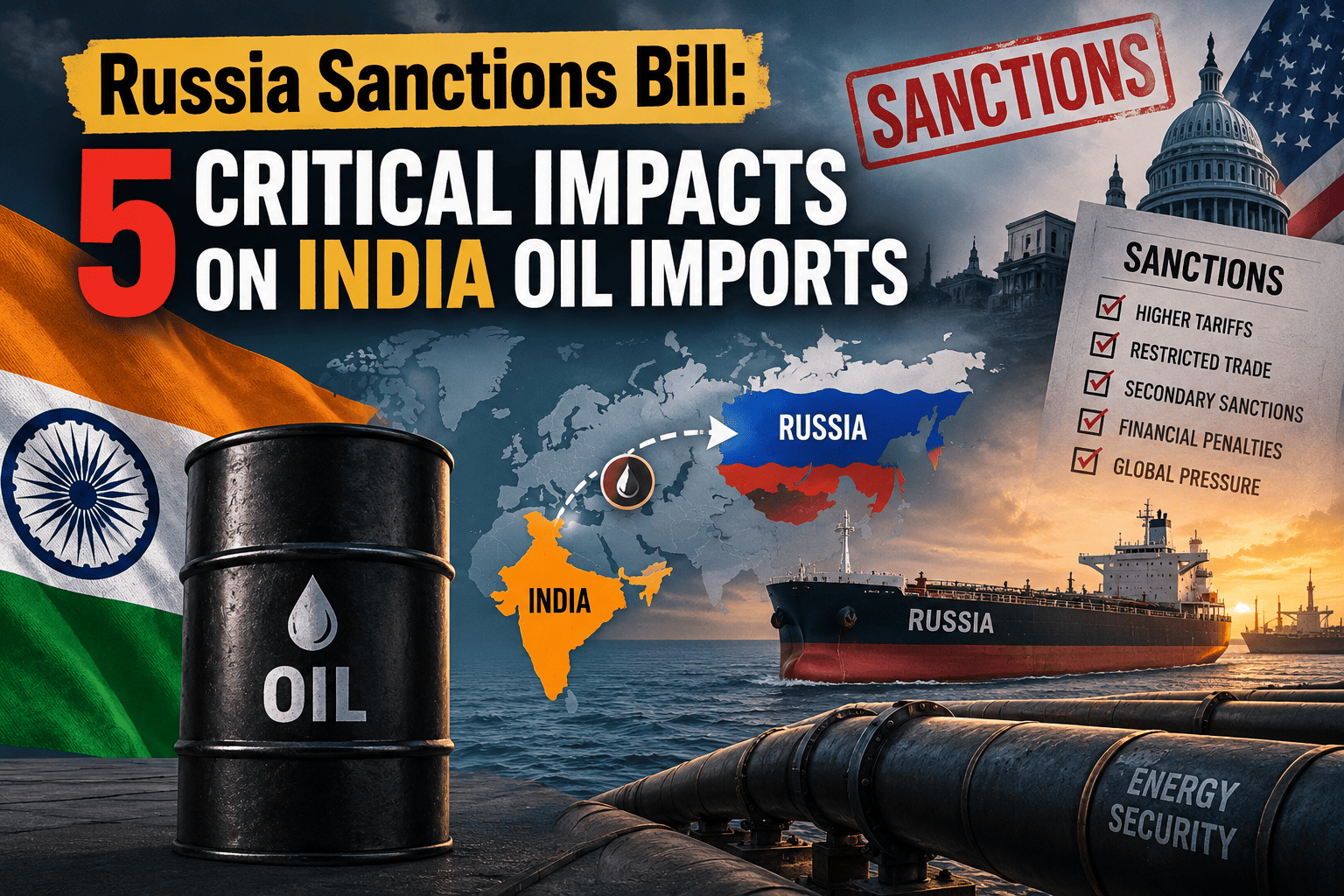


The Russia Sanctions Bill recently passed by the United States Senate with an overwhelming 86-11 vote has sent shockwaves across international trade routes, energy markets, and global diplomatic channels. Officially titled the Lindsey O. Graham Sanctioning Russia and Iran Act of 2026, this aggressive piece of trade legislation equips the US executive branch with discretionary authority to impose secondary tariffs of up to 100% on nations that purchase crude oil and natural gas from the Russian Federation.
Because India relies heavily on discounted Russian crude oil to satisfy its vast domestic energy requirements, the potential enforcement of the Russia Sanctions Bill presents critical economic, operational, and diplomatic challenges for New Delhi. As the bill moves to the US House of Representatives, Indian refiners, policymakers, and market analysts are evaluating what secondary trade penalties could mean for India’s domestic inflation, export competitiveness, and broader geopolitical standing.
What Is the Russia Sanctions Bill?
The Russia Sanctions Bill is designed to cut off foreign revenue streams used by Moscow to fund military operations by targeting foreign trading partners that continue purchasing Russian energy products. Under its statutory framework, the bill targets three specific categories of international trade actors:
-
Top Crude Importers: The top five global buyers of Russian crude oil by volume over a 12-month period.
-
Top Natural Gas Buyers: The top five global buyers of Russian natural gas over the preceding 12 months.
-
Sanctions Evasion Networks: Nations or commercial entities found knowingly facilitating the bypass of existing energy sanctions or dark-fleet maritime oil shipments.
According to initial policy assessments, the primary crude oil purchasing nations exposed to 100% tariff penalties under the Russia Sanctions Bill include China, India, Slovakia, Hungary, and Azerbaijan.
Detailed Breakdown of the Russia Sanctions Bill Provisions
To understand the scope of the Russia Sanctions Bill, it helps to analyze its core operational parameters:
| Legislation Metric | Statutory Provision & Detail |
| Official Title | Lindsey O. Graham Sanctioning Russia and Iran Act of 2026 |
| US Senate Vote | Passed 86-11 on August 7, 2026 |
| Maximum Penalty | Up to 100% secondary tariffs on all goods exported to the US |
| Enforcement Review | US Trade Representative recalculates top importers every 180 days |
| Primary Target Nations | China, India, Slovakia, Hungary, and Azerbaijan |
| Current Status | Pending consideration in the US House of Representatives |
The legislation grants authority to the Executive Branch to re-rank top importers every six months. This creates a long-term regulatory shadow over nations sourcing energy from Russia.
Why India Is Directly Exposed to the Russia Sanctions Bill
Since 2022, India’s energy procurement strategy has shifted toward discounted Russian crude oil. Previously accounting for less than 1% of India’s total energy import basket, Russian petroleum quickly expanded to represent between 30% and 50% of monthly imports.
Indian state-owned refiners—such as Indian Oil Corporation (IOCL), Bharat Petroleum Corporation Limited (BPCL), and Hindustan Petroleum Corporation Limited (HPCL)—alongside private refiners like Reliance Industries and Nayara Energy, capitalized on discounted Urals crude to stabilize domestic fuel prices and refine petroleum products for domestic consumption and global export.
However, this high volume of imports places India near the top of the target list under the Russia Sanctions Bill. Because the legislation evaluates the preceding 12-month period, India’s historical crude import volumes automatically place it within the top five global buyers.
The Economic Risks Facing India Under the Russia Sanctions Bill
If the Russia Sanctions Bill passes the US House of Representatives and receives presidential signature without explicit exemptions for New Delhi, the economic ramifications could ripple across multiple sectors.
1. Severe Tariff Pressure on Indian Exports
The United States remains one of India’s largest export markets. If secondary tariffs of up to 100% are applied to goods originating from India, key labor-intensive export sectors would suffer immediate margin erosion. Sectors most vulnerable to trade disruptions under the Russia Sanctions Bill include:
-
Textiles and Garments: Highly price-sensitive export items facing intense competition from Vietnam and Bangladesh.
-
Engineering Goods and Auto Components: Precision manufacturing exports supplied to American supply chains.
-
Pharmaceuticals: Generic medicine exports that keep healthcare costs manageable in Western markets.
-
IT Services and Tech Exports: Potential cross-border trade friction impacting broader bilateral services trade.
2. Spiking Domestic Fuel Inflation and Energy Bills
Discounted Russian crude oil has saved India billions of dollars in foreign exchange reserves over recent years. If Indian refiners are forced to halt Russian imports within the 30-day window mandated by the Russia Sanctions Bill, they will be forced to compete on the global spot market for Middle Eastern, West African, or American crude.
This sudden demand pivot would drive up global spot prices, raising India’s national energy import bill and putting upward pressure on domestic retail petrol and diesel prices.
3. Supply Chain Bottlenecks for Refiners
Indian refining facilities have calibrated their processing units to optimize heavy and medium sour crude grades like Russian Urals. Abruptly re-routing tankers and modifying refinery blends to comply with the Russia Sanctions Bill within 30 days would create severe operational and logistical bottlenecks for major domestic oil companies.
Detailed Sectoral Impact Analysis
┌─────────────────────────────────────────────────────────────┐
│             RUSSIA SANCTIONS BILL: SECTOR IMPACT            │
├────────────────────────────┬────────────────────────────────┤
│ Target Metric              │ Projected Sector Impact        │
├────────────────────────────┼────────────────────────────────┤
│ Indian Energy Imports      │ $40B+ Crude Procurement Risk   │
│ Domestic Refiners          │ High Supply Re-alignment Costs │
│ US-Bound Product Exports   │ 100% Potential Tariff Barrier  │
│ Consumer Inflation Index   │ High Risk via Fuel Price Rise  │
└────────────────────────────┴────────────────────────────────┘
The combination of higher crude acquisition costs and lower export competitiveness presents a structural challenge for Indian macro-economic stability under the Russia Sanctions Bill.
India’s Diplomatic and Geopolitical Stance
Indian policymakers have maintained a consistent stance regarding foreign trade restrictions and energy procurement strategies. External Affairs Minister S. Jaishankar has repeatedly stated that securing affordable energy for a population of 1.4 billion people is an essential national duty.
Key arguments put forward by Indian diplomats and policy experts include:
-
Market Stabilization Role: By absorbing Russian crude that was diverted away from Western markets, India prevented global oil prices from surging past $120 per barrel.
-
Sanctions Compliance: Indian oil marketing companies maintain that all energy transactions have been conducted without violating price caps or international legal sanctions.
-
Strategic Autonomy: India maintains a non-aligned foreign policy and resists external economic mandates that compromise domestic security or welfare.
Comparing Past Sanctions Regimes with the Russia Sanctions Bill
To understand how the Russia Sanctions Bill differs from previous foreign policy tools, it helps to review past US trade legislation:
| Legislative Framework | Core Focus | Executive Waiver Rules | Primary Impact on India |
| CAATSA (2017) | Defense & Intelligence Sector Sanctions | Strict 180-day review cycles required | Created friction over S-400 defense systems |
| Iran Energy Sanctions (2018) | Zero-tolerance policy on Iranian crude | Temporary SRE exemptions issued then revoked | Forced India to halt Iranian crude imports |
| Russia Sanctions Bill (2026) | Top 5 importers of Russian energy | Flexible Presidential Waiver retained | Potential 100% secondary tariffs on exports |
Unlike earlier frameworks, the Russia Sanctions Bill combines secondary trade tariffs with flexible presidential waiver authority, turning trade access into direct diplomatic leverage.
Strategic Alternatives for Indian Refiners
If the Russia Sanctions Bill is enacted into law without national interest waivers for India, domestic energy firms will likely pursue several risk-mitigation strategies:
Diversification of Crude Origins
Indian state refiners are already rebuilding long-term contract relationships with traditional suppliers across the Middle East, including Saudi Aramco, Iraq’s SOMO, and the UAE’s ADNOC. Additionally, imports of West African and Latin American crude grades could be scaled up.
Strategic Sourcing of US Energy Supplies
To offset trade imbalances and reduce tariff risks under the Russia Sanctions Bill, Indian energy firms may increase long-term procurement of American Liquefied Natural Gas (LNG) and West Texas Intermediate (WTI) crude oil.
Domestic Refining Blend Adjustments
Engineers at major Indian refineries are testing alternative crude slates to ensure that replacing Russian Urals with lighter or heavier alternatives does not diminish refined product yields or damage processing infrastructure.
Legislative Horizon: What Happens Next in Washington?
While the Senate passed the Russia Sanctions Bill with a clear majority, the legislation must complete several additional procedural steps before becoming law:
-
House of Representatives Consideration: The bill must be introduced, debated, and voted on in the US House.
-
Harmonization and Amendments: Any structural amendments made by House committees must be reconciled with the Senate-passed draft.
-
Presidential Approval: The finalized bill requires executive signature to take effect.
Procedural debates regarding potential global energy price spikes could slow down immediate adoption in the House. This legislative window provides time for Indian diplomats and commercial entities to engage with Washington, highlight supply-chain realities, and advocate for presidential waiver provisions.
Navigating Uncertainty Under the Russia Sanctions Bill
The Russia Sanctions Bill underscores the evolving intersection of energy security, trade policy, and global geopolitics. While the threat of 100% secondary tariffs creates genuine economic uncertainty for Indian exporters and energy refiners, India’s strategic positioning, large domestic market, and diplomatic leverage provide crucial buffer options.
Whether through diplomatic waivers, diversified energy sourcing, or bilateral trade compromises, India’s response to the Russia Sanctions Bill will shape its economic and energy strategy for years to come.