
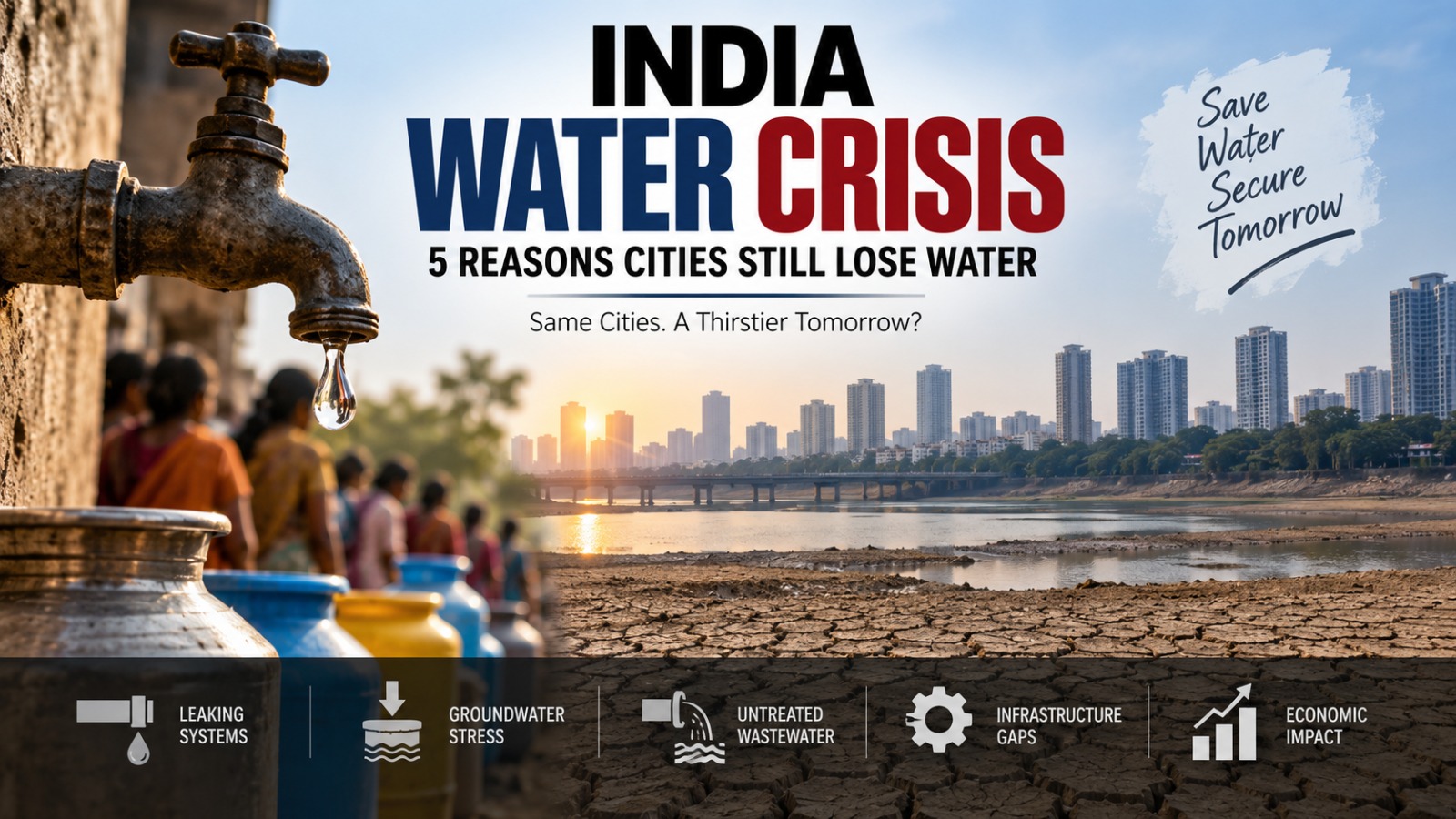
India Water Crisis: 5 Reasons Cities Still Lose Water
India’s water crisis is often presented as a simple question: Does India have enough water?
The reality is much more complicated.


India has made major investments in drinking-water supply, sewage systems and urban infrastructure. Yet many cities continue to face unreliable supply, groundwater stress, leaking distribution networks and growing wastewater problems.
The bigger question is no longer just how much water India has.
It is how efficiently we manage the water we already have.
India’s water challenge is therefore not only an environmental issue. It is becoming an infrastructure, economic and public-management issue that affects households, farmers, businesses and entire cities.
So why do Indian cities still struggle with water?
Here are five reasons.
1. Indian Cities Lose Water Before It Reaches Consumers
One of the least visible parts of India’s water crisis happens underground.
Water entering a city’s distribution network does not necessarily become water that reaches households. Some of it is lost through leaking pipelines, faulty connections, inaccurate meters, theft and water that is supplied but never properly accounted for.
This is known as Non-Revenue Water (NRW).
The issue has also been highlighted in recent parliamentary analysis of India’s urban water systems.
Earlier estimates have put urban water losses at extremely high levels, while more recent estimates have also shown that a significant share of water can still be lost before reaching consumers.
Think about what that means.
A city can spend money bringing water into its system, treat that water and pump it through kilometres of pipelines — and still lose a significant amount before it reaches the consumer.
That makes leakage reduction one of the most important and least visible parts of solving the water crisis.
Better metering, regular maintenance, pressure management and faster detection of leaks can help cities recover water without finding an entirely new source.
The question is not only how much water a city has.
It is how much of that water actually reaches the person who needs it.
2. Groundwater Is Under Growing Pressure
When surface water becomes unreliable, groundwater becomes the backup.
For millions of households, farmers and businesses, groundwater is essential for everyday life and economic activity. But groundwater is not an unlimited underground reservoir that can simply be pumped whenever demand increases.
India’s groundwater resources are under increasing pressure, with groundwater extraction varying significantly across regions.
The national average can also hide serious local problems.
Some areas have abundant groundwater, while others are already experiencing declining water tables and increasing dependence on deeper extraction.
Groundwater is not used only for drinking.
Agriculture accounts for the overwhelming majority of groundwater use, while cities, industries and households also depend on it.
If groundwater continues to be treated as an unlimited backup supply, today’s water shortage can become tomorrow’s water emergency.
The challenge is therefore not simply to extract groundwater when needed, but to ensure that extraction remains sustainable.
3. We Generate Wastewater — Then Struggle to Treat It
There is another side of India’s water crisis that receives far less attention.
India does not simply run out of water.
We also turn large quantities of freshwater into wastewater — and then struggle to treat and reuse it.
Indian cities generate enormous quantities of sewage every day, yet treatment capacity and actual utilisation remain uneven.
That creates a strange contradiction.
Cities are searching for more sources of freshwater.
At the same time, huge quantities of wastewater are being generated every day.
Instead of treating wastewater simply as something that needs to be disposed of, India could increasingly treat it as a resource.
After proper treatment, recycled water can be used for several non-drinking purposes, including industrial applications, landscaping, construction and other activities.
The principle is simple:
Use → Treat → Reuse → Use again.
If cities can safely reuse more wastewater, the pressure on freshwater sources can also be reduced.
4. Building Water Infrastructure Does Not Guarantee Reliable Water
India has made substantial investments in water infrastructure, but recent problems with urban housing and infrastructure have shown how quickly gaps in regulation and maintenance can affect people’s safety.
But there is an important difference between building infrastructure and delivering a reliable service.
A pipeline reaching a neighbourhood does not automatically mean residents receive water reliably every day.
A treatment plant can exist without operating at its full capacity.
A city can have an extensive pipeline network and still lose water through leakage.
And a sewage-treatment plant can be built without solving the larger problem if the wastewater never reaches the plant or the treated water is not reused.
This distinction matters because the success of a water system should ultimately be measured by the service people receive.
Is the water available when people need it?
Is the supply reliable?
Is the water safe?
Is the system sustainable?
India’s next water challenge may therefore be less about simply building more infrastructure and more about making existing infrastructure work better.
5. India’s Water Crisis Is Becoming an Economic Problem
Water is usually discussed as an environmental issue.
But water is also an economic input.
Just as India’s employment challenge cannot be understood only by counting degrees, its water challenge cannot be understood only by counting infrastructure.
Farmers need it to grow food.
Factories need it for production.
Cities need it for households, construction, sanitation and services.
Businesses need reliable water systems to operate.
When water becomes unreliable, the economic consequences can appear in places that are not immediately associated with the water crisis.
A farmer may face lower productivity.
A business may have to purchase water privately.
A household may spend additional money securing water.
An industry may face restrictions on production.
A city may have to spend more money transporting water from distant sources.
The cost of poor water management therefore does not always appear as one large number.
Sometimes it appears as higher costs.
Sometimes as lost productivity.
Sometimes as lost working hours.
And sometimes as an additional burden on ordinary households.
This is why India’s water crisis should not be treated only as an environmental story.
It is also an economic story.
India’s Water Problem Is Not Simply a Shortage
It would be easy to look at India’s water challenges and conclude that the country simply does not have enough water.
But the reality is more complicated.
India faces major differences in water availability across regions, seasons and sectors.
Some areas experience severe shortages.
Others experience flooding during periods of heavy rainfall.
Some cities struggle to secure drinking water while simultaneously dealing with untreated wastewater.
Some regions depend heavily on groundwater while others have significant surface-water resources.
The country therefore faces several water problems at the same time:
Too little water in some places.
Too much water in others.
Water lost through inefficient distribution.
Groundwater under pressure.
And wastewater that is not being fully treated and reused.
That means the India water crisis is fundamentally a water-management crisis as well as a water-availability crisis.
What India Needs to Do Next
The solution cannot simply be to build more dams, pipelines or treatment plants.
India also needs to make the systems it already has more efficient.
That means reducing leakage and non-revenue water.
It means improving metering and monitoring.
It means maintaining pipelines instead of waiting for major failures.
It means protecting groundwater and improving recharge.
It means ensuring that sewage-treatment plants operate closer to their intended capacity.
And it means treating wastewater as a potential resource rather than simply as waste.
Cities also need better data.
Without knowing how much water is entering a city, how much is being consumed, how much is being lost, and how much wastewater is being generated and reused, it becomes difficult to manage the system effectively.
The direction is therefore clear.
India does not only need more water infrastructure.
It needs better water management.
The Bigger Question for India
India’s water crisis will not be solved by one government scheme, one city or one technology.
It requires a change in how we think about water.
Water cannot be treated as an unlimited resource that appears when a tap is opened and disappears when it goes down a drain.
Every litre has a cost.
It has to be extracted, transported, treated, distributed and eventually managed after use.
India has already invested heavily in expanding water infrastructure.
The next challenge is to make that infrastructure efficient, reliable and sustainable.
That means wasting less.
Measuring better.
Protecting groundwater.
Treating more wastewater.
And reusing water wherever it is safe and practical.
Because perhaps the most important question for India’s water future is not:
“Where will we find more water?”
It is: