
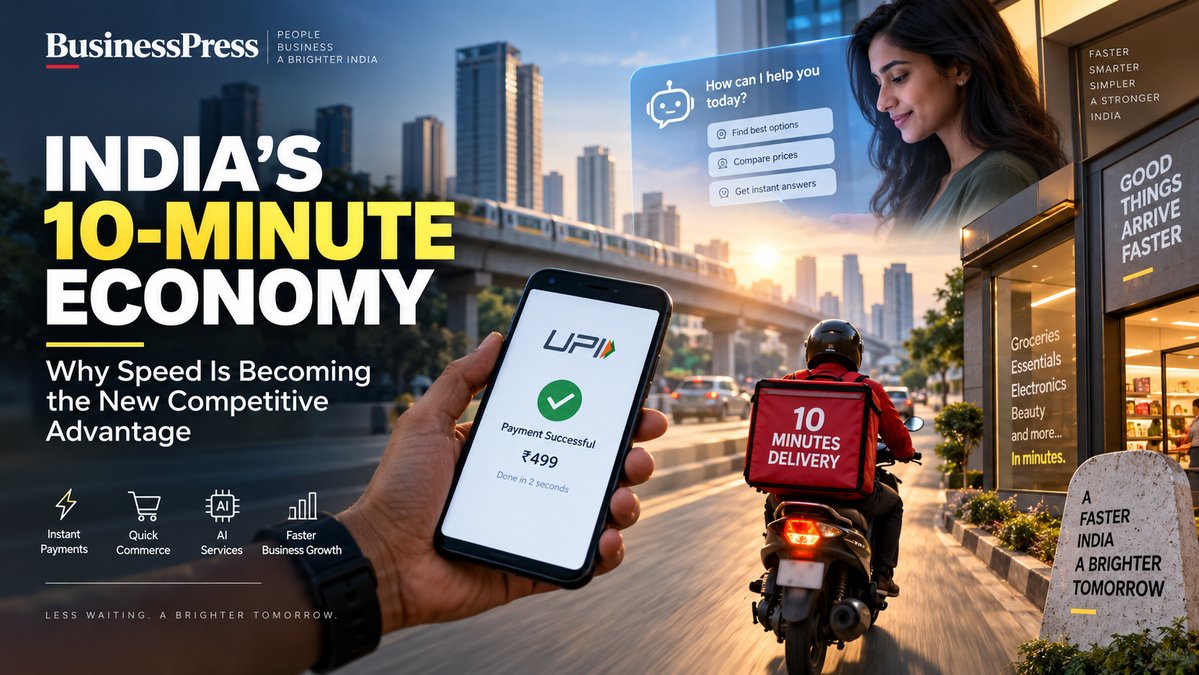
India is entering a new phase of consumer behaviour: the 10-minute economy. From instant digital payments and quick-commerce deliveries to AI-powered recommendations and faster customer service, waiting is becoming less acceptable.
Speed was once considered a premium feature. Today, it is increasingly becoming a basic expectation.


A customer who can send money instantly through UPI, order groceries in minutes and get an answer from an AI assistant within seconds naturally begins to expect the same level of convenience from other businesses. The result is a major shift in how companies compete.
The question is no longer simply, “What are you selling?”
Increasingly, it is:
“How quickly can you deliver the value?”
India Is Learning Not to Wait
For decades, businesses competed mainly on price, product quality, location and customer service. Speed mattered, but it was rarely the central selling point.
That has changed.
India’s digital infrastructure has created an environment where transactions that once took hours or days can now happen almost instantly. A payment can be completed in seconds. A product can arrive within minutes. A customer can compare products without visiting multiple stores. An AI tool can summarise information or generate a response almost immediately.
This has quietly changed consumer expectations.
The modern customer does not necessarily want to spend more time navigating a business. They want the business to remove unnecessary steps.
That is the foundation of the 10-minute economy.
It does not literally mean that every product or service needs to arrive within ten minutes. Instead, it represents a broader shift toward instant gratification, low friction and faster decision-making.
The businesses benefiting from this shift understand one important principle: customers increasingly value the time saved as much as the product itself.
The 10-Minute Economy Is Already Here
The idea of instant commerce is most visible in India’s quick-commerce market.
Platforms have trained consumers to think differently about everyday purchases. Instead of planning groceries several days in advance, consumers can increasingly order what they need when they need it.
This has changed more than delivery.
It has changed purchasing behaviour.
A customer who knows that a missing ingredient can be delivered quickly may be less likely to plan a large weekly shopping trip. A customer who can receive personal-care products, electronics accessories or household items rapidly may also become more comfortable making smaller, more frequent purchases.
According to a 2026 Google-Deloitte report, India’s e-commerce market is projected to reach around $250 billion by 2030, while quick commerce is projected to become a $50 billion market.
That growth suggests that speed is moving beyond being a convenience feature. It is becoming part of the business model itself.
And the impact will not be limited to groceries.
Beauty, fashion, electronics and other categories are increasingly being pulled into faster digital commerce models.
The competitive advantage is therefore shifting from simply having products available to being able to make those products available at the right moment.
UPI Changed What “Instant” Means
One of the biggest reasons Indian consumers have become comfortable with instant transactions is UPI.
Digital payments have fundamentally changed the meaning of convenience.
A customer no longer needs to carry cash, search for an ATM or wait for a bank transfer to clear. A payment can be completed in seconds using a smartphone.
The scale is enormous.
According to NPCI’s official statistics, UPI processed more than 22.7 billion transactions in June 2026, with transaction value of about ₹28.92 lakh crore.
The significance of UPI goes beyond payment volume.
It has trained an entire generation of consumers to expect digital interactions to be simple and immediate.
That expectation now extends beyond payments.
If transferring money takes seconds, customers may question why opening an account takes several days.
If ordering a product takes minutes, they may question why customer support takes hours to respond.
If information is instantly available online, they may question why a business website makes them search through multiple pages to find a simple answer.
In this way, instant payments have contributed to a much larger cultural shift: people are becoming less tolerant of unnecessary waiting.
Quick Commerce Turned Speed Into a Product
The rise of quick commerce demonstrates perhaps the clearest example of speed becoming a product.
Traditionally, delivery was considered a service attached to a purchase.
Today, delivery itself can influence the purchase decision.
Imagine two businesses selling a similar product at a similar price. One can deliver it tomorrow. The other can deliver it within minutes.
For an increasingly time-conscious customer, the second business may have a significant advantage.
This is why quick commerce is forcing companies to rethink inventory, warehousing, logistics and even product selection.
Speed requires products to be closer to customers.
It requires better forecasting.
It requires technology that can predict demand and manage inventory.
And it requires logistics networks capable of handling thousands of small orders efficiently.
The business challenge is therefore much bigger than simply hiring more delivery workers.
Behind a ten-minute delivery promise is a complex system involving technology, inventory management, data, fulfilment centres and last-mile logistics.
The faster the customer experience becomes, the more sophisticated the business infrastructure needs to be.
The Consumer Is No Longer Online or Offline
Another important change is the disappearance of the traditional divide between online and offline shopping.
Consumers increasingly move between channels without thinking about the distinction.
A customer may discover a product on Instagram, research it on Google, watch a review on YouTube, compare prices on an e-commerce platform, visit a physical store and finally complete the purchase through a mobile phone.
The journey is no longer linear.
This creates a new challenge for businesses.
Customers expect the same information, pricing clarity and convenience across different touchpoints.
A website that is slow can damage the experience.
A confusing checkout process can cause abandonment.
A physical store that cannot provide basic digital information can lose customers to competitors.
The 10-minute economy therefore isn’t only about delivery speed. It is about reducing the amount of time customers spend moving from interest to decision to action.
The best businesses are beginning to compete across this entire journey.
AI Is Removing Another Kind of Waiting
Speed is also changing in an area that does not involve physical delivery: information.
Artificial intelligence is making it possible for customers to get answers, recommendations and assistance almost immediately.
Instead of browsing dozens of websites, a consumer can ask an AI system to compare options.
Instead of manually writing an email, a business employee can use AI to create a first draft.
Instead of spending hours analysing large amounts of information, teams can use AI tools to summarise and organise it.
This is creating another form of instant gratification.
The customer is not necessarily asking for a product in ten minutes.
They are asking for certainty in ten minutes.
That distinction is important.
The future of customer experience will increasingly depend on how quickly a business can help people understand what they need, make a decision and complete an action.
AI can shorten each of these stages.
This is one reason Deloitte and Google describe India’s next phase of commerce around four forces: inspired, immersive, instant and intelligent.
The combination of AI, digital platforms and fast fulfilment could make the traditional shopping funnel much less linear.
But Faster Doesn’t Always Mean Better
There is an important limitation to the speed economy.
Faster is not automatically better.
A business that promises ten-minute delivery but provides poor product quality will eventually lose trust.
An AI system that provides an instant but inaccurate answer can create more problems than it solves.
A website that makes checkout extremely fast but hides important information can frustrate customers.
Speed works when it is combined with quality, reliability and trust.
This is especially important as businesses compete to remove friction.
Consumers may want convenience, but they also want transparency. They want to know what they are buying, how much it costs, when it will arrive and what happens if something goes wrong.
The next stage of India’s digital economy will therefore not simply be about becoming faster.
It will be about becoming faster without becoming careless.
What Businesses Need to Learn From the 10-Minute Economy
The rise of the 10-minute economy offers several lessons for businesses across industries.
1. Find the waiting time in your customer journey
Every business has friction.
It could be a slow website, a complicated form, delayed customer support, unclear pricing or a lengthy purchase process.
Companies should identify where customers are forced to wait and ask whether that waiting is genuinely necessary.
Removing one unnecessary step can sometimes create more value than adding another feature.
2. Make speed part of the product experience
Speed should not be treated only as an operational metric.
It can become part of the value proposition.
For one company, that could mean faster delivery.
For another, it could mean instant quotations.
For a software company, it could mean faster onboarding.
For a financial service, it could mean quicker approvals.
The definition of speed will differ by industry, but the underlying principle remains the same: reduce the distance between a customer’s need and the solution.
3. Use technology to remove repetitive delays
Automation and AI can help businesses eliminate tasks that previously consumed employee time.
Customer queries can be handled faster.
Documents can be processed automatically.
Leads can be qualified more efficiently.
Reports can be generated faster.
Recommendations can become more personalised.
The goal should not be to automate everything simply because technology makes it possible.
The goal should be to use technology where it genuinely improves the customer and employee experience.
4. Don’t sacrifice trust for speed
A fast experience that customers do not trust has limited value.
Businesses need clear pricing, secure payments, accurate information and reliable service.
As transactions become faster, trust becomes even more important because customers have less time to think before acting.
The strongest companies will combine speed with transparency rather than treating them as competing priorities.
The Future May Belong to Businesses That Remove Friction
India’s consumer economy is moving toward a world where convenience is no longer a luxury.
It is becoming an expectation.
UPI has made instant payments normal. Quick commerce has made rapid delivery increasingly familiar. E-commerce has made product discovery easier. AI is reducing the time required to search, compare and make decisions.
Together, these changes are creating the 10-minute economy.
But the biggest opportunity for businesses is not to obsess over the number ten.
It is to understand what the number represents.
It represents a customer who values time.
It represents a consumer who expects technology to work in the background rather than create additional effort.
And it represents a competitive environment where companies that remove friction can gain an advantage over companies that make customers work harder.
The next generation of successful businesses may therefore not be the ones that simply offer the cheapest product or the largest selection.
They may be the ones that make the entire experience feel effortless.
Because in a market where almost everything is becoming faster, saving customers time may become one of the most valuable products a business can offer.