
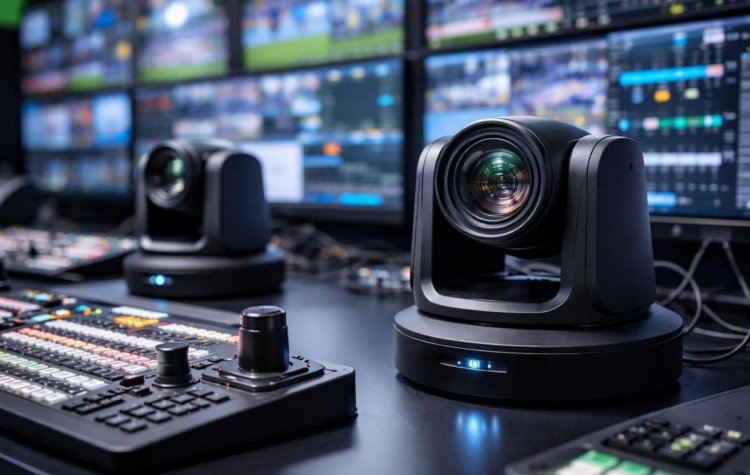
In a significant development for the global media technology industry, Canon Inc. and Ross Video have announced a strategic partnership to deliver next-generation broadcast-grade AI PTZ Cameras (pan-tilt-zoom) systems. The collaboration, unveiled on April 20, 2026, aims to integrate advanced imaging capabilities with automation, robotics, and AI-driven production workflows, reflecting the rapidly evolving demands of modern content creation environments.
The partnership comes at a time when the global broadcast industry is undergoing a structural transformation. With audiences consuming content across multiple platforms and formats, production teams are under pressure to deliver high-quality visuals with greater efficiency and reduced operational complexity. Canon and Ross Video’s joint initiative seeks to address these challenges by combining their respective strengths—Canon’s expertise in imaging and Ross Video’s leadership in live production systems.


At its core, the collaboration signals a broader industry shift toward automation and intelligent production ecosystems. By enabling seamless integration between AI PTZ Cameras, robotics, and control systems, the partnership aims to redefine how live events, sports broadcasts, and digital content are produced. This move is expected to have far-reaching implications for broadcasters, production houses, and content creators worldwide.
Strategic Collaboration and Technology Integration
The partnership between Canon and Ross Video is built on the integration of Canon’s professional AI PTZ Cameras lineup—particularly the CR-N700 and CR-N500 models with Ross Video’s advanced production platforms. These cameras can now be deployed directly within Ross Video’s workflows, including systems such as DashBoard, OverDrive, Ross Robotics, Vision[Ai]ry, and Quorum.
This integration enables broadcasters to operate AI PTZ Cameras remotely while maintaining full control over production processes. By combining imaging technology with robotics and automation, the solution allows for smoother camera movements, precise framing, and consistent output quality. The result is a streamlined production environment that reduces manual intervention and enhances operational efficiency.
According to Gina Witzke, Product Manager at Ross Video, the collaboration delivers a “broadcast-ready AI PTZ Cameras solution built for modern production environments.” This statement underscores the partnership’s focus on addressing the needs of contemporary broadcasters, who require flexible and scalable solutions capable of adapting to rapidly changing production demands.
Advanced Features and Technical Capabilities
The AI PTZ Cameras systems developed under this partnership incorporate a range of advanced technical features designed for high-end broadcast applications. Canon’s CR-N700 and CR-N500 cameras offer 4K output, a 1-inch sensor, optical image stabilization, and support for multiple connectivity standards including NDI and 12G-SDI. These capabilities ensure that the AI PTZ Cameras can deliver high-quality visuals across a variety of production scenarios.
One of the most notable features is the integration of tracking data and AI-assisted functionalities, such as FreeD tracking for augmented and virtual reality production. This allows broadcasters to create immersive visual experiences by synchronizing camera movements with digital elements in real time. The inclusion of AI-driven workflows further enhances the system’s ability to automate complex production tasks.
Additionally, the AI PTZ Cameras
support remote operation and multi-camera management, enabling production teams to control multiple units simultaneously from a centralized interface. This capability is particularly valuable in large-scale productions, where coordination between multiple camera angles is critical. By simplifying these processes, the partnership aims to reduce production costs while maintaining high standards of quality.
Industry Context and NAB Show 2026 Launch
The announcement of the Canon–Ross Video partnership coincides with the 2026 NAB Show in Las Vegas, one of the world’s leading events for media, entertainment, and technology. The companies are showcasing their integrated AI PTZ Cameras solutions at the event, providing industry professionals with a firsthand look at the capabilities of the new system.
The timing of the launch is significant, as the NAB Show serves as a platform for unveiling cutting-edge innovations in broadcast technology. With over 1,100 exhibitors and participants from more than 18,000 companies, the event highlights the scale and competitiveness of the industry. The presence of Canon and Ross Video at this event underscores the importance of their collaboration within the broader technological landscape.
Industry trends showcased at NAB 2026 indicate a growing emphasis on AI, cloud-based workflows, and integrated production ecosystems. The Canon–Ross partnership aligns closely with these trends, positioning both companies at the forefront of innovation. By addressing key industry challenges such as workflow complexity and resource constraints, the collaboration is expected to attract significant interest from broadcasters and production companies.
Business Impact and Market Implications
The partnership between Canon and Ross Video has important implications for the global broadcast and media technology market. By combining hardware and software capabilities into a unified solution, the companies are offering a value proposition that addresses both technical and operational challenges. This integrated approach is likely to enhance competitiveness and drive adoption across various segments of the industry.
For broadcasters, the ability to deploy high-quality AI PTZ Cameras within automated workflows represents a significant advantage. It enables them to produce content more efficiently while maintaining professional standards. This is particularly relevant in an era where content demand is increasing and production timelines are becoming more compressed.
From a market perspective, the collaboration reflects a broader shift toward end-to-end production ecosystems. Companies are increasingly focusing on providing comprehensive solutions that integrate multiple components of the production process. This trend is expected to reshape the competitive landscape, encouraging further partnerships and innovation within the industry.
Outlook
The Canon–Ross Video partnership marks a pivotal moment in the evolution of broadcast technology. By integrating advanced imaging systems with AI-driven workflows and robotics, the collaboration sets a new benchmark for modern video production. The initiative not only addresses current industry challenges but also anticipates future demands, positioning both companies as leaders in the next phase of technological innovation.
Looking ahead, the success of this partnership will depend on its ability to deliver tangible benefits to users, including improved efficiency, reduced costs, and enhanced creative capabilities. As the media industry continues to evolve, solutions that combine flexibility, scalability, and intelligence are likely to gain widespread adoption.
In a broader context, the collaboration highlights the growing importance of convergence between hardware, software, and artificial intelligence. As these elements become increasingly interconnected, the boundaries between traditional broadcast systems and digital production environments will continue to blur. The Canon–Ross Video partnership is a clear indication that the future of media production lies in integrated, intelligent, and adaptive ecosystems.