
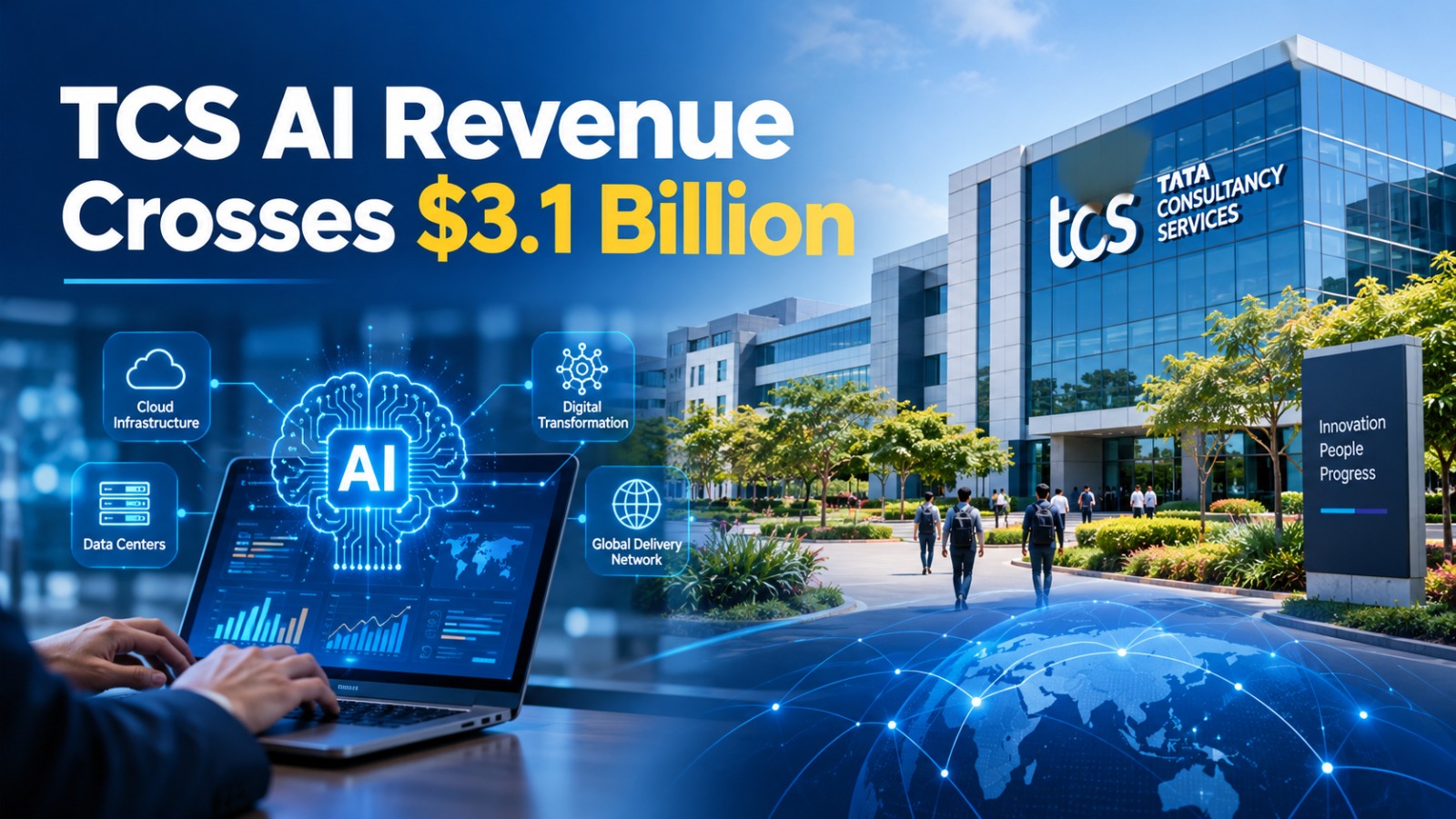
TCS AI revenue has emerged as a key indicator of the growing commercial importance of artificial intelligence in India’s technology services industry. Tata Consultancy Services (TCS), one of India’s largest IT services companies, is expanding its AI business while working to maintain profitability amid changing client demand and increasing investments in emerging technologies.
In a development reported on October 9, 2026, TCS shares gained as much as 6.2% after investors responded positively to the company’s ability to maintain operating margins despite rising investments in artificial intelligence. The development highlights the importance of balancing technology spending with sustainable financial performance.


TCS AI Revenue Highlights Growing Enterprise Demand
TCS’s annualised artificial intelligence revenue reached approximately $3.1 billion, reflecting nearly 20% quarter-on-quarter growth. This performance points to growing demand for AI-related services as businesses explore ways to improve productivity, automate operations and modernise their digital infrastructure.
Artificial intelligence is becoming an increasingly important part of enterprise technology spending. Companies across industries are exploring AI applications in customer service, software development, data analytics, business process automation and decision-making.
For technology service providers such as TCS, this shift creates opportunities to develop new solutions, support AI implementation and help businesses integrate advanced technologies into existing systems.
TCS Maintains Operating Margins Amid AI Investments
One of the most significant aspects of the latest development is TCS’s ability to maintain operating margins at approximately 24%, despite increasing investment in artificial intelligence.
Technology companies are under pressure to invest in AI infrastructure, employee training, research and development, and new service offerings. At the same time, clients are increasingly looking for measurable business outcomes and greater efficiency from their technology partners.
Maintaining profitability while funding these investments is becoming an important challenge for IT service providers. TCS’s reported margin stability helped strengthen investor confidence, although future performance will depend on demand, project execution and the company’s ability to turn AI opportunities into sustainable revenue.
Why Artificial Intelligence Is Reshaping India’s IT Industry
The growing adoption of artificial intelligence is changing how technology companies deliver services and generate revenue. Traditional IT outsourcing models often rely on employee hours and long-term service contracts. AI-powered tools can automate certain tasks, potentially reducing the time required to complete projects.
While this can create pricing pressure for conventional services, it also opens opportunities in AI consulting, enterprise automation, cloud modernisation, data engineering and customised AI solutions.
Indian IT companies are therefore working to adapt their business models to meet changing client expectations. Businesses that can combine technical expertise with industry knowledge and measurable outcomes may be better positioned to benefit from this transition.
However, the financial benefits of AI adoption are not guaranteed. Companies must demonstrate that new AI services generate sufficient revenue and productivity gains to justify the investments required.
What TCS’s AI Growth Means for Businesses
The expansion of TCS’s AI business reflects a wider shift in corporate technology strategy. Businesses are moving beyond experimenting with AI and increasingly evaluating how it can support practical operational improvements.
For startups and small businesses, this trend offers opportunities to adopt AI-powered customer support, marketing automation, predictive analytics and workflow management tools. These technologies may help organisations improve efficiency without expanding their teams at the same rate as their operations.
At the same time, companies need to consider implementation costs, data security, employee training and the reliability of AI-generated outputs before adopting new solutions.
The broader lesson is that successful AI adoption requires more than purchasing technology. Businesses must identify specific problems, establish measurable objectives and evaluate whether AI solutions deliver meaningful results.
Outlook for India’s Technology Services Sector
TCS’s latest performance highlights the growing importance of AI in the future of India’s IT services industry. Strong demand for AI-related solutions could create new growth opportunities, but technology companies will also face challenges involving pricing pressure, changing client budgets and the need for continuous investment.
Investors will continue to assess whether companies can convert AI demand into consistent revenue growth while protecting profitability. The pace of enterprise adoption, the scale of new contracts and the ability to deliver measurable results will remain important factors.
As artificial intelligence becomes more integrated into business operations, India’s IT sector is likely to experience further changes in service delivery, workforce requirements and competitive positioning.
Conclusion
TCS’s reported annualised AI revenue of $3.1 billion demonstrates the growing commercial significance of artificial intelligence in India’s technology industry. Its ability to maintain operating margins while investing in AI has attracted investor attention and highlights the importance of balancing innovation with financial discipline.
For businesses, startups and technology professionals, the development reinforces a broader message: AI is becoming an important part of business strategy, but long-term success will depend on how effectively organisations translate technological capabilities into practical value.
To Read More Such News Visit Business Press.