
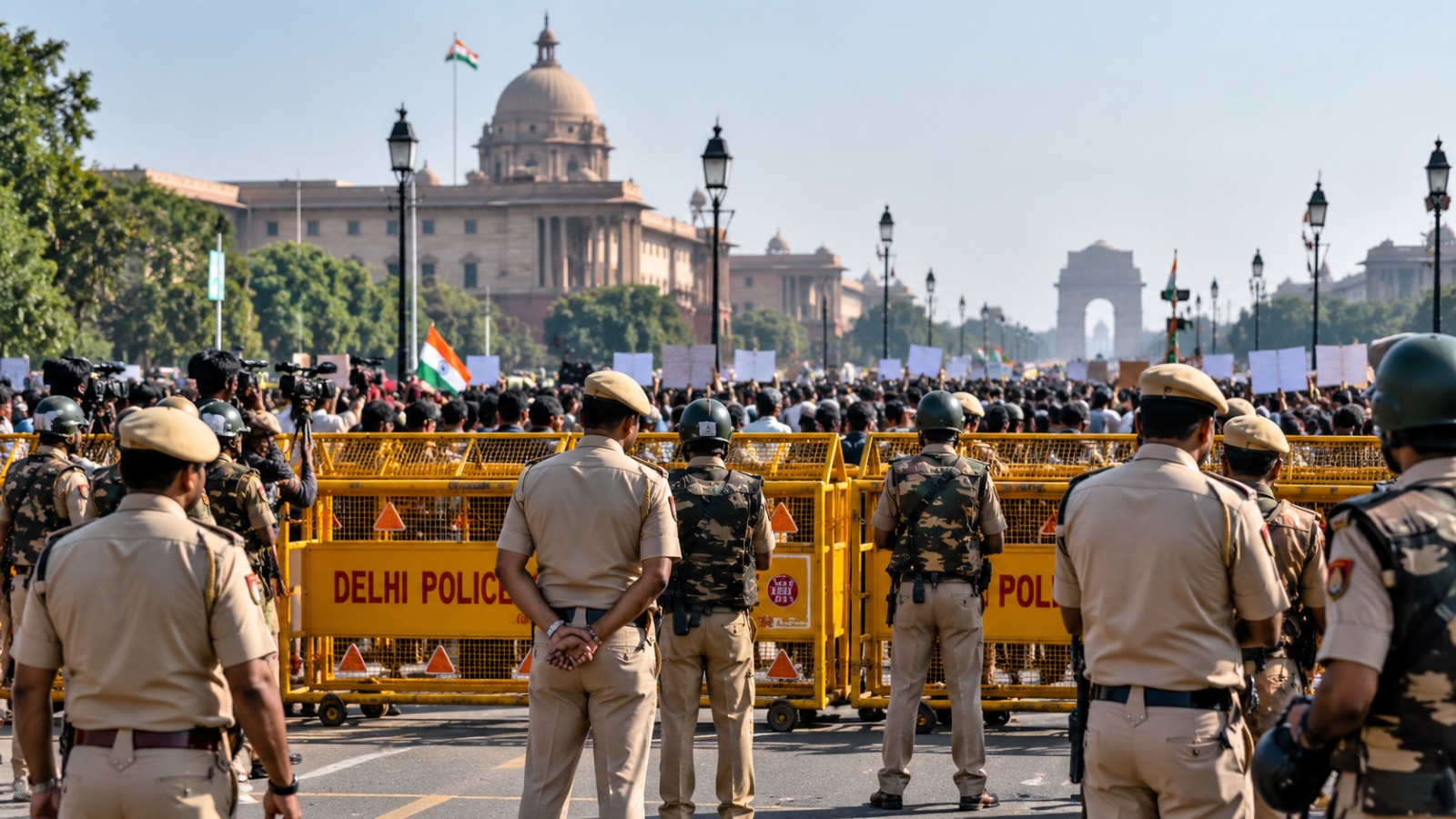
1. Why Are Delhi Protests Taking Place?
The latest Delhi protests centre on the Special Intensive Revision of electoral rolls and demands for the resignation of Chief Election Commissioner Gyanesh Kumar.
The demonstrations involve the youth-led Cockroach Janta Party (CJP), opposition leaders and other participants who have raised concerns about the voter-list revision process. Protesters allege that the exercise has unfairly affected sections of the electorate and question whether the process has been conducted impartially.


The Election Commission’s position differs from these allegations. The electoral authority has attributed deletions from voter lists to factors including deaths, migration and voters who could not be traced during verification. Critics, however, have called for greater scrutiny of the process and its consequences for eligible voters.
The dispute has developed into a wider political and administrative issue because electoral rolls determine who can participate in elections. Any concerns about incorrect deletions or missing names can therefore affect citizens’ ability to exercise their voting rights.
It is important to distinguish allegations made by protesters from established findings. Claims of politically motivated deletions remain disputed and should not be treated as proven without supporting evidence.
2. Police Detentions and Security Restrictions in Delhi
Security arrangements intensified in central Delhi ahead of the planned demonstrations on 10 October. Police and paramilitary personnel were deployed around protest locations, while barricades and restrictions were introduced in parts of the capital.
According to media reports, hundreds of people were detained during subsequent demonstrations, and restrictions were eased in some areas on 11 October. However, detentions continued during smaller gatherings.
The detentions became a major part of the dispute because lawyers and petitioners raised concerns about whether people were being detained outside areas covered by prohibitory orders.
Authorities are responsible for maintaining public order and preventing violence. At the same time, any detention must comply with applicable law and legal safeguards.
The precise number of people detained varies across reports and dates. Figures should therefore be attributed to the publication or authority reporting them rather than presented as a single confirmed total.
The issue is not limited to protesters themselves. Large security operations can also affect people travelling to work, attending classes, visiting government offices or attempting to reach hospitals and railway stations.
3. Supreme Court Issues Directions on Movement and Detentions
The Supreme Court became directly involved after petitions challenged restrictions imposed during the protests.
On 11 October, a special bench of Justices Joymalya Bagchi and V. Mohana addressed issues involving metro and railway operations, movement across Delhi and the detention of people attending peaceful gatherings.
According to media reports, the Court directed that metro and railway services should function normally, subject to lawful restrictions required to maintain public order. It also emphasised that people should be allowed to move freely, subject to traffic regulations, and that detentions must follow the procedure established by law.
The Court also addressed concerns about access to professional duties for lawyers and journalists.
These directions are significant because they concern the balance between maintaining public order and avoiding restrictions that unnecessarily interfere with everyday life.
The proceedings do not mean that every restriction imposed by authorities has automatically been declared unlawful. The legality of particular actions depends on the applicable orders, circumstances and the Court’s findings.
“Readers can consult the Supreme Court of India’s official website to check its latest orders and judicial updates.”
4. Delhi Metro Restrictions Affect Commuters
Public transport became one of the most visible aspects of the Delhi protests.
Authorities restricted access to several metro stations ahead of demonstrations, citing security considerations. These measures affected travel through central Delhi, where metro connections are used by office workers, students, visitors and people travelling between railway stations and other parts of the city.
The Supreme Court’s directions on 11 October called for normal metro and railway operations, subject to lawful measures necessary for public order. The issue remained relevant on Monday, 12 October, when the Delhi Metro Rail Corporation closed six central Delhi stations between 6 am and 4 pm in anticipation of a Congress-led march towards the Supreme Court, according to media reports.
The six stations reported closed were Janpath, Mandi House, Barakhamba Road, Central Secretariat, Rajiv Chowk and Patel Chowk. Interchange facilities remained operational, according to the reports.
The closures illustrate the difficulty of managing security around major demonstrations while maintaining access to public transport. Even temporary restrictions can create longer journeys, increase congestion and make it harder for commuters to reach workplaces or appointments.
For commuters, the practical lesson is to check official Delhi Metro Rail Corporation announcements and current traffic advisories before travelling through affected areas.
5. Opposition Leaders Plan a March to the Supreme Court
The protests also drew participation from opposition political leaders.
On 12 October, a Congress-led march was planned from the Connaught Place–Barakhamba Road junction towards the Supreme Court. The demonstration, described as “Chalo Dilli”, was intended to press demands concerning the Election Commission and Chief Election Commissioner Gyanesh Kumar.
The planned march added another development to the dispute, bringing opposition demands into the same public debate as the demonstrations organised by the Cockroach Janta Party and other groups. The route and nearby transport facilities required additional security arrangements.
The march was a political demonstration, and its demands should be understood as the position of the organisers rather than as a judicial finding against the Election Commission.
The controversy has also highlighted the different roles played by political parties, protest groups, the police and the judiciary. Political organisations can raise demands and organise demonstrations, police authorities are responsible for enforcing the law, and courts examine legal questions brought before them.
For the public, the immediate concerns include access to transport, safety around demonstration sites and clarity about restrictions affecting daily movement.
6. The Dispute Raises Questions About Electoral Rolls
The underlying disagreement concerns the Special Intensive Revision of electoral rolls.
“The controversy has also raised wider questions about the Election Commission’s handling of electoral-roll revisions and the objections surrounding the process.”
Electoral rolls contain the names of eligible voters and are essential to the conduct of elections. Revision exercises are intended to improve their accuracy, including by identifying deceased voters, duplicate entries and people who have moved away.
However, the deletion or omission of an eligible voter’s name can prevent that person from voting unless the error is corrected in time.
The current dispute has therefore raised questions about how deletions are verified, how voters are informed and what procedures are available when someone believes their name has been removed incorrectly.
The Election Commission has defended the revision process, while critics have questioned its implementation and demanded greater accountability. These competing positions should be assessed against official data, documented cases and the applicable electoral rules.
For ordinary voters, the practical concern is whether their own details are correct. Citizens should check their names in the official electoral roll, verify their polling information and follow the Election Commission’s procedures if they discover an error.
The Delhi protests also connect to a wider public-interest question: how can electoral authorities maintain accurate voter lists while ensuring that eligible citizens are not wrongly excluded?
The debate is likely to continue through political discussions, administrative reviews and legal proceedings.
7. What Happens Next in the Delhi Protests?
The situation remains a developing story, with legal proceedings, political demonstrations and security arrangements continuing to shape events.
The Supreme Court’s directions have placed public transport, freedom of movement and lawful detention at the centre of the immediate dispute. Further hearings and responses from the authorities may clarify the issues raised in the petitions.
Meanwhile, protest organisers and opposition leaders have indicated that they intend to continue raising their demands. The Election Commission’s handling of the electoral-roll revision will remain an important part of the wider debate.
The next developments to watch include any new court orders, official statements from Delhi Police and the Election Commission, changes to metro or road restrictions, and the publication of further information about detentions.
It is also important to establish whether restrictions announced for a particular day remain in effect. Security arrangements can change quickly, and reports about earlier closures should not be assumed to describe current conditions.
Readers should rely on current official travel advisories and verified news updates before making decisions about travel through central Delhi.
Conclusion
The Delhi protests have developed from demonstrations over the electoral-roll revision into a wider dispute involving police action, public transport, political accountability and access to peaceful assembly.
The Supreme Court’s directions on 11 October 2026 addressed the need for lawful detentions, movement across the capital and the normal functioning of essential transport services, subject to lawful public-order measures.
At the same time, the underlying disagreement over voter-list revisions remains contested. Protesters and opposition groups have raised allegations, while the Election Commission has defended the process.
For the public, the key issues are straightforward: eligible voters must be able to verify their registration, authorities must act within the law, and essential services should remain accessible wherever security conditions permit.
As the situation develops, further court proceedings and official statements will be important in establishing what happened, which restrictions were justified and how the dispute over electoral rolls will be addressed.