
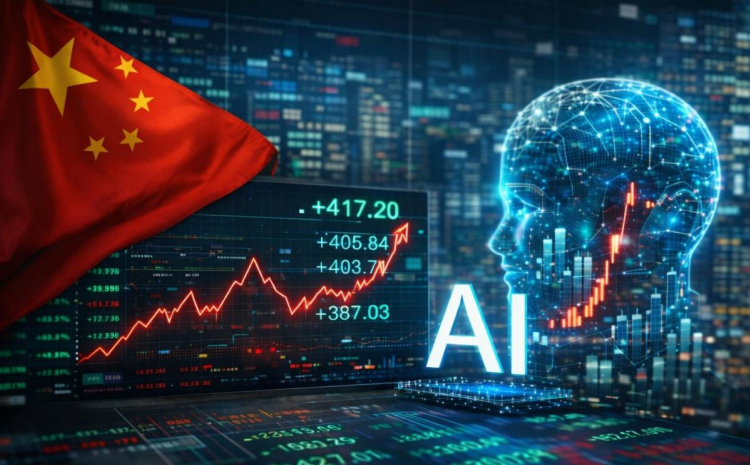
A striking divergence has emerged in global financial markets as Chinese AI companies continue to rally while U.S. and European software stocks tumble under what analysts are calling the “AI scare trade.” As fears spread across Western markets that generative China AI Stocks could cannibalise traditional software business models, investors have been aggressively selling off major tech names. In contrast, Chinese investors are pouring capital into homegrown AI firms, driving valuations to record highs and signalling an entirely different interpretation of AI’s long-term impact.
Shares of leading Chinese AI developers such as Zhipu AI (Knowledge Atlas Technology) and MiniMax Group have surged by over 400% in the past year, supported by domestic fundraising, rising enterprise adoption, and China’s tight restrictions on foreign competitors accessing its digital ecosystem. Analysts argue that while global markets remain anxious about AI’s disruptive potential, China AI Stocks views the technology as a strategic growth catalyst — especially as the country accelerates self-reliance in advanced computing, LLM development and chip innovation.


China’s AI Rally Outpaces Global Markets
China AI Stocks sector has seen historic capital inflows over the last 12 months. According to data from mainland exchanges, companies such as Zhipu AI, MiniMax, and Moonshot AI have seen valuations balloon due to strategic partnerships with state-owned enterprises, cloud providers and education, finance and manufacturing clients. Zhipu’s flagship model, GLM-4, has become one of China’s most widely adopted enterprise LLMs.
Meanwhile, MiniMax, known for its consumer AI assistants and multimodal platforms, reported a surge in daily active users across multiple apps. This rapid adoption helped fuel investor confidence, pushing its valuation above $2.5 billion in recent private equity rounds. Chinese analysts note that unlike U.S. markets — where fears of AI cannibalising software revenues dominate — China’s AI rally is seen as a national priority and a backbone for industrial upgrading.
Western Markets Hit by the “AI Scare Trade”
In contrast, U.S. markets have faced intense volatility, with the so-called “AI scare trade” pressuring software giants. Investors have been selling shares of firms like Salesforce, Adobe, Autodesk, and ServiceNow, concerned that generative AI tools will replace core product lines or drastically shrink subscription demand.
Wealth management groups in the U.S. have noted a rising shift in client sentiment. According to a report by Morgan Stanley’s CIO office, many investors fear that AI’s ability to generate code, design documents, and automate workflows could disrupt “entire layers of conventional software engineering.” Even though AI has created new opportunities, uncertainty over where profits will accumulate continues to fuel selling pressure.
By contrast, China AI Stocks markets are insulated from this fear due to the government’s strong regulatory control over digital infrastructure and the absence of dominant Western cloud-AI platforms like OpenAI, Google, Meta and Anthropic.
Limited Foreign Access Drives Domestic AI Confidence
One of the biggest tailwinds behind China AI Stocks rally is the limited access global AI companies have to Chinese markets. Foreign LLMs are heavily restricted, giving domestic firms a unique monopoly-like advantage. China’s regulatory structure ensures that Chinese AI developers enjoy a large captive user base, particularly in enterprise, education, public administration and state-owned industries.
As a result, Chinese AI models such as Zhipu’s GLM, Alibaba’s Qwen, Baidu’s Ernie, and Tencent’s Hunyuan have been able to develop rapidly without direct competition from global leaders. This has reassured domestic investors that China AI Stocks AI ecosystem has long-term structural support, shielding local firms from the global downturn in software valuations.
Industry strategist Chen Yu of Gaoling Capital explained, “The fear in the West is that AI will destroy existing business lines. The belief in China is that AI will create entirely new industries. That difference in mindset is shaping capital flows.”
Funding Rounds Signal Enduring Domestic Appetite
China AI Stocks venture funding ecosystem has staged a strong comeback, particularly in AI. Recent funding rounds include:
• Zhipu AI: Raised over $400 million in combined Series B and C funding from Alibaba, Tencent, Xiaomi and state-backed funds.
• MiniMax Group: Secured more than $250 million in its latest round from leading tech investors including Bytedance-affiliated funds.
• Moonshot AI: Raised $1 billion, one of China AI Stocks largest investments of the year.
This scale of funding sharply contrasts with the slowdown in Silicon Valley, where venture capital investment in AI has become increasingly concentrated among a few major players. In China, by contrast, dozens of LLM firms continue to receive strong financial backing.
Economists argue that China’s broader economic strategy — which prioritises digital sovereignty and AI-led productivity upgrades — creates “certainty of purpose” for investors, unlike the fragmented regulatory environment in the West.
Outlook
Economists anticipate that the divergence between China and the West will continue through 2026. While Western markets may stabilise once the long-term winners of the AI revolution become clearer, China AI Stocks domestic-only AI ecosystem is expected to expand aggressively — driven by government incentives, enterprise adoption and strategic funding.
International market watchers caution that China’s optimism could face challenges from chip export restrictions, compute shortages and regulatory tightening. However, for now, domestic investors are overwhelmingly confident that China’s AI industry is entering a “golden acceleration phase.”
As global markets remain torn between fear and opportunity, China’s AI boom offers a distinctly different narrative — one where artificial intelligence is seen not as a threat, but as a defining engine of national growth.


