
Food Waste in India: 5 Key Facts About What Happens From Harvest to Consumer
India’s food supply chain does not end when a crop leaves the farm. Between harvesting and reaching a household, food can pass through sorting, packing, storage, transportation, markets and processing. At each stage, some produce can be damaged, spoiled or rejected.
The scale of this problem is significant. A Ministry of Food Processing Industries study conducted through NABARD Consultancy Services (NABCONS), covering 54 commodities across 292 districts, estimated losses across several stages of the agricultural supply chain for 2020–22. Fruits recorded estimated post-harvest losses of 6.02% to 15.05%, while vegetables recorded losses of 4.87% to 11.61%.


It is important to distinguish food loss from food waste. The government study primarily measures harvest and post-harvest losses, while food waste can also refer to food discarded later by retailers, food-service businesses and households.
So, what does food waste in India actually look like, and where does food disappear before it reaches consumers?
1. Food Waste in India Starts Before Food Reaches the Market
When people think about food waste in India, they may picture uneaten food being thrown into a bin. But a considerable part of the problem occurs much earlier in the supply chain.
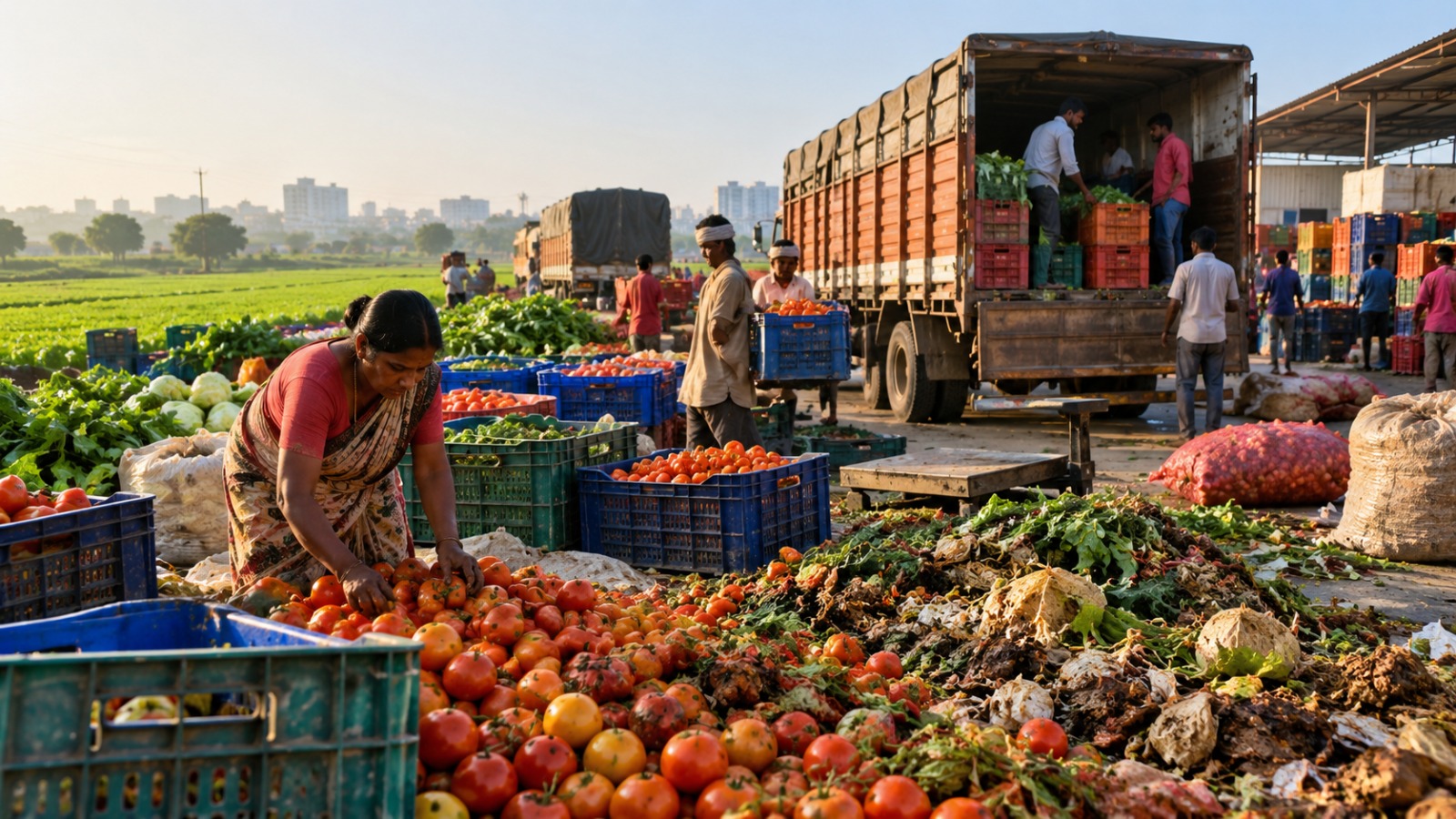
Food can be lost during harvesting, collection, grading, sorting, drying, packaging, transportation and storage. The NABCONS study identified inefficient harvesting, handling, storage and transportation as major reasons for losses in commodities such as fruits, vegetables, cereals and plantation crops.
For farmers, this means that producing a crop does not necessarily mean being able to sell the entire harvest.
A farmer may harvest a crop successfully, but part of it can be damaged during handling or transportation. Perishable products can also deteriorate when they remain in unsuitable conditions for too long.
This makes food waste in India more than a consumer-level issue. It is also a supply-chain and infrastructure issue.
The numbers show why this matters. The government has reported estimated post-harvest losses of 7.36 million tonnes of fruits and 11.97 million tonnes of vegetables, based on the NABCONS study.
2. Fruits and Vegetables Face Some of the Highest Losses
Fresh produce is particularly vulnerable because fruits and vegetables can deteriorate quickly.
According to a Ministry of Food Processing Industries study, the NABCONS study estimated post-harvest losses of 6.02% to 15.05% for fruits and 4.87% to 11.61% for vegetables during 2020–22.
These percentages are ranges rather than a single national percentage for every fruit or vegetable. Different commodities, regions and stages of the supply chain face different conditions.
Harvesting practices also matter. Produce can be damaged during picking, collection or sorting. Once harvested, fruits and vegetables may need appropriate packaging, ventilation, temperature control and timely transportation.
If those systems do not work efficiently, the product can lose quality before reaching a retailer or consumer.
This is one reason why reducing food waste in India cannot depend only on asking consumers to waste less. Improvements are also needed at the farm, market, warehouse and transportation levels.
3. Storage and Transportation Can Decide Whether Food Reaches Consumers
A strong food supply chain requires more than roads and trucks. Different products require different storage conditions, and perishable products may need temperature-controlled transportation and other forms of cold-chain infrastructure.
The government’s Integrated Cold Chain and Value Addition Infrastructure scheme is designed to support infrastructure connecting different stages of the supply chain, from farm-level handling and processing to distribution. The objective is to reduce post-harvest losses and improve supply-chain efficiency.
The scale of the challenge can also be seen in the monetary estimates from the NABCONS study. Estimated monetary losses included about ₹29,545 crore for fruits and ₹27,459 crore for vegetables, alongside losses across cereals, pulses, oilseeds and other commodities.
These figures should not be interpreted as money directly added to consumer prices. The Ministry of Food Processing Industries has stated that it has not conducted a specific study quantifying the direct impact of post-harvest food losses on food prices.
However, reducing avoidable losses can improve the efficiency of the available food supply.
That makes investment in storage, transportation, processing and cold-chain infrastructure an important part of addressing food waste in India.
4. Food Loss Affects Farmers, Markets and Food Security
The impact of food waste in India extends beyond the food that physically disappears.
When part of a harvest is lost, farmers may have less produce available to sell. For highly perishable crops, delays between harvesting and selling can be particularly costly.
At the market level, supply-chain inefficiencies can also affect how efficiently agricultural produce moves from production centres to consumers.
The government has linked post-harvest infrastructure with better supply-chain efficiency, farmer returns and food processing. Under the Pradhan Mantri Kisan SAMPADA Yojana (PMKSY), the government supports food processing and preservation infrastructure with the stated objective of reducing post-harvest losses and improving value addition.
As of June 30, 2026, the Ministry of Food Processing Industries said 1,256 projects were operational under PMKSY, benefiting about 37.76 lakh farmers.
Food loss also matters from a food-security perspective. Food that is produced but does not successfully move through the supply chain cannot serve consumers. Improving the efficiency of that journey can therefore become part of a broader effort to strengthen India’s food system.
5. Reducing Food Waste in India Requires More Than One Solution
There is no single solution to food waste in India because losses happen at different stages and for different reasons.
Better harvesting and handling practices can reduce physical damage. Improved packaging can protect produce during transportation. Warehouses and storage facilities can help extend shelf life, while cold-chain systems can support products that require controlled temperatures.
Food processing can also create another route for agricultural produce. Instead of selling every product only as fresh produce, processing and preservation can help extend its usable life and create additional value.
The government has several programmes addressing these areas. These include the Mission for Integrated Development of Horticulture, Agriculture Infrastructure Fund, Agricultural Marketing Infrastructure, e-NAM and PMKSY, among others.
Food waste can also become an input for other industries, including renewable-energy projects that convert organic material into biogas.
At the consumer level, better meal planning, storage, portion management and awareness can help prevent edible food from being unnecessarily discarded.
However, consumer behaviour is only one part of the picture.
What Needs to Change?
The numbers around food waste in India point to a broader question: how efficiently does food move through the country’s supply chain?
The answer depends on several connected systems.
Farmers need access to appropriate post-harvest infrastructure. Markets need efficient handling and storage facilities. Transport networks need to move perishable products quickly and safely. Food processors can create additional avenues for products that might otherwise have limited shelf life.
The government has also expanded efforts around cold-chain and food-processing infrastructure. Official data shows that these programmes are intended to create stronger connections between farmers, processors and markets.
According to a Ministry of Food Processing Industries study, fruits recorded estimated post-harvest losses of 6.02% to 15.05%, while vegetable losses ranged from 4.87% to 11.61%.
But infrastructure alone cannot eliminate food waste in India. Better coordination, technology, market access, processing capacity and consumer awareness all have a role to play.
The Bigger Question for India
India produces a large amount of agricultural and food commodities, but producing food is only the first step.
The journey from farm to consumer involves multiple points where food can lose quality or become unusable. The latest government data on post-harvest losses shows that the challenge is particularly important for perishable commodities such as fruits and vegetables.
At the same time, it is important not to treat every form of food loss as the same thing. Post-harvest losses measured in agricultural supply chains are different from food waste occurring in retail, food service or households.
For India, tackling food waste in India therefore means looking at the entire food system rather than focusing on a single stage.
Better infrastructure, improved handling, efficient transportation, cold-chain investment, food processing and responsible consumption can collectively reduce avoidable losses.
The larger opportunity is not simply to throw away less food. It is to build a food supply chain in which more of what farmers produce successfully reaches the people who need it.