
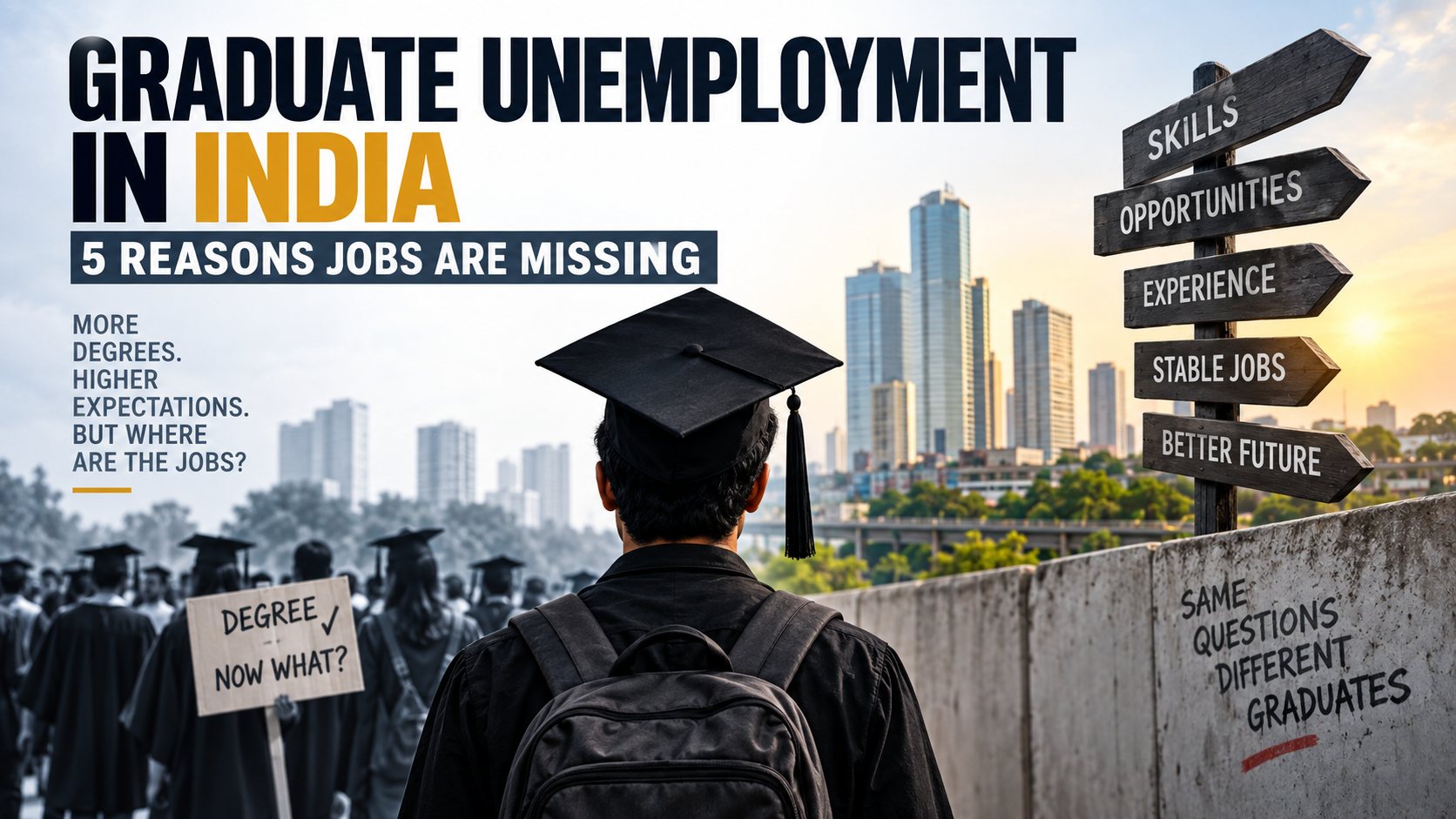
India’s unemployment rate stood at 5.1% in July 2026, according to the latest Periodic Labour Force Survey (PLFS). On paper, that may look like a sign of an improving job market. But the picture changes sharply when we look at young graduates.
Graduate unemployment in India remains a serious concern, particularly among people entering the workforce for the first time. The State of Working India 2026 report found that 39.33% of graduates below the age of 25 were unemployed, while the rate for graduates aged 25–29 stood at 20.04%.


This creates a difficult question for a country that is rapidly expanding higher education: if more young Indians are earning degrees, why aren’t enough of them moving into suitable employment?
The answer is more complicated than simply saying that India does not have enough jobs. It involves the quality of jobs being created, the skills employers demand, the education young people receive and the difficult transition from classrooms to careers.
1. The Unemployment Number Does Not Tell the Whole Story
India’s headline unemployment rate is an important economic indicator, but it does not tell the entire story of India’s labour market.
The government’s July 2026 PLFS bulletin reported an overall unemployment rate of 5.1% for people aged 15 years and above. The same bulletin showed the overall Labour Force Participation Rate at 55.4% and the Worker Population Ratio at 52.5%.
These numbers indicate that labour-market conditions have improved on several measures. But looking only at the national unemployment rate can hide differences between age groups and education levels.
The experience of a 45-year-old worker and a 22-year-old graduate entering the labour market for the first time can be completely different.
The State of Working India 2026 report illustrates this gap clearly. Based on PLFS 2023–24 data, unemployment among graduates was 39.33% for those below 25 years and 20.04% for graduates aged 25–29. For graduates aged 30–34, the rate fell to 8.94%.
This suggests that the most difficult stage is often not simply being educated. It is getting the first foothold in the labour market.
For a young person, unemployment at the beginning of a career can also have long-term consequences. A delayed first job can mean delayed savings, delayed financial independence and fewer opportunities to gain workplace experience.
2. India Is Producing More Graduates — But Employment Has Not Kept Pace
India’s education system has expanded enormously over the past few decades.
More young people are entering colleges and universities, and the number of graduates has grown substantially. That is a major achievement in itself.
But education creates an expectation.
A student spends years studying, pays tuition and other education-related expenses, and eventually expects a degree to improve their chances of securing a stable career.
The labour market, however, does not automatically create a suitable job for every graduate.
The State of Working India 2026 report estimates that 11 million of the 63 million graduates aged 20–29 were unemployed in 2023. The report also points to a widening challenge created by the growing number of young people obtaining degrees.
This is where the conversation needs to move beyond the simple question of whether India has “enough jobs.”
The more important question is:
Are enough productive and stable jobs being created for the increasingly educated workforce?
That distinction matters.
A person may technically be employed while working in a job that has little connection with their education, limited income growth or no meaningful career progression.
Employment is therefore not simply about having a job. It is also about what kind of job that person has.
3. The Degree-to-Job Gap Is Becoming a Major Problem
One of the biggest challenges facing young Indians is the transition from education to employment.
A degree provides formal education, but employers often look for practical experience, communication skills, digital abilities, problem-solving skills and specialised knowledge.
This creates a difficult situation for fresh graduates.
Employers may ask for experience before offering an entry-level position, while graduates cannot gain that experience until someone gives them their first opportunity.
The result is a familiar cycle:
Degree → job applications → experience requirement → rejection → more courses → more applications.
The International Labour Organization’s India Employment Report 2024 highlighted the difficult transition faced by young people from education into employment. It also noted that youth employment tends to be of poorer quality than employment for adults, with young workers more likely to be concentrated in vulnerable or informal forms of work.
This is why the graduate unemployment problem cannot be solved simply by increasing the number of college seats.
India needs a stronger bridge between what students learn and what workplaces actually require.
4. Skills Matter — But Skills Alone Are Not the Whole Answer
It is tempting to blame graduate unemployment entirely on a lack of skills.
That would be an incomplete explanation.
There is evidence of a genuine skills mismatch in India. In February 2026, the World Bank approved an $830 million programme to help modernise India’s Industrial Training Institute system and improve alignment between skills training and labour-market needs.
The World Bank said India’s youth account for roughly 72% of the unemployed and pointed to a persistent mismatch between the skills young people receive and the skills firms need. It also said that the existing ITI system faces challenges including inadequate facilities, trainers and resources.
But improving skills cannot be the only solution.
If every graduate is told to simply “learn more skills,” the responsibility shifts entirely onto the individual.
That ignores the other side of the equation.
Skills need jobs to meet them.
A student can learn coding, data analysis, accounting, digital marketing or other specialised skills, but if the local economy does not create enough relevant opportunities, skills alone cannot guarantee employment.
The real challenge is therefore two-sided:
Young people need market-relevant skills, while businesses and the economy need to generate enough productive opportunities to use those skills.
5. India’s Job Problem Is Also a Quality Problem
Another important part of the debate is the quality of employment.
India has millions of people working outside traditional salaried employment. Informal work, self-employment and casual employment remain significant parts of the labour market.
For some workers, these forms of employment provide an essential source of income. But they may also come with lower earnings, limited job security and weaker access to social protection.
The ILO’s India Employment Report 2024 found that youth employment is generally of poorer quality than adult employment, with young workers more likely to be in vulnerable occupations or informal employment.
This creates a second problem after unemployment: underemployment.
A graduate may find work but still struggle to use their education or earn enough to build financial independence.
This is especially important in India’s cities, where young workers often face high housing, transport and living costs.
A job that barely covers basic expenses may technically count as employment, but it does not necessarily provide a clear path toward economic security.
India therefore needs to think about decent employment, not only employment numbers.
6. Opportunity Is Concentrated in India’s Major Cities
Another part of the problem is geography.
India’s strongest employment opportunities are often concentrated around major urban and industrial centres.
This means a graduate from a smaller town may have to move to Bengaluru, Mumbai, Delhi, Hyderabad, Pune or another large employment hub to access a wider range of opportunities.
The World Bank noted in 2026 that millions of young Indians leave their towns and villages in search of work, while many smaller communities remain underinvested and underutilised.
Migration can create opportunities, but it also creates costs.
Young workers moving to large cities have to deal with rent, transport, food, accommodation and the general cost of establishing themselves in an unfamiliar place.
This makes the employment problem closely connected to India’s housing and urban infrastructure problems. India’s recent student housing crisis shows how the cost and availability of accommodation can directly affect young people trying to study and build careers in major cities.
A young graduate does not simply need a job.
They need to be able to live near that job and afford the life that comes with it.
7. The First Job May Be the Hardest
The early years of a career matter enormously.
A person who enters employment early can begin accumulating experience, professional networks and practical skills.
Someone who spends several years unemployed may find it increasingly difficult to compete for entry-level positions because employers continue to prefer candidates with experience.
The State of Working India 2026 report highlights the difficulty of securing stable salaried work after graduation. Only a small share of young graduates move into permanent salaried or white-collar employment soon after completing their education.
This is a crucial distinction.
Getting any work is not the same as starting a career.
For many young Indians, the real ambition is not simply to earn a salary this month. It is to find a job that provides experience, progression and enough stability to plan the next five or ten years of life.
8. The Government Has Recognised the Problem — But Scale Matters
The employment challenge is not being ignored.
The government has introduced several initiatives aimed at improving employability and the transition from education to work.
One example is the Prime Minister’s Internship Scheme, which was designed to provide young people with practical experience inside companies.
The original programme aimed to provide one crore internship opportunities in the top 500 companies over five years. In 2026, the government also expanded eligibility to include final-year undergraduate and postgraduate students between 18 and 25, allowing students to gain industry exposure before completing their education.
That is an important direction because internships can help address one of the biggest problems faced by fresh graduates: the experience gap.
But the scale of India’s youth population means implementation will matter as much as policy design.
An internship can provide valuable experience, but it cannot substitute for a functioning labour market capable of absorbing millions of young people into productive employment.
The larger question is whether India’s education, skills and employment policies can work together rather than operate as separate programmes.
9. India’s Demographic Dividend Has a Deadline
This may be the most important reason to take graduate unemployment seriously.
For years, India’s young population has been described as one of the country’s greatest economic advantages.
A large working-age population can increase production, consumption, entrepreneurship and tax revenues.
But a demographic dividend is not automatic.
Young people have to move successfully from education to skills, from skills to employment, and from employment to productive careers.
The State of Working India 2026 report warns that India’s working-age population share is expected to begin declining after 2030.
That gives India a limited window.
If young people spend their most productive years unemployed, underemployed or trapped in low-productivity work, the country loses more than individual income.
It loses potential economic output.
It loses entrepreneurship.
It loses household purchasing power.
And it risks creating a generation that has spent years preparing for opportunities that did not arrive at the required scale.
What India Needs to Change
There is no single solution to graduate unemployment in India.
The answer cannot simply be “create more colleges” or “teach more skills.”
India needs a stronger education-to-employment pipeline.
Colleges need closer links with employers and greater emphasis on practical learning.
Students need access to internships, apprenticeships and work-based learning before graduation rather than after months of unsuccessful job applications.
Employers need to create genuine entry-level pathways instead of treating every junior position as a role requiring previous experience.
Skills programmes need to be evaluated by actual employment and earnings outcomes rather than simply by the number of people trained.
And policymakers need to focus not only on the number of jobs created but also on where those jobs are, what they pay, how productive they are and whether workers receive basic social protection.
The government is already moving in some of these directions through initiatives such as the PM Internship Scheme and the modernisation of ITIs. The challenge now is scale, implementation and coordination.
India Does Not Just Need Jobs. It Needs Pathways to Careers.
The debate around unemployment often becomes a debate about percentages.
The unemployment rate rises.
The unemployment rate falls.
A new scheme is announced.
Another skills programme is launched.
But behind every statistic is a young person trying to answer a much simpler question:
What am I going to do with the degree I worked so hard to earn?
India’s graduate unemployment problem is therefore not just an employment issue.
It is an education issue.
It is a skills issue.
It is a business issue.
It is an urban-development issue.
And ultimately, it is a question about India’s economic future.
The country has made enormous progress in expanding access to higher education. The next challenge is ensuring that education leads to opportunity.
India’s demographic advantage will not be measured by how many young people it has.
It will be measured by how many of those young people are able to turn their education, skills and ambition into productive work and a secure future.
The headline unemployment rate may tell us how many people are without work.
But for India’s young graduates, the more important question is:
Can the economy give them a career worth building a life around?