
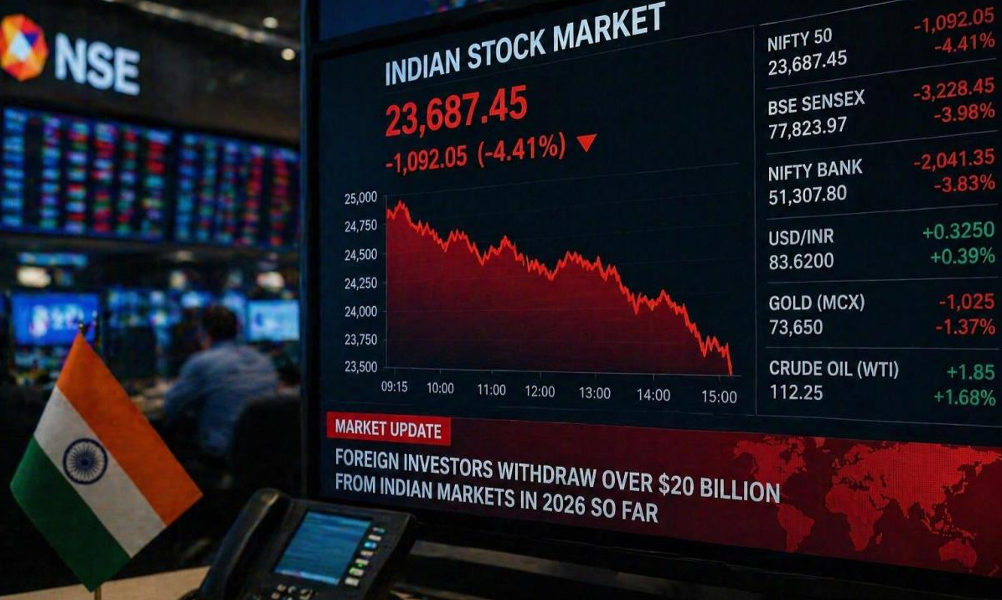
India’s financial markets are facing renewed turbulence as foreign investors have withdrawn over $20 billion in 2026 so far, marking one of the sharpest capital outflows in recent years. The exodus, driven largely by surging oil prices and escalating geopolitical tensions in the Middle East, has intensified pressure on the country’s equity markets, currency, and broader economic outlook.
The ongoing Iran-linked conflict has disrupted global energy supply chains, pushing crude oil prices above $110–115 per barrel and triggering inflationary concerns across oil-importing economies like India foreign outflows 2026. As a country that imports nearly 85–90% of its crude oil needs, India remains particularly vulnerable to such shocks, making it highly sensitive to global energy price fluctuations.


This wave of foreign capital withdrawal is not just a market event but a reflection of deeper structural vulnerabilities. It highlights how external geopolitical developments can rapidly alter investor sentiment, capital flows, and macroeconomic stability in emerging economies.
Scale and Nature of Capital Outflows
Foreign portfolio investors (FPIs) have pulled more than $20 billion from Indian equities in the first four months of 2026, surpassing total outflows recorded in the entire previous year. The magnitude of this withdrawal underscores the severity of the current financial stress and marks a significant reversal from earlier periods of strong foreign inflows.
A large portion of these outflows has been concentrated in key sectors such as financial services and information technology. These sectors, which traditionally attract strong foreign investment, have been hit by concerns over slowing earnings growth, global demand uncertainties, and the disruptive impact of artificial intelligence on India’s export-driven IT industry.
Oil Shock and Macroeconomic Pressures
The surge in crude oil prices has compounded the challenges facing the Indian economy. Higher oil prices directly impact India foreign outflows 2026 trade deficit, inflation levels, and fiscal balance, creating a ripple effect across multiple economic indicators.
Rising import costs are putting pressure on the Indian rupee, increasing the likelihood of currency depreciation. At the same time, inflationary pressures may limit the central bank’s ability to cut interest rates, potentially slowing economic growth.
This combination of external shocks and domestic constraints creates a complex macroeconomic environment, requiring careful policy calibration to maintain stability.
Impact on Equity Markets and Currency
The sustained outflow of foreign capital has led to increased volatility in Indian equity markets. Benchmark indices have experienced fluctuations as selling pressure from FPIs outweighs domestic inflows.
The India foreign outflows 2026 rupee has also come under pressure, reflecting the broader impact of capital outflows and rising import bills. Currency weakness can further exacerbate inflation by making imports more expensive, creating a feedback loop that affects both consumers and businesses.
Despite these challenges, domestic institutional investors have provided some support to the markets, partially offsetting the impact of foreign selling. However, their capacity to absorb large-scale outflows remains limited.
Geopolitical Risks and Investor Sentiment
Geopolitical tensions in the Middle East have emerged as a key driver of investor sentiment. The Iran-linked conflict has raised concerns about the stability of global energy supplies and the potential for further escalation.
For foreign investors, such uncertainties increase risk perception, prompting a shift toward safer assets and developed markets. Emerging economies like India foreign outflows 2026 often bear the brunt of such shifts, experiencing capital outflows and market volatility.
This dynamic underscores the interconnected nature of global financial markets, where geopolitical developments in one region can have far-reaching consequences for economies worldwide.
Conclusion
The $20 billion India foreign outflows 2026 highlight the profound impact of global oil shocks and geopolitical tensions on emerging market economies. The combination of rising crude prices, capital flight, and currency pressures presents a multifaceted challenge for policymakers and investors alike.
Going forward, the trajectory of India foreign outflows 2026 markets will depend on both global and domestic factors, including the evolution of Middle East tensions, oil price trends, and policy responses aimed at stabilizing the economy.
While short-term volatility may persist, the situation also underscores the importance of strengthening economic resilience and reducing dependence on external shocks in an increasingly uncertain global environment.