
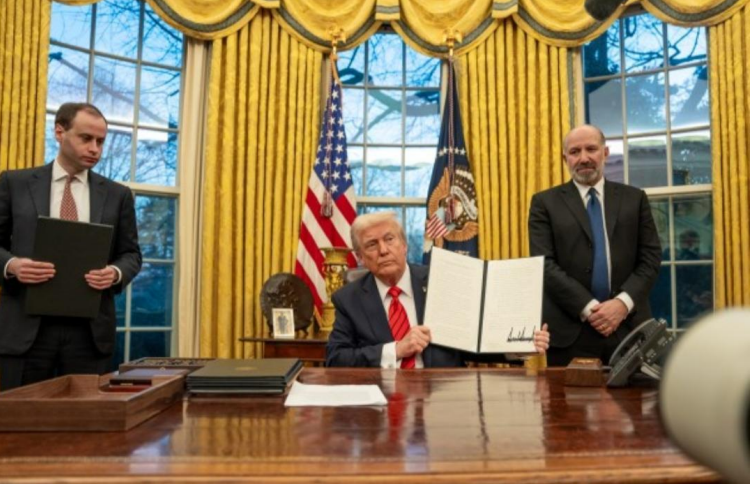
In one of the most consequential foreign-policy decisions of his current term, Donald Trump on Wednesday, January 7, 2026, signed an executive order directing the United States to suspend its participation in and financial support for 66 international organisations, agencies, and commissions. The move follows months of internal reviews ordered by the White House to reassess US exit organisations involvement in multilateral bodies, including those operating under or alongside the United Nations system.
The executive order instructs federal departments to immediately halt funding, staffing, and formal engagement with the identified organisations, while also mandating a broader reassessment of all remaining international commitments. According to the administration, the review was guided by a central question: whether continued participation in global institutions advances US exit organisations national interests, sovereignty, and economic priorities. The conclusion, officials said, was that dozens of organisations no longer meet that threshold.


The decision marks a sharp escalation in President Trump’s long-standing scepticism of multilateralism. Since his first term, Trump has consistently argued that international organisations place disproportionate financial and political burdens on the United States while delivering limited returns. In signing the order, he reiterated his belief that many global bodies have evolved into “bureaucratic structures” that constrain US exit organisations decision-making, promote agendas misaligned with American values, and lack meaningful accountability.
At the centre of the announcement was the administration’s assertion that US exit organisations taxpayers have, for decades, underwritten institutions that operate with little transparency. Senior officials argued that the United States contributes more funding than any other country to international organisations while exercising limited control over outcomes. The executive order, they said, is intended to rebalance that equation by shifting U.S. engagement away from permanent multilateral commitments and toward selective, interest-based cooperation.
Scope of Organisations Affected
Among the organisations affected are a wide range of UN-linked agencies, advisory commissions, and treaty-based bodies covering climate policy, labour standards, population and development, cultural cooperation, and global governance frameworks. Particularly significant is the suspension of US exit organisations participation in bodies connected to international climate coordination, including mechanisms associated with the UN climate architecture. These structures have historically served as platforms for global negotiations on emissions targets, climate finance, and adaptation strategies.
The administration defended the move by arguing that climate and social policy decisions should be made domestically rather than through international forums that, in its view, impose obligations without enforceable reciprocity. Officials stressed that the United States would continue to pursue environmental and economic goals independently and through bilateral arrangements, rather than through global agreements that they believe restrict national policy flexibility.
A Broader Shift in U.S. Foreign Policy
The order also reinforces earlier withdrawals from prominent institutions such as the World Health Organization, the UN Human Rights Council, and UNESCO, signalling a broader philosophical shift rather than a one-off decision. Together, these actions underscore a foreign-policy doctrine that prioritises sovereignty, transactional diplomacy, and direct negotiations over collective rule-making.
Domestic Reaction
Reaction to the announcement was swift and polarised. Supporters within the United States hailed the decision as a long-overdue correction to what they see as excessive global entanglement. Conservative lawmakers and commentators argued that the US exit organisations has too often compromised its interests to maintain international consensus, and that withdrawing from underperforming organisations allows Washington to reclaim strategic autonomy. They also suggested that US exit organisations leverage is stronger outside multilateral forums, where financial contributions are no longer treated as obligations.
Critics, however, warned that the withdrawal risks isolating the United States at a moment of heightened global instability. Foreign-policy analysts argue that exiting international organisations does not eliminate global challenges, but merely removes the US exit organisations from the tables where those challenges are addressed. Climate change, public health crises, migration, and labour standards, they note, are inherently transnational issues that cannot be effectively managed through unilateral action alone.
Geopolitical and Legal Implications
There are also concerns that the decision will reduce US exit organisations influence while creating space for rival powers to shape global norms. Countries such as China and Russia, which have steadily expanded their presence in international institutions, could gain greater sway in setting standards on technology, development, and governance. Diplomats fear that long-term disengagement may weaken Washington’s ability to build coalitions or respond rapidly to global emergencies.
Legal and constitutional questions have also emerged, particularly regarding treaties and frameworks that were ratified by the US exit organisations Senate. While the administration maintains that it has the authority to suspend participation and funding, some lawmakers argue that full withdrawal from certain agreements may require congressional approval. These disputes are expected to surface in the months ahead, potentially setting the stage for judicial and legislative challenges.
International Response
Internationally, the response has ranged from muted concern to open alarm. Several allies privately expressed unease over the pace and scale of the US exit organisations disengagement, warning that it undermines collective efforts on issues ranging from climate resilience to humanitarian coordination. Others acknowledged that the decision reflects a broader recalibration of U.S. foreign policy rather than a temporary political posture, forcing partners to reconsider how global institutions function without American leadership.
The White House, however, has been clear that disengagement does not mean isolation. Officials emphasised that the United States will continue to engage internationally through bilateral agreements, ad-hoc coalitions, and trade relationships. The difference, they said, is that participation will be conditional, limited, and explicitly tied to measurable benefits for the US exit organisations economy and security.
Conclusion
In conclusion, the decision to exit 66 international organisations represents one of the most far-reaching retreats from multilateralism in modern U.S. history. Framed by the Trump administration as a defence of sovereignty and fiscal responsibility, the move fundamentally reshapes America’s role in global governance.
Whether it strengthens U.S. autonomy or diminishes its influence will depend on how effectively Washington navigates a world where cooperation increasingly occurs without the institutional frameworks it once helped build. What is certain is that the order marks a decisive break from post-war assumptions about American leadership—and sets the tone for a more transactional, inward-looking phase of US exit organisations engagement with the world.


