
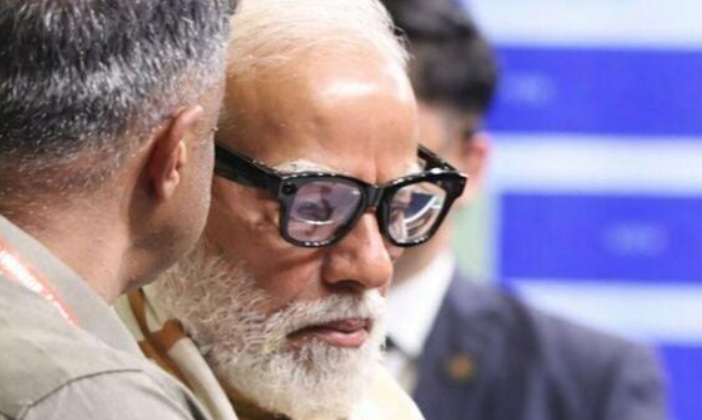
Indian artificial intelligence startup Sarvam AI formally entered the consumer hardware space with the launch of its Sarvam Kaze AI Glasses, during the India AI Impact Summit 2026 in New Delhi.
The unveiling took place before an audience comprising policymakers, global technology leaders, venture capital investors and academic researchers, positioning the product as a symbol of India’s ambition to move beyond software innovation into integrated AI hardware development.


Founded in Bengaluru, Sarvam Kaze AI Glasses has built its reputation around developing large language models optimised for Indian languages and context-aware AI applications. The launch of Kaze represents the company’s first foray into wearable consumer technology.
Company executives described the device as a “Made-in-India intelligent wearable platform,” engineered to combine real-time AI assistance, voice interaction and visual data processing within a lightweight eyewear form factor.
During the product presentation, Sarvam Kaze AI Glasses leadership stated that Kaze is designed to function as a multimodal AI companion capable of processing speech, contextual cues and environmental inputs. The glasses integrate an AI assistant powered by Sarvam’s proprietary language model, enabling real-time translation, contextual reminders and hands-free navigation support.
Technical Capabilities and Product Architecture
Sarvam Kaze AI Glasses incorporates an embedded AI chipset designed to support on-device processing for low-latency responses, reducing reliance on continuous cloud connectivity. According to company representatives, this architecture enhances data privacy and ensures faster response times during usage in dynamic environments.
The device features directional microphones, a micro-display integrated into the lens frame and voice-controlled interaction. Sarvam AI stated that Kaze supports multiple Indian languages alongside English, reflecting the company’s broader strategy to develop inclusive AI solutions tailored for diverse linguistic markets.
Demonstrations at the summit highlighted real-time transcription, multilingual translation and contextual information retrieval functions.
Engineers involved in the project emphasised that the hardware was developed in collaboration with domestic manufacturing partners, aligning with India’s push to strengthen electronics production under national industrial initiatives. While specific pricing and commercial rollout timelines were not formally disclosed, the company indicated that pilot deployments are expected later in 2026.
Leadership Vision and Strategic Context
At the summit, Sarvam AI’s co-founder addressed the audience, stating that India’s AI ecosystem must “progress from building algorithms to building intelligent products that shape everyday experiences.”
The leadership framed the launch as a strategic milestone in India’s broader technological evolution, arguing that wearable AI devices represent the next frontier in human-computer interaction.
The India AI Impact Summit 2026 itself is being viewed as a platform designed to elevate India’s role in shaping global AI discourse. Representatives from multiple countries attended the event, underscoring growing international engagement in AI governance and technological collaboration.
Within that context, Sarvam AI’s product launch signalled domestic capacity to innovate in hardware-driven AI solutions.
Industry observers noted that global competition in AI wearables is intensifying, with companies worldwide exploring augmented reality glasses and AI-integrated devices. Sarvam’s entry into this space marks one of the first high-profile Indian attempts to compete in consumer AI hardware, a domain historically dominated by multinational technology firms.
Market Implications and Industry Response
Technology analysts present at the summit described the Kaze launch as “symbolically significant” for India’s startup ecosystem.
While Indian companies have achieved scale in software services and SaaS platforms, fewer have ventured into integrated hardware innovation at the consumer level. Sarvam AI’s move suggests a diversification of ambition within the country’s tech landscape.
Venture capital representatives attending the summit indicated that interest in AI-native hardware is expanding, particularly where devices are tailored to regional needs and multilingual functionality.
By embedding support for Indian languages and contextual awareness, Sarvam Kaze AI Glasses appears to be positioning Kaze for both domestic adoption and potential export to emerging markets.
The broader wearable technology market continues to grow globally, driven by demand for smart assistants, augmented interfaces and productivity tools. Sarvam AI’s entry into this segment may catalyse further innovation within India’s startup community, especially in areas combining AI research with physical device manufacturing.
India’s Expanding Role in AI Innovation
The unveiling of Sarvam Kaze AI Glasses reflects a larger shift in India’s AI ecosystem from foundational research and services toward end-to-end product development.
Over the past few years, India has witnessed increased investment in semiconductor design, AI model training and electronics manufacturing capabilities. The introduction of an AI-powered wearable developed by a domestic startup aligns with this trajectory.
Policy experts attending the summit emphasised that for India to become a global AI leader, domestic companies must demonstrate the ability to commercialise advanced technologies across hardware and software layers. Sarvam Kaze AI Glasses initiative may be seen as an early indicator of that integrated ambition.
As the India AI Impact Summit 2026 continues, the launch of Sarvam Kaze AI Glasses stands out as one of its most tangible technological announcements.
Whether the product achieves large-scale adoption remains to be seen, but its debut underscores a significant development: Indian AI enterprises are increasingly seeking to define the future of intelligent devices, not merely contribute to their underlying algorithms.
With Kaze, Sarvam Kaze AI Glasses has positioned itself at the intersection of language technology, wearable computing and national innovation strategy. The coming months will determine how effectively this vision translates into commercial traction, but the unveiling itself marks a notable chapter in India’s evolving AI narrative.


