
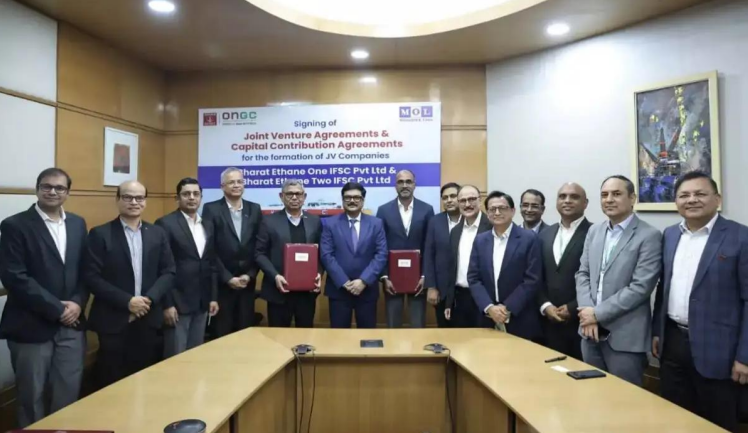
India’s state-run energy major Oil & Natural Gas Corporation (ONGC Mitsui Ethane) has entered into a joint venture with Japanese trading and investment group Mitsui & Co. to develop a dedicated ethane shipping business, marking a significant step in securing long-term feedstock supply for India’s petrochemical sector.
Under the arrangement, ONGC Mitsui Ethane will acquire a 50 per cent equity stake in the joint venture, with the remaining held by Mitsui, creating a balanced partnership that combines India’s energy demand with Japan’s shipping and logistics expertise.


The joint venture has been structured to focus on the transportation of ethane, a critical raw material used in petrochemical production from international supply sources to India. Officials familiar with the development say the partnership is aligned with ONGC’s broader strategy of strengthening downstream integration and reducing vulnerabilities in key input supply chains amid volatile global energy markets.
Why Ethane Matters for India
Ethane has emerged as an increasingly strategic commodity for India’s petrochemical ambitions. As a cleaner and more efficient feedstock compared to alternatives such as naphtha, ethane enables the production of key chemicals like ethylene at lower costs and with reduced emissions.
India’s growing demand for plastics, packaging, automotive components and consumer goods has intensified the need for reliable and competitively priced ethane supplies.
For ONGC Mitsui Ethane, securing shipping capacity through equity participation offers greater control over logistics, pricing stability and delivery timelines. Rather than relying solely on third-party charter arrangements, the joint venture model allows ONGC Mitsui Ethane to directly participate in fleet planning and long-term transportation contracts, insulating its operations from shipping market fluctuations.
Mitsui’s Role and Operational Expertise
Mitsui brings to the joint venture deep experience in global energy logistics, shipping management and commodity trading. The Japanese conglomerate has a long track record of operating and financing specialised gas carriers, including vessels designed for transporting liquefied ethane under stringent safety and temperature requirements.
Industry analysts note that Mitsui’s participation reduces execution risk for the project, particularly in vessel acquisition, regulatory compliance and international maritime operations.
The partnership also reflects Japan’s continued engagement with India’s energy transition and industrial growth, even as Tokyo balances its own decarbonisation goals with the need for stable energy and materials supply chains in Asia.
Implications for ONGC’s Downstream Strategy
The ethane shipping joint venture fits into ONGC’s evolving role beyond upstream oil and gas exploration. In recent years, the company has been expanding its footprint in refining, petrochemicals and value-added energy segments, seeking to diversify revenue streams and hedge against long-term uncertainty in fossil fuel demand.
By securing ethane transportation capacity, ONGC strengthens the viability of its petrochemical investments and improves feedstock security for existing and planned facilities.
The move also signals a shift toward asset-backed partnerships, where equity participation is used to gain strategic advantages rather than purely financial exposure.
Broader Economic and Geopolitical Context
The joint venture comes at a time when global supply chains for energy and petrochemicals are being reshaped by geopolitical tensions, shipping disruptions and energy transition policies.
For India, reducing dependence on spot markets and foreign-controlled logistics has become a strategic priority, particularly for inputs critical to manufacturing and infrastructure growth.
The partnership with Mitsui also underscores India–Japan economic cooperation in energy and industrial sectors. As both countries seek resilient and diversified supply chains, such collaborations are likely to increase, spanning fuels, chemicals, clean energy technologies and advanced manufacturing.
Outlook
Looking ahead, the ONGC Mitsui Ethanei joint venture is expected to play a stabilising role in India’s petrochemical supply chain, particularly as domestic demand continues to rise.
Much will depend on how quickly the joint venture can scale its shipping capacity and secure long-term ethane sourcing contracts aligned with ONGC Mitsui Ethane downstream needs.
If successful, the model could be replicated for other critical energy and chemical inputs, reinforcing ONGC Mitsui Ethane transformation into an integrated energy and materials company.
For India’s broader industrial ecosystem, the deal signals a growing emphasis on strategic partnerships that combine global expertise with domestic demand, a trend likely to shape the next phase of the country’s energy and manufacturing expansion.


