
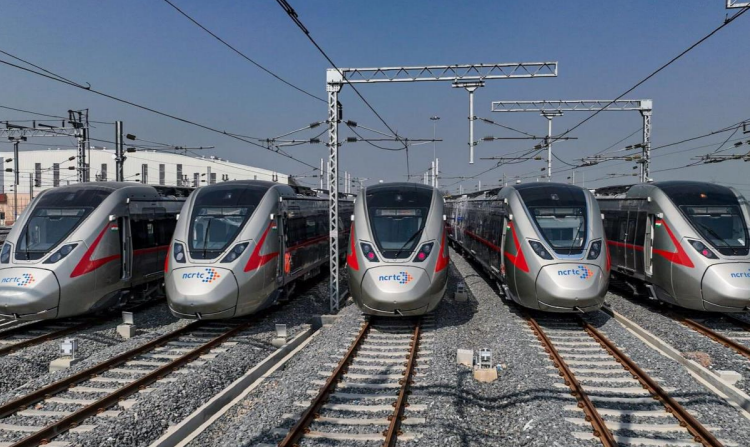
India’s first Regional Rapid Transit System (RRTS), branded as Namo Bharat RRTS, has reported its highest passenger ridership since operations began, marking a significant milestone for the country’s next-generation transport infrastructure. The priority section of the Delhi–Ghaziabad–Meerut corridor, currently operational between Sahibabad and Duhai Depot, has seen steadily rising commuter traffic, exceeding early projections released by the National Capital Region Transport Corporation (NCRTC).
Officials say the surge reflects a structural shift in commuter behaviour, with increasing numbers opting for high-speed, predictable public transport over traditional road-based travel. The rise comes at a critical juncture for India’s mobility landscape, as policymakers push for rapid adoption of modern transit systems to decongest cities, cut emissions and integrate regional economic zones more efficiently.


Ridership Surge Shows Strong Public Acceptance
The first weeks of operation have shown a pattern of consistent growth, with daily ridership figures surpassing earlier benchmarks as public awareness increases. NCRTC officials noted that several days recorded peak-hour loads nearly 20–25% higher than early estimates, especially on weekdays when office and student commuters rely heavily on rapid connectivity. Weekend patterns also indicate growing leisure-warped travel along the corridor.
The fact that this surge has come while only 17 km of the 82-km corridor is open is seen as a strong indicator of the system’s long-term potential. Mobility experts say that even this limited stretch manages to demonstrate two crucial value propositions — speed and reliability. With average speeds reaching 100 km/h and top design speeds up to 160 km/h, the Namo Bharat RRTS offers a new category of travel that lies between metro-speed urban commutes and long-distance rail.
The demographic profile of passengers, officials note, is also diversifying: early users primarily included office-goers from Ghaziabad, but in recent weeks students, intercity travellers and occasional riders have contributed significantly to traffic, indicating a maturing commuter base.
NCRTC Highlights Tech, Efficiency and Service Reliability
The surge in ridership has been accompanied by high operational reliability. According to NCRTC’s internal performance indicators, the system has operated with over 99% punctuality, placing it among the most efficient regional transit services globally. Managing Director Vinay Kumar Singh stated that the public response “reflects a growing appetite for modern, time-saving transport solutions.”
Part of this success is attributed to the Namo Bharat RRTS’ infrastructure — advanced signalling technology such as ETCS Level-2, platform screen doors, automated train supervision systems and fully air-conditioned, driverless-ready trainsets built with modern crashworthiness standards. Ticketing innovations such as QR-code entry, mobile payments and the One India Pass have further streamlined passenger movement.
Enhanced services at stations such as real-time information displays, security integration and multimodal last-mile connections have also contributed to commuter satisfaction. The stations at Sahibabad, Guldhar and Duhai, in particular, have seen the sharpest increase in footfall during peak working hours.
Economic and Social Impact Emerges Along the Corridor
The operational stretch is already demonstrating early economic spillovers. Local markets near major stations have seen increased footfall, with small businesses reporting higher weekend sales. Real estate developers operating in Ghaziabad and Meerut say inquiries for commercial and residential spaces near RRTS nodes have risen, anticipating long-term travel demand.
For commuters, the impact is immediate. The Namo Bharat RRTS reduces travel on the operational section from 30–45 minutes by road to just a few minutes, allowing workers to reclaim valuable time daily. Students commuting between Ghaziabad and educational institutions along the route have reported more predictable and less stressful travel.
Urban planners say that once the corridor becomes fully functional from Sarai Kale Khan in Delhi to Meerut South, the resulting 60-minute end-to-end travel time, compared with the usual 3–4 hours by road, will dramatically reshape labour mobility. This, they argue, will encourage de-densification of Delhi, increasing economic opportunities across the NCR.
Full Corridor Construction Progresses Rapidly
Work on the remaining sections of the Delhi–Meerut Namo Bharat RRTS corridor is progressing rapidly. NCRTC has completed tunneling in key sections, with the underground Delhi portion and elevated bridges expected to be opened in phases. Government officials have emphasised that the corridor remains a priority national infrastructure project, aligning with broader goals of improving mobility and lowering carbon emissions.
Once completed, the full network will include 22 stations, multiple interchanges with Delhi Metro, and state-of-the-art depots supporting high-frequency operations. The project represents one of India’s largest public transport investments of the decade, with an estimated cost exceeding ₹30,000 crore.
The long-term intention is to integrate the Namo Bharat RRTS with emerging corridors such as Delhi–Alwar, Delhi–Panipat and Delhi–Haryana, creating a regional grid that enhances NCR-wide travel efficiency. Experts believe the success of the initial stretch strengthens the case for accelerated rollout of these future corridors.
India’s Regional Mobility Vision Gains Momentum
Urban mobility experts say that Namo Bharat RRTS is poised to fill a critical gap in India’s transport system — fast regional travel between cities separated by 50–150 km. The early ridership success lends credibility to India’s vision of a high-speed regional mobility backbone, designed to support economic expansion and reduce road congestion.
NCRTC leaders emphasize that the Namo Bharat RRTS is not merely a transportation project but a structural reform in how the National Capital Region moves, works and grows. With the successful launch of the first stretch, India joins the league of countries investing in suburban rapid transit systems that bridge the gap between metro rail and conventional trains.
With every week of operation, officials say, the public’s trust in high-speed, predictable commuting is deepening — laying the foundation for the full corridor’s transformative impact once the entire line becomes operational.
Conclusion
The record-setting ridership on the Namo Bharat RRTS marks a pivotal moment in India’s transport evolution. By offering faster travel, greater reliability and an environmentally cleaner commuting alternative, the system demonstrates how well-executed infrastructure can reshape mobility patterns. As Namo Bharat RRTS construction advances and additional phases come online, the Delhi–Meerut RRTS is set to become a defining model for regional transit nationwide, reinforcing India’s long-term commitment to modern, efficient and sustainable transport solutions.


