
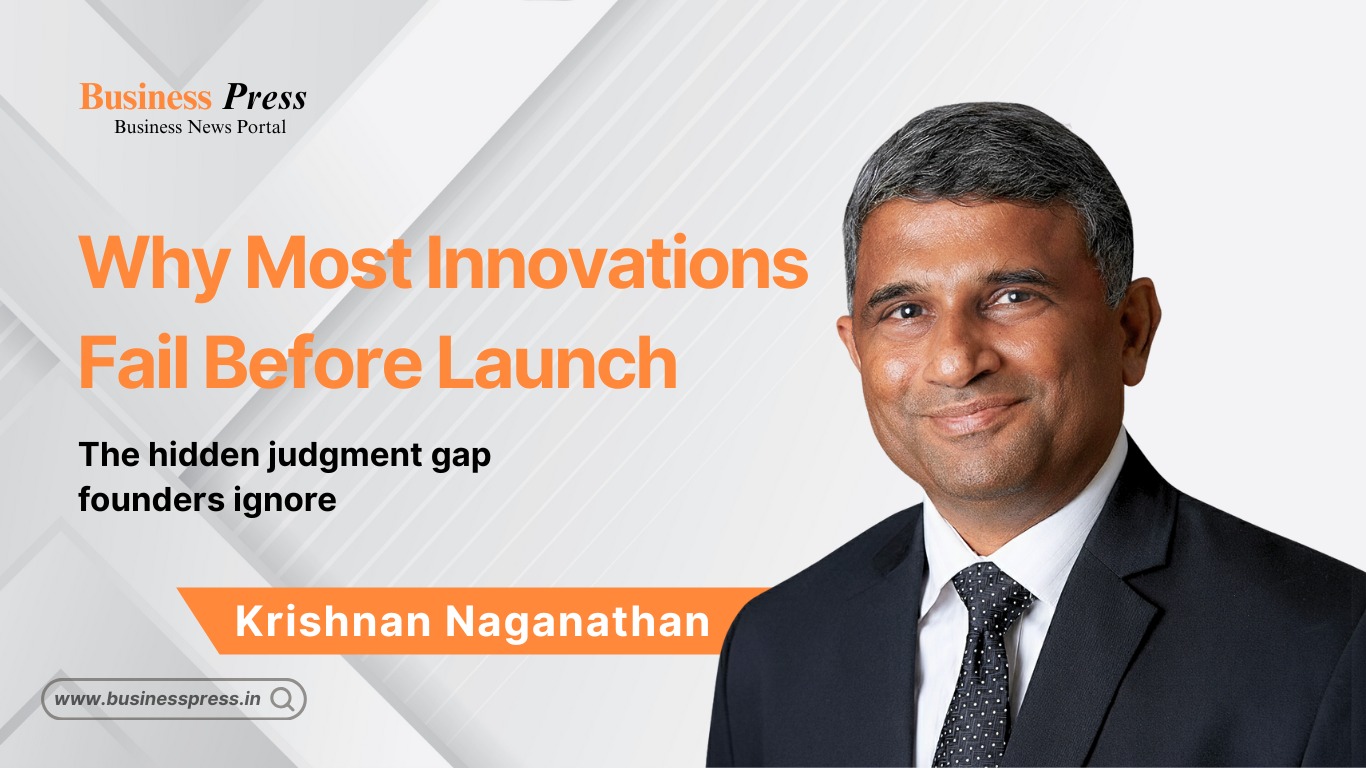
For many founders and leaders, innovation feels like a race. Move fast. Scale early. Tell a convincing story. But for Krishnan Naganathan innovation has never been about speed or spectacle. It has always been about judgment.
Over decades spent inside boardrooms, factories, consulting war rooms, and founder conversations, Krishnan Naganathan innovation has seen a recurring pattern. Ideas were not the problem. Technology was not the problem. Even capital was often available. What failed, repeatedly, was the ability to make clear, disciplined decisions when the future was still uncertain.


That observation would quietly shape his journey and eventually define the work he does today.
Early Career and a Front Row Seat to Complexity
Krishnan’s professional path began across some of India’s most demanding industrial and corporate environments, including Castrol, Ford, and Ashok Leyland. These early roles offered a deep grounding in how real businesses operate, where constraints are tangible, and mistakes are costly.
His transition into consulting expanded that exposure. At ECS Limited (now part of PwC) and later as CEO of Valcon India, he worked closely with leadership teams across engineering, FMCG, automotive, and global enterprises. The work spanned transformation, growth, and execution, often in environments where certainty was assumed but rarely present.
It was during these years that Krishnan Naganathan innovation noticed a quiet contradiction. While companies spoke constantly about innovation, very few treated it as a serious strategic discipline. Even consulting firms lacked a structured way to think about innovation beyond process improvement or surface-level experimentation.
That gap stayed with him.
The Moment That Shifted Direction

After nearly 15 years in consulting, including significant time with global clients, Krishnan Naganathan innovation made a conscious decision to step deeper into the field of innovation itself. He pursued formal learning, becoming one of the early consultants certified as an Innovation Management Black Belt, by a Swedish organisation.
More importantly, he began to work directly with innovation and product development challenges, both in India and globally. This exposure sharpened a key insight.
Most innovations did not fail because the technology did not work. They failed because economic sense was never designed early enough.
Between technical feasibility and financial commitment sat a dangerous blind spot. Decisions were being made without clarity on whether a venture should exist at all. That judgement gap, as Krishnan Naganathan innovation describes it, was where the most expensive mistakes were being made.
Identifying the Real Problem
In emerging ecosystems like India, the cost of being wrong is unusually high. Experiments are expensive. Markets are unclear. Failure carries long-term consequences for founders and organisations alike. At the same time, capital often demands certainty far too early.
Imported innovation frameworks, borrowed from mature ecosystems, assume that failure is reversible and markets are deep. Applied without adaptation, they push teams toward premature narratives, aggressive scaling assumptions, and innovation theatre that looks impressive but destroys value.
Krishnan Naganathan innovation work emerged as a response to this reality. Rather than helping founders sell stories, he focused on helping them make better decisions under uncertainty.
Building a Practice Grounded in Economic Sense
Through his work at Think Horizon Consulting, Krishnan Naganathan innovation offers highly personalised advisory and mentoring engagements for founders, innovation leaders, investors, and family offices. His approach is deliberate and disciplined, built around one core question:
Where does economic surplus come from, and who captures it?
Using frameworks such as Innovation Rent and the Nine Stages of Innovation, he helps ventures design their economics before momentum distorts judgement. This includes venture thesis development, structured modelling of value creation, and scenario-based decision frameworks.
For deep-tech startups, his advisory focuses on identifying fatal versus manageable uncertainties and designing experiments that reduce existential risk rather than chasing validation. For investors and family offices, the work extends to portfolio advisory, helping align patient capital with uncertainty reduction instead of conventional funding milestones.
What sets this work apart is its refusal to rely on marketing narratives. The emphasis is always on economic logic, decision sequencing, and long-term value creation.
Challenges of Working Ahead of the Market
Operating in the innovation consulting space has not been easy. Corporates often seek optics over substance. Startups struggle to pay for advisory support. The ecosystem itself is still evolving.
As a result, scaling has remained difficult, and Krishnan Naganathan innovation has largely operated as a focused, high-impact practitioner rather than a large firm. Yet this constraint has also preserved the integrity of the work, allowing him to stay close to complex decisions where judgement truly matters.
A Defining Milestone
A major turning point came through his work with one of India’s largest conglomerates on innovation initiatives and with one of the largest Middle Eastern governments on Scenario Planning. The engagement validated the depth and relevance of his thinking and established his reputation as someone doing genuinely original work in this space.
That credibility opened new doors, enabled him to refine his services, and led to the writing of his book Innovation GPS. More importantly, it allowed him to engage with a wider range of leaders who were ready to move beyond surface-level innovation.
Looking Ahead: From Advisory to Venture Building
Over the next five years, Krishnan Naganathan innovation vision is to evolve this work into a disciplined pre-seed venture studio focused on deep-tech and emerging technologies.
In the near term, the focus is on formalising an Economic Surplus Venture Studio, working with a small and selective group of founders to prove economic sense before scale. Medium-term plans include building a portfolio model that partners with patient capital and public innovation institutions.
In the long term, the ambition is clear:
To be recognised as a specialist platform operating at the boundary where feasibility ends and finance begins. Not by increasing the number of startups, but by improving which ventures deserve to exist.
Advice for Founders
Krishnan Naganathan innovation guidance to aspiring entrepreneurs is simple, though not easy to follow. Slow down.
Before thinking about building or fundraising, ask whether the venture should exist economically. Be honest about the problem being solved. Design the economics early. Use early capital to eliminate the most dangerous assumptions rather than to create noise.
Walking away from an idea that does not make economic sense is not failure. It is good judgement.
In ecosystems where the cost of being wrong is high, the founders who endure are not those who move fastest, but those who decide wisely, in the right sequence.
Connect with Krishnan Naganathan
To learn more about Krishnan Naganathan innovation work and perspectives on innovation and venture judgement, visit his website at www.krishnaganathan.com and connect with him on LinkedIn at Krishnan Naganathan.


