
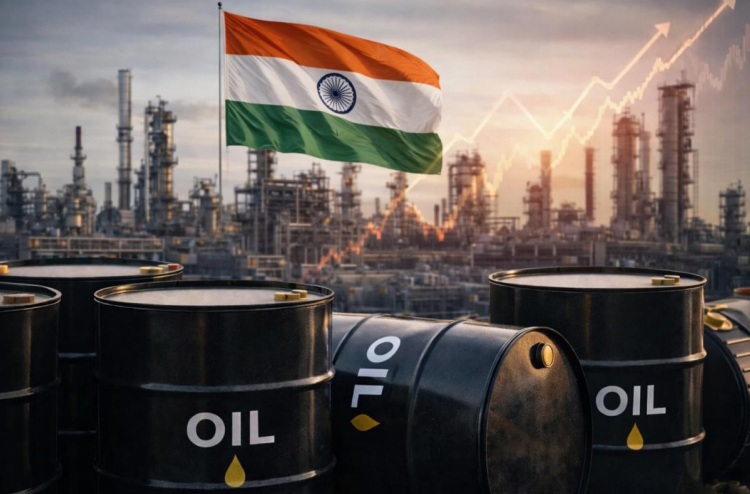
India’s economic outlook is facing renewed scrutiny as global crude India oil prices climb amid geopolitical tensions and supply uncertainties in the Middle East. Economists warn that sustained increases in India oil prices could place significant pressure on India’s inflation trajectory, fiscal position and external balance, given the country’s heavy dependence on imported energy.
India imports more than 85% of its crude oil requirements, making it one of the world’s most oil-dependent large economies. As global prices rise, the cost of importing crude increases sharply, raising the country’s import bill and widening the current account deficit while transmitting inflationary pressures across multiple sectors of the economy.


Oil Import Dependence Exposes India to Global Price Shocks
India’s structural reliance on imported energy remains the primary reason rising crude prices pose a macroeconomic risk. Nearly half of India’s crude oil shipments originate from Gulf producers such as Iraq, Saudi Arabia, the UAE and Kuwait, many of which rely on shipping routes through the strategically sensitive Strait of Hormuz.
Geopolitical disruptions in the region can quickly translate into higher India oil prices and supply concerns. Analysts note that any prolonged disruption to the Strait of Hormuz, through which about 20% of global oil trade flows could have severe implications for energy-importing economies like India.
According to Nomura analysts, India is among the Asian economies most vulnerable to rising India oil prices due to its heavy import dependence. Even moderate price increases can have outsized macroeconomic effects compared with more energy-self-sufficient economies.
Inflationary Pressures and Rising Import Bill
One of the most immediate consequences of higher India oil prices is inflationary pressure. Energy costs directly influence transportation, logistics and production costs, which in turn feed into consumer prices across the economy.
Economists estimate that every $10 per barrel increase in crude India oil prices could widen India’s current account deficit by about 0.35% of GDP and increase inflation by roughly 20–30 basis points, depending on the extent of fuel price pass-through to consumers.
Higher crude prices also substantially increase India’s import bill. Estimates suggest that a $10 increase in India oil prices can raise the country’s annual import costs by $13–14 billion, further worsening trade balances and increasing pressure on the rupee.
Impact on Industries and Economic Growth
Rising oil prices affect not only consumers but also a wide range of industries dependent on energy inputs. Sectors such as aviation, logistics, chemicals, fertilisers, paints and manufacturing are particularly sensitive to fuel costs, which can compress corporate profit margins and raise production costs.
Higher energy costs can also reduce household disposable income, as fuel and transportation expenses rise. Economists describe this effect as a “tax on net importers,” meaning countries that rely heavily on imported oil effectively experience a reduction in purchasing power when crude prices increase.
In macroeconomic terms, sustained oil price increases can slow economic growth. Analysts estimate that every $10 increase in crude prices may reduce India’s GDP growth by around 0.3 percentage points, reflecting the combined effects of weaker consumption, higher production costs and external sector pressures.
Policy Response and Government Mitigation Measures
Despite rising oil prices, the immediate inflation impact in India may remain limited due to government intervention in fuel pricing. Retail petrol and diesel prices have often remained relatively stable because state-owned oil marketing companies absorb part of the price shock or governments adjust taxes to moderate consumer prices.
Economists also note that India’s large foreign exchange reserves and diversified crude import sources provide some buffer against external shocks. Policymakers have increasingly turned to discounted crude imports and strategic energy diplomacy to manage supply risks.
The Reserve Bank of India and the government closely monitor oil-price movements as part of broader macroeconomic management. If energy prices remain elevated for an extended period, fiscal measures such as tax adjustments or subsidies may be used to mitigate the impact on consumers and businesses.
Outlook
While short-term volatility in oil markets is common, sustained high crude prices could pose a broader macroeconomic challenge for India. Rising energy costs threaten to widen the current account deficit, weaken the rupee and complicate inflation management.
However, economists argue that India’s diversified energy procurement strategy, controlled fuel pricing and growing renewable energy investments could help cushion the long-term impact. Ultimately, the trajectory of global India oil prices and geopolitical developments in key energy-producing regions will determine how significantly India’s economy is affected in the months ahead.


