
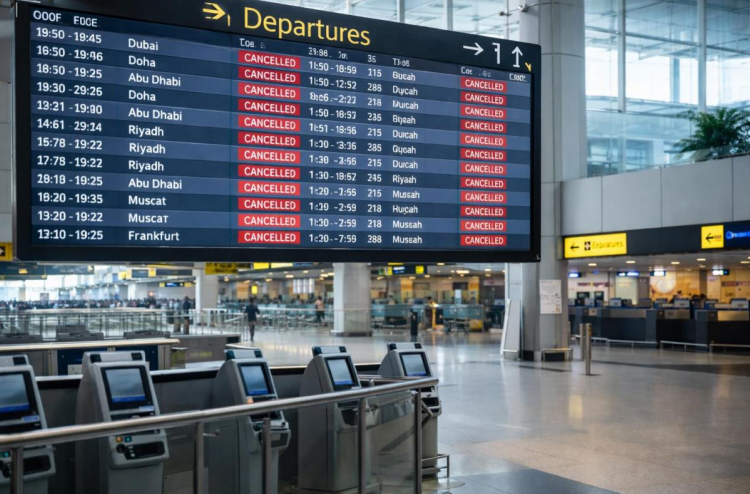
India’s aviation sector is witnessing one of its most severe single-day disruptions in recent years, as the Ministry of Civil Aviation (MoCA) confirmed that 444 flights scheduled for March 2 stand cancelled due to ongoing Middle East airspace restrictions. The cancellations, affecting both international and domestic connectivity, were triggered after multiple Gulf nations imposed temporary India Flight Cancellations-routing curbs following escalating regional conflict and missile-related security alerts.
According to MoCA officials, airlines including Air India, IndiGo, Vistara and Air India Express have been forced to re-route or ground India Flight Cancellations that typically transit Middle Eastern corridors used for Europe, Africa and long-haul routes. Aviation authorities say the situation remains dynamic, with the Directorate General of Civil Aviation (DGCA) working closely with carriers to manage capacity, alternative routings and passenger support as the crisis evolves hour by hour.


Surge in Cancellations as Airspace Restrictions Intensify
The Civil Aviation Ministry confirmed that nearly 420 flights were cancelled between midnight and 6 AM, and additional cancellations pushed the total to 444 flights by mid-day. Of these, approximately 260 are international India Flight Cancellations, while the remaining are domestic flights disrupted due to aircraft and crew rotation issues. Officials said that long-haul operations to London, Frankfurt, Paris, Toronto and New York faced the heaviest impact.
An MoCA spokesperson stated that India is coordinating with the International Civil Aviation Organization (ICAO) and foreign authorities for safe alternate corridors. However, rerouting India Flight Cancellations around the Gulf adds three to six hours of flying time, making several operations commercially unsustainable for the day. As a result, airlines opted for cancellations over excessively long detours.
Air India was among the worst hit, cancelling more than 78 flights, followed by IndiGo with over 120 cancellations, especially on westbound routes. Airport authorities in Delhi and Mumbai reported significant congestion at rebooking counters but confirmed that operations remain stable despite the unusually high volume of stranded passengers.
DGCA and Airlines Activate Emergency Operational Measures
To manage the sudden operational shock, the DGCA issued advisories allowing airlines to implement emergency waiver policies, including free date changes, full refunds and penalties waived for cancellations arising from the conflict-related disruptions. A DGCA official told reporters that “passenger convenience is the priority, given the extraordinary situation unfolding across multiple Gulf airspaces.”
Air India released a public statement noting it had “activated an international disruption control room” and deployed additional ground staff at Delhi, Mumbai, Bengaluru and Hyderabad. The airline said it is working with global partners to secure long-haul slots on alternate routes but warned that “operational feasibility is limited under current airspace constraints.”
IndiGo, India’s largest carrier by fleet size, also issued a statement urging passengers travelling to the Middle East, Europe and Africa to “check updated India Flight Cancellations advisories before heading to the airport.” The airline confirmed that it is offering fee-free rescheduling on affected sectors and has requested passengers to “avoid crowding at check-in counters to ensure smooth management.”
International Ripple Effect as Global Carriers Adjust Routes
The cancellations in India are part of a wider disruption affecting airlines across Asia and Europe. Major global carriers such as Emirates, Qatar Airways, Lufthansa and British Airways have also diverted or cancelled routes passing through high-risk Gulf airspace. Several European carriers have notified that detours are adding four to seven hours of India Flight Cancellations time to certain long-haul sectors.
A senior MoCA official confirmed that the Government of India is in “continuous communication” with aviation regulators in the UAE, Qatar, Saudi Arabia and Kuwait, the countries most affected by the recent missile-tracking alerts. While these nations have not closed their airports, the restricted airspace corridors used for civil aviation have forced large-scale operational disruptions.
Foreign airlines operating in India have issued travel advisories. Lufthansa and Air France warned of “significant network delays” into India, while the UK’s Department for Transport issued a special bulletin urging British travellers to “expect cancellations and extended India Flight Cancellations durations” into South Asia due to the shifting aviation risk environment.
Airports Activate Contingency Plans as Passengers Face Delays
At Delhi’s Indira Gandhi International Airport (IGIA), India’s largest aviation hub, authorities activated crowd-management protocols to handle thousands of passengers affected by the cancellations. Terminal 3 saw long queues at airline helpdesks as travellers sought rebooking options. Airport sources confirmed that over 30,000 passengers are expected to be impacted throughout the day.
Mumbai’s Chhatrapati Shivaji Maharaj International Airport (CSMIA) reported similar scenes, with several wide-body aircraft grounded due to unavailable westbound corridors. Airlines deployed staff to assist passengers with vouchers, lounge access and hotel accommodations depending on eligibility. Airport operators stated that operations remain “safe and manageable” despite the unusual surge in ground load.
Several passengers expressed frustration online. Social media posts highlighted travellers stranded with last-minute notifications, while others praised airlines for providing meal vouchers and support. MoCA urged the public to “remain patient and follow verified advisories,” warning against misinformation circulating on social media channels.
Outlook
The Ministry of Civil Aviation said it is holding hourly review meetings with the DGCA and airline operators to track developments as Gulf tensions continue to evolve. Officials noted that while India Flight Cancellations has contingency routes through the Arabian Sea and Iran-Turkmenistan corridors, many of these channels are currently congested due to global rerouting.
Union Aviation Minister Jyotiraditya Scindia has been briefed on the situation and is expected to address the operational impact later today. According to early ministry assessments, fuel burn for diverted India Flight Cancellations has increased by 18–25%, and airlines may face financial strain if the crisis extends over several days.
MoCA emphasised that safety remains the top priority and warned that additional India Flight Cancellations “cannot be ruled out” if missile-tracking alerts continue in the region. Airlines have been instructed to prepare enhanced support desks and deploy extra manpower across India’s major airports through the weekend.


