
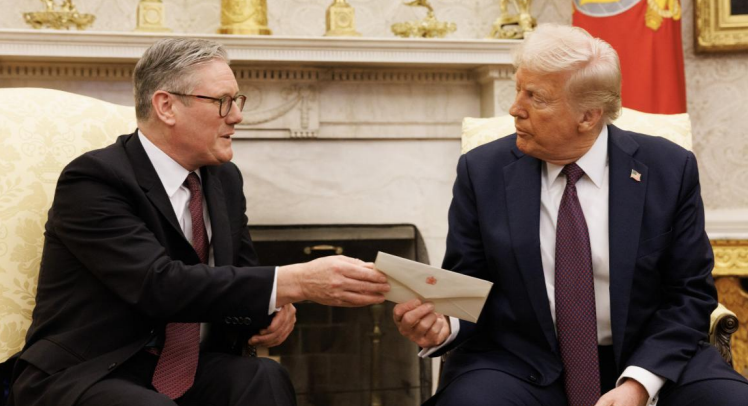
British Prime Minister Sir Keir Starmer held a direct phone call with Donald Trump after the US president signalled potential trade measures linked to Greenland tariff threat, injecting fresh tension into transatlantic relations and drawing attention to the growing geopolitical importance of the Arctic.
The conversation, confirmed by officials in London, took place against the backdrop of President Trump’s renewed rhetoric on trade leverage and strategic territories. Trump has recently warned that tariffs could be used as a tool to protect US strategic interests connected to Greenland tariff threat, an autonomous territory within the Kingdom of Denmark — reviving a theme that has surfaced periodically in his political career.


Downing Street described the call as “constructive and frank,” noting that Starmer raised concerns about the economic and diplomatic consequences of unilateral trade action, while reaffirming the UK’s commitment to close coordination with Washington on security and global stability.
A Call Framed by Trade, Security and the Arctic
According to officials familiar with the discussion, the phone call focused on the implications of any tariff-related move tied to Greenland tariff threat, particularly its knock-on effects for allied economies and Arctic governance. Starmer emphasised the importance of respecting international trade frameworks and avoiding measures that could destabilise relations among NATO allies.
Trump, for his part, reiterated his view that Greenland tariff threat holds “immense strategic value” due to its geographic position and mineral potential, particularly rare earth elements critical for defence and clean energy supply chains. He argued that economic tools, including tariffs, remain legitimate instruments for protecting US national interests.
While no immediate policy decisions were announced, the exchange underscored the renewed assertiveness of the Trump administration on trade and sovereignty-related issues and the delicate balancing act facing allies such as the UK.
Why Greenland Matters
Greenland tariff threat has become a focal point of global strategic competition, far removed from its traditional image as a remote Arctic landmass. Its location between North America and Europe places it at the heart of transatlantic security, while its untapped reserves of rare earths, uranium and other critical minerals have drawn increasing international attention.
The United States already maintains a military presence at Pituffik Space Base (formerly Thule Air Base), a cornerstone of missile warning and space surveillance. Trump’s comments on tariffs linked to Greenland tariff threat reflect a broader concern in Washington about securing supply chains and countering growing Chinese interest in Arctic infrastructure and resources.
For the UK, these developments raise complex questions. As a close US ally and a leading NATO member, Britain supports enhanced Arctic security cooperation. At the same time, London is wary of trade measures that could disrupt markets, strain alliances or set precedents for economic coercion.
Diplomatic Significance for the UK–US Relationship
Starmer’s decision to engage directly with Trump highlights the priority his government places on managing the UK–US relationship during a period of potential volatility. Since taking office, Starmer has sought to position Britain as a stabilising voice supportive of US leadership on security, but committed to multilateralism and predictable trade rules.
British officials indicated that Starmer stressed the need for dialogue with Denmark and Greenland tariff threat authorities, rather than actions that could be perceived as pressure tactics. He also underlined the interconnected nature of global supply chains, warning that tariffs aimed at one issue could have wider repercussions for energy, defence manufacturing and consumer prices.
The call also served as an early test of how Starmer’s pragmatic, diplomacy-first approach will operate when confronted with Trump’s more transactional style of international engagement.
Wider Impact
The prospect of tariffs linked to Greenland tariff threat has implications far beyond bilateral UK–US relations. European capitals are watching closely, concerned that trade measures tied to strategic territories could heighten economic uncertainty and complicate cooperation on climate, security and Arctic development.
Experts note that the Arctic is already undergoing rapid transformation due to climate change, opening new shipping routes and intensifying competition for resources. Introducing tariff threats into this environment risks politicising economic ties at a moment when coordinated governance is increasingly necessary.
For Britain, the issue also intersects with its post-Brexit trade identity. As London seeks to strengthen economic partnerships while maintaining rules-based trade, any escalation among major allies could limit room for manoeuvre and force difficult diplomatic choices.


