
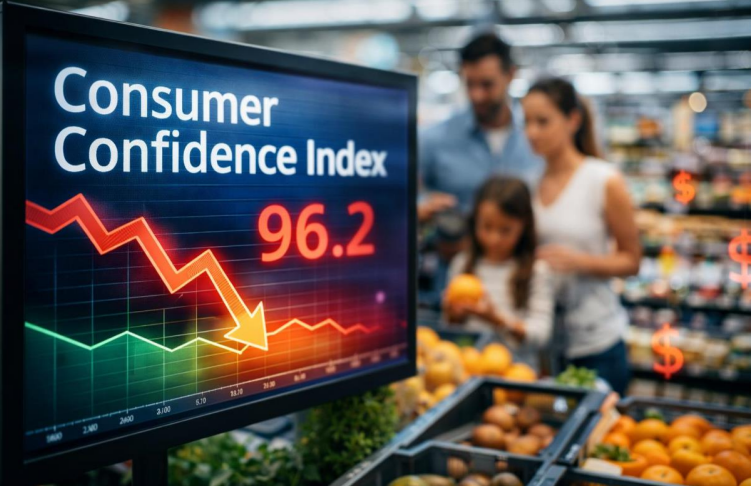
Freshly released quarterly data indicate that the Global Consumer Confidence Index has edged lower, reflecting growing caution among households in major economies amid persistent inflationary pressures and uncertainties surrounding employment conditions. The latest composite reading shows a marginal decline compared with the previous quarter, underscoring a shift in sentiment even as macroeconomic indicators remain mixed across advanced and emerging markets.
According to aggregated survey data compiled from key economies in North America, Europe and Asia-Pacific, the Global Consumer Confidence Index slipped by approximately 1.8 points quarter-on-quarter. While the drop remains modest in historical context, analysts note that the movement signals heightened sensitivity among Global Consumer Confidence Index to rising living costs, interest rate trends and global economic volatility.


Quarterly Decline Reflects Cost Pressures
The updated Global Consumer Confidence Index at 96.2 points, down from 98.0 in the prior quarter. Economists generally regard the 100-point mark as the neutral threshold separating positive and negative sentiment. The current reading therefore suggests a mildly pessimistic tilt among households.
Survey responses show that inflation continues to be the most cited concern across regions. In advanced economies, approximately 62 percent of respondents reported that higher food and energy prices have reduced their discretionary spending capacity. Meanwhile, 54 percent expressed concern about future price stability despite signs of moderating headline inflation in certain markets.
Core inflation measures, though easing in some regions, remain elevated relative to pre-pandemic averages. As a result, households appear to be adjusting their consumption behaviour, with greater emphasis on savings and reduced non-essential purchases.
Employment Outlook Drives Sentiment Shifts
Labour market expectations also influenced the Global Consumer Confidence Index decline. While unemployment rates in several major economies remain near multi-year lows, survey data reveal growing apprehension regarding job security and wage growth sustainability.
Approximately 47 percent of respondents indicated uncertainty about employment prospects over the next six months, compared with 41 percent in the previous survey cycle. This shift reflects broader concerns about slowing economic growth, technological disruption and corporate cost-cutting measures in certain sectors.
Wage growth, although positive in nominal terms, has not uniformly outpaced inflation, contributing to perceptions of diminished purchasing power. Analysts observe that consumer sentiment is increasingly shaped not only by present employment conditions but also by forward-looking expectations.
Regional Variations in Confidence Levels
The decline in confidence was not uniform across regions. North America recorded a moderate dip of 1.5 points, primarily driven by concerns over interest rates and housing affordability. Europe saw a slightly larger drop of 2.3 points amid ongoing energy cost uncertainties and geopolitical tensions affecting supply chains.
In contrast, parts of Asia-Pacific demonstrated relative resilience. Some emerging markets reported stable or marginally improved sentiment, supported by domestic demand growth and easing inflationary pressures. However, urban respondents across multiple economies expressed heightened concern over housing costs and debt servicing burdens.
These regional disparities highlight the interplay between local economic fundamentals and global macroeconomic trends. While Global Consumer Confidence Index sentiment remains subdued, pockets of optimism persist in markets experiencing stronger employment growth or fiscal support measures.
Spending Intentions and Savings Behaviour
Survey data further indicate a shift in consumer spending intentions. Approximately 38 percent of respondents reported plans to reduce discretionary expenditures in the coming quarter, up from 32 percent previously. Categories most affected include travel, luxury goods and large-ticket consumer durables.
Conversely, there is an observable increase in precautionary savings. Roughly 44 percent of households indicated intentions to prioritise savings over spending, reflecting a cautious approach amid economic uncertainty. Financial analysts suggest that this behavioural adjustment could influence retail sales growth and service sector performance in the months ahead.
Credit usage patterns also showed signs of moderation. Data reveal a slight decline in consumer borrowing appetite, particularly in regions where interest rates remain elevated. The cost of credit, combined with inflation concerns, appears to be tempering household risk-taking.
Market and Policy Implications
The dip in Global Consumer Confidence Index carries implications for policymakers and businesses alike. Central banks closely monitor sentiment indicators as leading signals of consumption trends, which constitute a significant share of GDP in many economies.
While the decline remains modest, sustained weakness in confidence could dampen domestic demand and complicate growth forecasts. Policymakers may weigh these developments when assessing interest rate trajectories and fiscal support measures.
Corporate strategists are also adjusting outlooks based on sentiment data. Retailers and service providers are increasingly adopting targeted pricing strategies and promotional campaigns to sustain consumer engagement. Analysts note that maintaining consumer trust will be critical in stabilising demand during periods of economic transition.
Conclusion
The latest Global Consumer Confidence Index reading underscores a cautious global mood shaped by inflation concerns, employment uncertainties and evolving economic conditions. Although the decline is incremental rather than dramatic, it signals that households remain sensitive to cost-of-living pressures and financial stability risks.
As policymakers and businesses navigate a complex macroeconomic landscape, Global Consumer Confidence Index sentiment will remain a key barometer of economic resilience. Whether confidence stabilises or weakens further will depend on inflation trends, labour market dynamics and the effectiveness of policy responses in addressing household concerns.


