
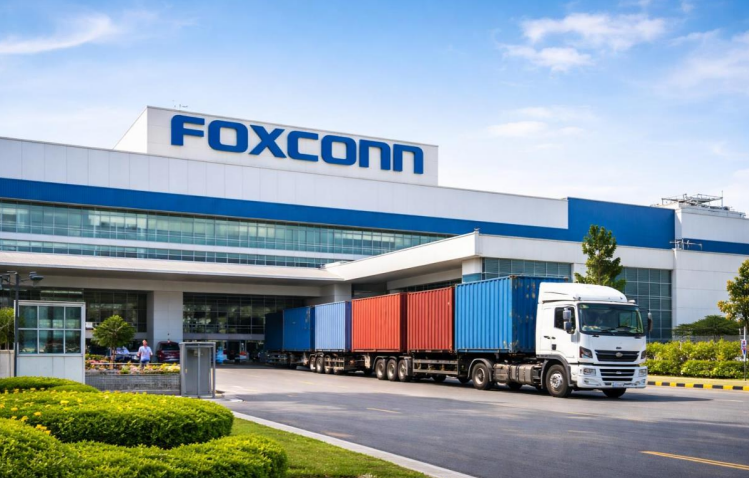
Taiwan’s Foxconn AI revenue, the world’s largest contract electronics manufacturer, has reported a 29.7% year-on-year rise in first-quarter revenue, underscoring the accelerating global shift toward artificial intelligence infrastructure.
The company recorded revenues of approximately T$2.13 trillion (around $66.6 billion), driven largely by surging demand for AI-related hardware, particularly servers and data center components.


The results highlight a pivotal transformation in Foxconn AI revenue business model, traditionally centered around consumer electronics such as smartphones. Increasingly, the company is positioning itself at the heart of the AI ecosystem, supplying critical infrastructure to major technology players including Nvidia and Apple.
This development reflects a broader global trend in which artificial intelligence is reshaping industrial priorities, investment flows, and supply chains. Foxconn’s performance serves as a key indicator of how deeply AI is influencing the global technology landscape, even amid geopolitical and economic uncertainty.
AI Infrastructure as the Primary Growth Driver
The strongest contributor to Foxconn’s growth has been its cloud and networking division, which includes AI servers and data center equipment.
The rapid expansion of AI applications—from generative models to enterprise automation—has significantly increased demand for high-performance computing infrastructure.
Major technology companies are investing billions of dollars into AI infrastructure, including hyperscale data centers and advanced computing clusters. Foxconn, as a leading manufacturer of AI server racks, has directly benefited from this surge in capital expenditure, positioning itself as a critical supplier in the AI value chain.
The company has indicated that demand for AI server racks is expected to remain strong into the coming quarters, suggesting that the current growth is not a short-term spike but part of a sustained structural trend. This positions Foxconn at the forefront of one of the fastest-growing segments in the global technology industry.
Role of Consumer Electronics and Product Cycles
While Foxconn AI revenue infrastructure has emerged as the primary growth engine, Foxconn’s traditional business segments also contributed to the strong quarterly performance.
The smart consumer electronics division, which includes iPhone manufacturing, recorded significant growth due to new product launches.
The combination of AI-driven demand and consumer electronics growth has created a diversified revenue base for the company. This dual engine of growth allows Foxconn to balance cyclical fluctuations in consumer demand with the more sustained expansion of enterprise and infrastructure markets.
However, the long-term trajectory suggests a gradual shift away from reliance on smartphones toward higher-value technology segments. As consumer electronics markets mature, the company is increasingly prioritizing areas with higher growth potential, such as AI, cloud computing, and advanced manufacturing.
Record Monthly Performance and Financial Trends
Foxconn AI revenue March performance highlights the intensity of current demand, with monthly revenue rising 45.6% year-on-year to T$803.7 billion, marking a record for that period.
This surge reflects the rapid scaling of AI-related production and strong order flows from global technology clients.
Despite the strong headline growth, the company’s revenue came slightly below market expectations, indicating the high benchmarks set by analysts in the current AI-driven environment. Nevertheless, the overall performance remains robust and indicative of strong underlying demand.
Financial markets have responded cautiously, with Foxconn’s shares underperforming broader market indices in recent months. This divergence reflects investor concerns about external risks, including geopolitical tensions and potential supply chain disruptions, even as the company reports strong operational results.
Geopolitical Risks and Supply Chain Challenges
Foxconn AI revenue has explicitly warned about the impact of “volatile global political and economic conditions”, particularly ongoing geopolitical conflicts, on its future outlook.
Chairman Young Liu identified global instability, including tensions in the Middle East, as a key external risk facing the company.
These risks are especially significant for a company with a highly globalized supply chain, spanning manufacturing hubs in China, India, Mexico, and the United States. Disruptions in any part of this network can affect production timelines, costs, and delivery schedules.
At the same time, rising energy prices and logistical challenges linked to geopolitical conflicts could increase operational costs. This creates a complex environment in which strong demand must be balanced against external uncertainties, requiring careful strategic planning.
Outlook
Foxconn’s nearly 30% revenue growth highlights the transformative impact of artificial intelligence on the global technology industry.
The company’s shift toward AI infrastructure reflects a broader structural change, where computing power and data processing capabilities are becoming central to economic growth.
In the near term, Foxconn AI revenue is expected to maintain strong momentum, supported by continued investment in AI by major technology firms. The company has indicated that growth will likely continue in the second quarter, driven by sustained demand for AI server systems.
Looking ahead, the key challenge will be navigating geopolitical risks while capitalizing on the AI boom. If current trends persist, Foxconn AI revenue evolution from a consumer electronics manufacturer to a leading provider of AI infrastructure could redefine its role in the global technology ecosystem for years to come.


