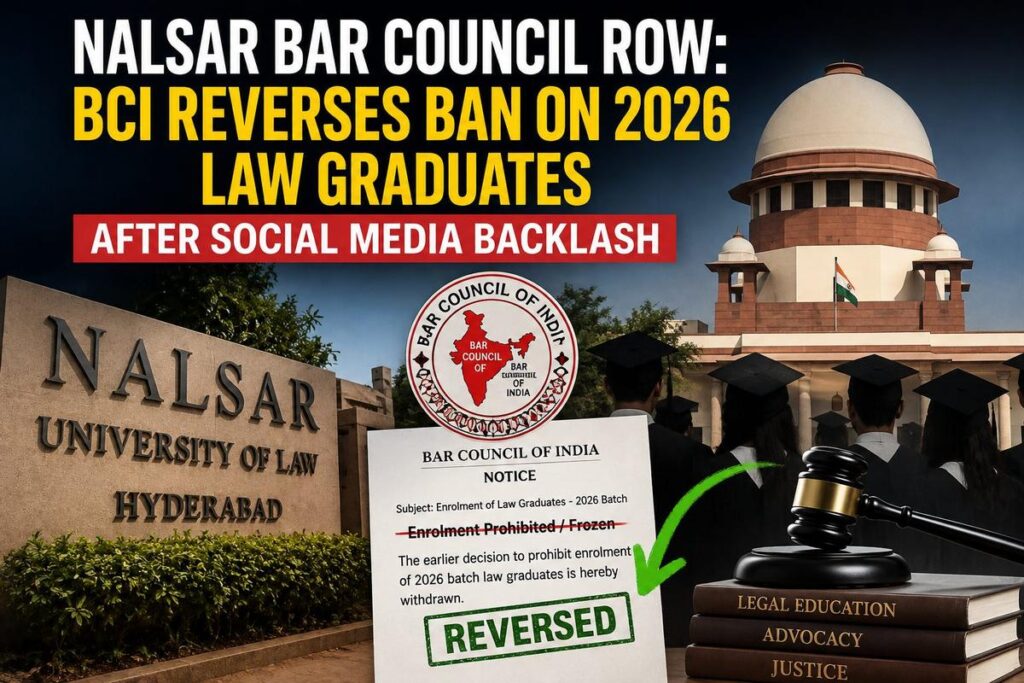
The NALSAR Bar Council row was resolved within hours on Thursday after the Bar Council of India withdrew its order freezing the enrolment of 2026 NALSAR graduates. The ban had followed a student campaign opposing Chief Justice of India Surya Kant’s proposed presence at the law university’s convocation.
The NALSAR Bar Council row that erupted in New Delhi on Thursday morning was over almost as quickly as it began, with the Bar Council of India reversing a sweeping enrolment freeze on an entire graduating class within a matter of hours. The episode has nonetheless reignited a debate about institutional overreach, student free speech, and the limits of disciplinary power wielded by professional regulators over young lawyers who have not yet begun their careers.


How the NALSAR Bar Council Row Began
The controversy traces back to a campaign mounted by students at NALSAR University of Law in Hyderabad, who objected to the institution’s proposal to invite Chief Justice of India Surya Kant as chief guest at its 2026 convocation. More than 450 of the university’s roughly 1,400 students signed a representation addressed to the Vice-Chancellor and senior faculty, asking that the invitation be reconsidered before any final decision was taken.
The students’ objection stemmed from oral remarks the CJI had made during a court hearing concerning alleged police excesses during the Delhi NEET protests, when he was reported to have told counsel that the court did not have time to watch video evidence being presented. That remark, students argued, reflected poorly on judicial sensitivity to student grievances, and they did not wish to honour the CJI at their own graduating ceremony.
BCI’s Sweeping Response Fuels the NALSAR Bar Council Row
What might have remained a campus-level dispute escalated dramatically when BCI chairman Manan Kumar Mishra issued a directive to every state bar council in the country, instructing them not to enrol any 2026 NALSAR graduate as an advocate until further notice. In his communication, addressed to the university’s Vice-Chancellor, Professor Srikrishna Deva Rao, and to state bar council secretaries, Mishra demanded a detailed factual report identifying the students principally responsible for organising the campaign. The BCI also alleged, without offering specifics, that certain faculty members had encouraged “groupism” among students to mislead them, and warned that a final decision on the matter would be taken on August 19.
The order landed like a shockwave across India’s legal education circles. An entire batch of law graduates, many of whom had already secured placements at law firms and were preparing to begin their professional careers, suddenly found themselves unable to formally practise law anywhere in the country over the actions of a subset of their peers. Legal commentators were quick to point out that the directive appeared to apply collective punishment to students who had no involvement in, or in many cases even awareness of, the original protest campaign.
Reversal Within Hours
The backlash was swift and largely unfolded on social media, where lawyers, alumni and legal educators criticised the BCI’s move as disproportionate and constitutionally questionable. Vikas Singh, president of the Supreme Court Bar Association, was among the most vocal critics, describing the original order as an illegal and unsustainable attempt to intimidate students for exercising their right to free expression, and arguing that university campuses ought to remain spaces for open debate rather than fear.
Facing mounting criticism, the Bar Council convened an emergency internal discussion and swiftly issued a fresh communication modifying its own order. In its revised notification, the council stated that its members had unanimously concluded, based on the latest information available, that the overwhelming majority of the 2026 NALSAR batch had no inclination to participate in what it termed a “move of disrespect” toward the Chief Justice. As a result, it lifted the enrolment freeze entirely, clearing the way for the graduating class to register with the state bar council of their choice without further hindrance.
What Comes Next in the NALSAR Bar Council Row
Even with the immediate crisis defused, several threads of the NALSAR Bar Council row remain unresolved. The council has not named which faculty members or outside individuals it believes played a role in organising the original protest, nor has it clarified what evidence supports those allegations. It has indicated it will wait for an internal inquiry report from the university’s Vice-Chancellor before considering any further disciplinary action, with the broader question of the matter still formally scheduled for review on August 19.
For NALSAR’s graduating students, the episode has been an unsettling introduction to the intersection of legal advocacy and institutional power that many will spend their careers navigating. For the wider legal fraternity, it has renewed longstanding questions about how much authority professional regulatory bodies should hold over students who are not yet enrolled advocates, and whether disciplinary consequences of this magnitude can be reasonably imposed without due process. As the country’s law schools prepare for their own convocation seasons in the months ahead, the NALSAR Bar Council row is likely to be remembered as a cautionary example of how quickly disputes over judicial respect and student dissent can escalate into questions of livelihood and constitutional principle.