

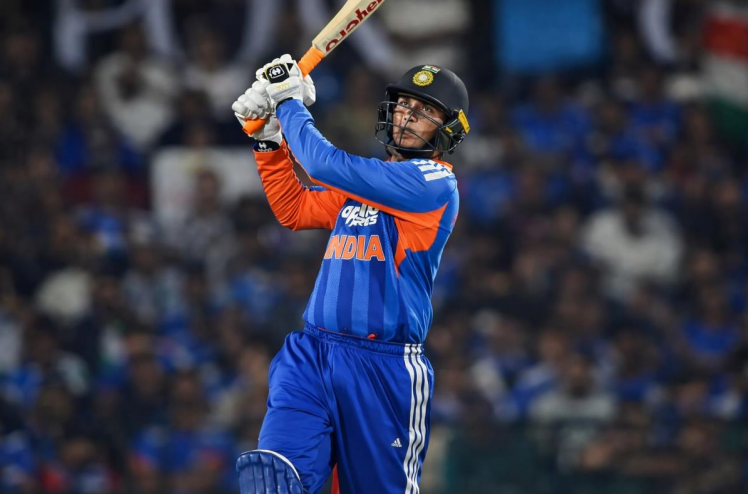
In a breathtaking display of modern Twenty20 cricket, the Indian men’s national team rewrote its own T20 International history, storming to an eight-wicket victory over New Zealand in the third T20I at the Barsapara Cricket Stadium. The win, which secured an unassailable 3–0 lead in the five-match series, showcased India’s evolving command of the India vs New Zealand T20I format, powered by explosive batting, disciplined bowling and precise tactical execution.
The match drew significant attention as India entered the third India vs New Zealand T20I, aiming to seal the series early following strong performances in Visakhapatnam and Thiruvananthapuram. Played before a capacity crowd at the Barsapara Cricket Stadium, the contest began with New Zealand posting 153 for 9 after being sent in to bat. India’s bowlers controlled key phases of the innings, limiting New Zealand’s acceleration at the death before the batting unit produced a record-breaking chase. The match took place under clear conditions with a dry surface favouring stroke play, setting the stage for what would become one of India’s fastest and most dominant India vs New Zealand T20I run chases in recent years.


Fastest Team Fifty in Indian T20I History
India produced one of its most aggressive powerplay performances ever recorded in T20I cricket. Chasing New Zealand’s 153, the hosts reached 50 runs in just 3.1 overs, marking the fastest team fifty in India’s T20I history. The innings erupted with clean ball striking, aggressive shot selection and relentless pressure on the bowlers from the very first ball.
This blistering start surpassed all previous Indian benchmarks in the format. By dominating the early overs, India seized complete control of the match and forced New Zealand into reactive, defensive fielding patterns. The powerplay approach reflected a decisive shift in India’s T20 mindset prioritizing immediate momentum and sustained pressure.
Individual Milestones and Collective Firepower
The innings was illuminated by the extraordinary performance of Abhishek Sharma, who delivered one of the most explosive knocks ever by an Indian in T20Is. He hammered an unbeaten 68 off 20 balls, bringing up his fifty in just 14 deliveries, the second-fastest T20I half-century by an Indian. His innings featured fearless elevation over the infield, powerful clean hits and confident domination of both pace and spin.
Only Yuvraj Singh’s iconic 12-ball fifty in 2007 remains faster for India, placing Sharma’s innings among the finest power-hitting displays by the national side.
Captain Suryakumar Yadav anchored the chase with maturity and aggression, scoring 57 not out off 26 balls. His knock blended intelligent placement with timely acceleration, ensuring India maintained the explosive tempo set by Sharma. Together, the pair exhibited India’s depth of India vs New Zealand T20I batting: youth-led aggression complemented by experienced composure.
Their partnership formed the backbone of India’s emphatic chase, one that dismantled New Zealand’s bowling plans and underscored the side’s adaptability across conditions.
Bowlers Set the Stage
Before the batting heroics took center stage, India’s bowling unit executed a disciplined and coordinated effort to restrict New Zealand to 153 for 9 in 20 overs. Pacer Jasprit Bumrah, awarded Player of the Match, delivered a spell rich in control, variation and tactical accuracy. His breakthroughs at key intervals disrupted New Zealand’s progression.
India’s spinners stabilized the middle overs by tightening lines and limiting scoring opportunities, while the seamers closed out the innings with precision. The bowlers’ collective restraint prevented New Zealand from generating late-overs momentum, ensuring India entered the chase with a psychologically comfortable target.
Records, Repercussions and the Road Ahead
India’s chase, completed in just 10 overs, was one of the fastest successful pursuits of a 150-plus target in India vs New Zealand T20I history. The team’s powerplay score of 94 for 2 stood among its highest against New Zealand, further confirming India’s intensifying power-hitting ethos.
The victory also extended India’s run to 11 consecutive India vs New Zealand T20I series wins, a testament to strategic continuity, squad depth and clarity of roles across the batting and bowling groups.
Following the match, captain Suryakumar Yadav praised the team’s commitment to an aggressive but calculated style, noting that players are being encouraged to express themselves freely while maintaining situational awareness. Team analysts and senior players echoed the sentiment, highlighting the significance of such performances ahead of major global India vs New Zealand T20I competitions scheduled later in the year.
Conclusion
India’s record-smashing triumph in Guwahati was more than a statistical outburst, it was a declaration of strategic intent. By setting a new standard for powerplay impact, showcasing fearless young talent and maintaining standout bowling discipline, India delivered a blueprint for its India vs New Zealand T20I approach in 2026.
India’s display in this match also highlights the broader evolution of the squad’s identity, one built on confidence, clarity of roles and a willingness to push the limits of conventional India vs New Zealand T20I play. With young talents rising and senior players offering tactical balance, the team appears to be entering a phase where aggression is not merely a strategy but a defining cultural element.
As India prepares for a year lined with global tournaments and high-stakes bilateral series, the Guwahati performance will stand as both a benchmark and a reminder of what this side is capable of when intent, execution and temperament align perfectly on the international stage.


