

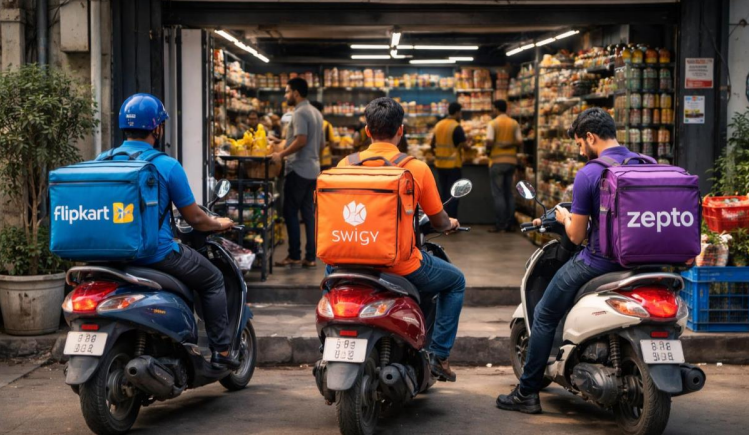
India’s leading Quick commerce delivery platforms — Flipkart, Swiggy and Zepto — have removed references to “10-minute delivery” from their branding and promotional communication, marking a notable shift in how ultra-fast delivery services are publicly positioned in the country.
The move follows growing regulatory scrutiny and safety concerns around the operational pressures created by extreme Quick commerce delivery timelines, even as demand for instant commerce continues to surge.


Quick commerce delivery platforms are transitioning from aggressive customer acquisition to operational consolidation. By stepping away from explicit Quick commerce delivery-time claims, companies are aligning their public messaging with emerging expectations around consumer protection, road safety and labour standards, even as competition in instant delivery remains structurally intact.
Regulatory intervention
The change was prompted after Indian authorities raised concerns that explicit delivery-time promises could encourage unsafe driving behaviour and intensify pressure on gig workers.
Regulators flagged that aggressive timelines risked compromising road safety and labour welfare, particularly in dense urban centres where delivery riders navigate congested traffic conditions.
While the government did not ban Quick commerce delivery or impose restrictions on delivery speed itself, officials urged platforms to avoid marketing claims that could incentivise reckless practices.
In response, companies voluntarily adjusted their public messaging, choosing to emphasise reliability and convenience over speed guarantees. Importantly, the underlying delivery infrastructure — including dark stores and hyperlocal logistics — remains unchanged.
How platforms are repositioning their services
Following the advisory, platforms moved quickly to recalibrate branding language across apps, websites and advertising.
The emphasis has shifted from fixed time promises to broader descriptors such as “fast delivery”, “minutes delivery” or “Quick commerce delivery doorstep fulfilment”. Industry executives argue this offers flexibility in operations while reducing legal and reputational risk.
Internally, companies continue to compete on speed, inventory proximity and order fulfilment efficiency. Delivery times of 10–15 minutes remain common in high-density neighbourhoods, but firms are now avoiding explicit numerical claims that could be interpreted as contractual or enforceable guarantees.
Worker safety, labour pressure and public debate
The episode has reignited debate over working conditions in India’s gig economy.
Labour advocates have long argued that ultra-fast delivery models place undue stress on riders, who are often paid per order and operate as independent contractors. The removal of the 10-minute branding is seen as a symbolic, though limited, acknowledgement of these concerns.
Companies maintain that rider safety protocols, incentive structures and route optimisation systems are designed to discourage speeding. However, critics argue that performance-linked pay and customer expectations still indirectly reward faster deliveries.
Policymakers are expected to continue discussions on minimum safety standards, insurance coverage and clearer accountability frameworks for gig platforms.
Market impact and competitive dynamics
The decision is unlikely to slow the growth of India’s Quick commerce delivery sector, which analysts estimate to be worth over $10 billion and expanding rapidly in major cities.
Consumer behaviour suggests that convenience and assortment matter as much as speed, especially for groceries and daily essentials.
Competition among platforms remains intense, driven by network density, private labels and operational efficiency rather than headline delivery times alone. By softening speed-centric branding, companies may also reduce customer dissatisfaction caused by rare delays, a frequent downside of rigid time promises.
Outlook
Industry observers view the shift not as a retreat from instant commerce, but as a maturing of the business model.
As regulatory oversight increases, platforms are likely to balance growth with compliance, focusing on sustainable logistics rather than headline claims. Further guidance from authorities on gig work standards and advertising norms could shape the next phase of the sector’s evolution.
For consumers, the change may be barely noticeable in day-to-day usage. For the industry, however, it marks an important recalibration, signalling that speed will remain a competitive edge, but no longer the sole public metric defining success in India’s fast-moving digital commerce landscape.


