
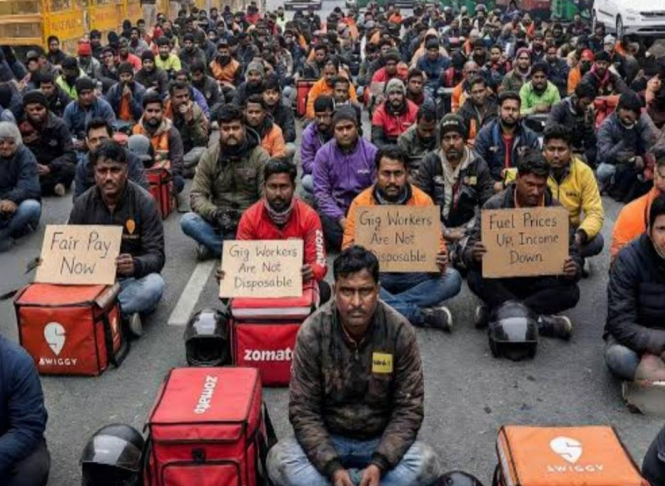
On December 31, 2025, as India prepared to welcome the New Year, a nationwide strike by Gig workers strike gig economy workers brought major delivery platforms to a temporary standstill. From the bustling streets of Mumbai to the tech corridors of Bengaluru and Hyderabad, thousands of riders, delivery personnel, and quick-commerce workers logged off their apps, leaving many restaurants and cloud kitchens struggling to fulfil orders during one of the busiest periods of the year. The action was organized by informal coalitions of gig workers who have long voiced concerns over shrinking earnings, unsafe working conditions, and opaque pay structures.
The timing of the strike was deliberate. By targeting New Year’s Eve when delivery demand typically surges, workers ensured maximum visibility for their demands. According to union representatives, participation numbers exceeded several lakhs across metropolitan and tier-2 cities, making it one of the most significant collective actions in the Gig workers strike sector in recent years.


“We have been patient for too long,” said Shaik Salauddin, a spokesperson for one of the leading Gig workers strike associations. “Platforms have promised fair pay and better safety multiple times, yet nothing has changed. This strike is our way of saying enough is enough.”
Central to this protest was a demand to reform the pay structure. Many workers reported that recent changes to incentive schemes had effectively reduced their earnings, despite longer working hours and increased delivery targets. Riders described the pressure of meeting ultra-fast delivery promises, often as short as 10 minutes, as a major source of stress. “It’s not just about money,” one Bengaluru rider said. “We risk our lives on the road every day to meet impossible deadlines. We want respect, security, and a system that doesn’t penalize us unfairly.”
Several participants also highlighted the absence of social protections such as health insurance, accident coverage, or paid leave, emphasizing that the current Gig workers strike model leaves them vulnerable to both economic and physical risks.
Delivery platforms responded to the strike with temporary measures to retain service levels. Enhanced pay-outs and special festive incentives were introduced, including higher per-order commissions and bonuses for peak hours. Yet workers dismissed these as short-term fixes that failed to address the structural issues. Union leaders stressed that sporadic incentives cannot substitute for predictable earnings, transparent pay systems, and legal recognition of Gig workers strike work as employment with social security benefits. They argued that without meaningful reform, similar disruptions could recur during other peak periods, affecting consumers, restaurants, and the platforms themselves.
The strike also exposed regional variations in participation. While cities like Hyderabad and Mumbai saw significant slowdowns in deliveries, other areas experienced moderate disruption, reflecting the uneven organization of Gig workers strikes across the country. Nevertheless, the symbolic impact of a coordinated nationwide action on such a high-profile day resonated widely on social media, sparking conversations among policymakers, platform executives, and the general public about the evolving dynamics of digital work.
Analysts suggest that this strike is indicative of broader tensions within India’s rapidly expanding gig economy. Unlike traditional employment, gig work is characterized by flexibility but also uncertainty and vulnerability. Algorithm-driven management, fluctuating pay, and the absence of labour protections create systemic risks for millions of workers who provide critical services in urban centers. The New Year’s Eve action illustrates how discontent in the gig sector can quickly translate into coordinated collective action, challenging the prevailing notion that independent contractor status prevents organized labour activity.
Moreover, the protest raises fundamental questions about the sustainability of the Gig workers strike economy’s growth model. As these platforms continue to scale, the balance between efficiency and fairness becomes increasingly delicate. Analysts argue that policymakers may need to intervene to ensure that digital workers are not left entirely at the mercy of algorithmic management, while platforms themselves must consider long-term strategies for retention and worker satisfaction that go beyond temporary bonuses.
As India entered 2026, the Gig workers strike left a clear message: the future of digital labour cannot be separated from issues of dignity, safety, and equitable compensation. While the immediate disruption affected deliveries for a day, the broader debate it sparked will shape discussions on regulation, platform accountability, and labour rights for years to come. The New Year’s Eve action was more than a protest; it was a signal that the workforce driving India’s digital economy is organizing to demand recognition, fair treatment, and sustainable working conditions.